TRANSMISSION // 2603.23398v4
A two-stage energy model takes a new route to generating graphs
Source published
Graph Energy Matching (GEM) combines fast, energy-guided graph edits with a stochastic sampling stage. In tests on molecular graph benchmarks, it performed strongly on several measures, but the results are limited to benchmark data and involve trade-offs in fidelity, computation and practical validation.
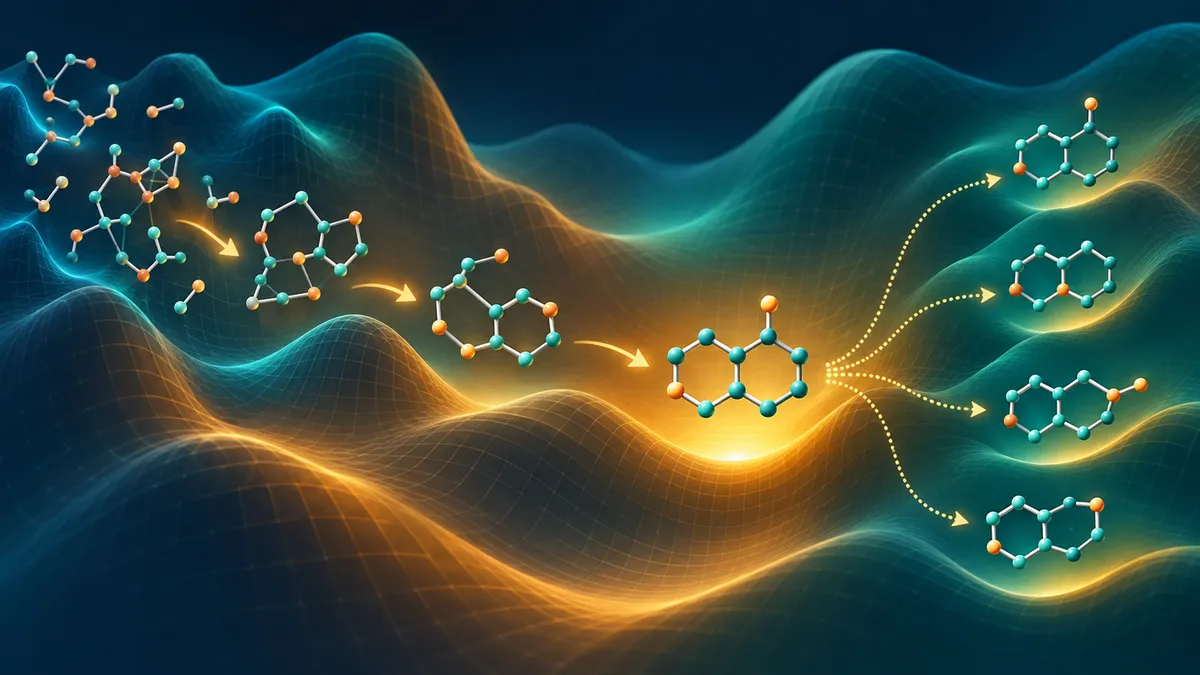
Molecules can be represented as graphs: atoms are nodes, and bonds are edges. Generating such graphs is challenging because each possible bond or atom type is a discrete choice. Michal Balcerak and colleagues propose Graph Energy Matching, a model intended to guide those choices while retaining a way to favor desired properties at sampling time.
Why generate graphs with an energy model?
A molecular graph is a compact description of which atoms are connected and what kinds of bonds join them. A model that can generate such graphs could help researchers explore candidate structures computationally. But a generated structure is useful only if it resembles the data of interest and meets relevant constraints.
One approach, discrete diffusion, generates graphs through a sequence of denoising steps. Energy-based models offer a different idea: assign each graph a scalar energy, with lower-energy graphs treated as more probable under the model. This can make it easier to add goals—such as a desired molecular property—when generating samples. The difficulty is sampling: a search can get stuck in unhelpful local minima, especially when it wanders through graph configurations unlike real data.
GEM, introduced by Michal Balcerak and colleagues, aims to combine an explicit energy landscape with a practical route through the enormous space of possible graphs.
How GEM works
The model learns a graph energy that does not depend on arbitrary node labels. That matters because renumbering a molecule’s atoms should not change the model’s assessment of its structure. The researchers implement the energy with a graph transformer and represent atom and bond categories with one-hot vectors, allowing gradients to help rank possible edits.
Sampling has two stages. First, a transport stage makes mostly deterministic edits intended to move a starting graph toward lower-energy, data-like regions. When it reaches a target energy or can no longer find an improving edit, the sampler switches to a stochastic mixing stage. This stage proposes further edits and uses a Metropolis–Hastings acceptance rule, a standard sampling technique that helps preserve the model’s target distribution. The authors’ formal stationarity guarantee applies to this fixed-temperature mixing stage—not to the entire practical process, which also uses approximations and a preceding transport phase.
The team tested GEM on the molecular benchmarks QM9 and MOSES, assessing measures including chemical validity, novelty, uniqueness and similarity to the benchmark distribution. They also tested property-guided generation on MOSES and examined paths connecting pairs of molecules. Additional experiments covered two non-molecular graph datasets.
What the results show—and don’t
The authors report that GEM matched or exceeded strong discrete diffusion baselines on most of the reported molecular metrics, with performance depending on the dataset, sampling setup and metric. For example, on MOSES, noise-initialized GEM scored better than the listed DeFoG baseline on the combined valid-unique-novel measure and on Fréchet ChemNet Distance. No single score captures every aspect of generation, and comparisons across methods depend on experimental settings and evaluation choices.
For property-guided generation, GEM generated samples meeting specified thresholds for measures such as drug-likeness and solubility-related predictions. These are computational benchmark results, not evidence that the resulting molecules have useful biological effects, are safe, or can be synthesized. The paper notes that real-world use would require additional screening and expert oversight.
The graph-to-graph path experiments suggest that including learned energy can favor paths with more chemically valid intermediate samples than a path based only on graph-edit distance. This finding concerns the study’s datasets, path construction and validity checks; it does not establish that these paths correspond to physical reactions or practical synthesis routes.
Remaining uncertainty
GEM’s transport steps use approximations, including approximate graph matching, and its formal sampling guarantee is narrower than the full sampling procedure. The authors also note computational costs: using gradients adds a theoretical overhead of roughly two to three times compared with models that only make forward predictions. The evaluation centers on two molecular benchmarks, alongside narrower tests on non-molecular graphs. Performance on other graph types or real discovery workflows remains to be established.
This account is based on the arXiv paper text and abstract for version 4, not an independent replication. Although the manuscript identifies itself as a NeurIPS 2026 paper, the source record available for this account does not independently establish its publication or review status. Benchmark comparisons should therefore be read in light of the paper’s methods, baselines and limitations—not as proof of practical scientific utility.
- graph generation
- energy-based models
- molecular graphs
- generative AI
- sampling
Related reading
Automatically matched by shared topic keywords. These links do not imply that the sources agree or establish a consensus.
Teaching graph generators which hidden dimensions matter
Source published
Shared keywords: graph generation
One Energy Lens for Many Kinds of Machine Learning
Source published
Shared keywords: energy based models
ZeroPoint gives a small decision model a way to choose nothing
Source published
Shared keywords: energy based models
LEF-JEPA targets object structure without preserving every visual detail
Source published
Shared keywords: energy based models
CoMoFlow Gives Protein Shape Generation a Set of Motion Controls
Source published
Shared keywords: generative ai