TRANSMISSION // 2603.23252v2
Where Should AI Live in a Satellite Network?
Source published
An analytical framework compares three placements for O-RAN’s AI, separating space-segment energy, control-action latency and model-refresh time.
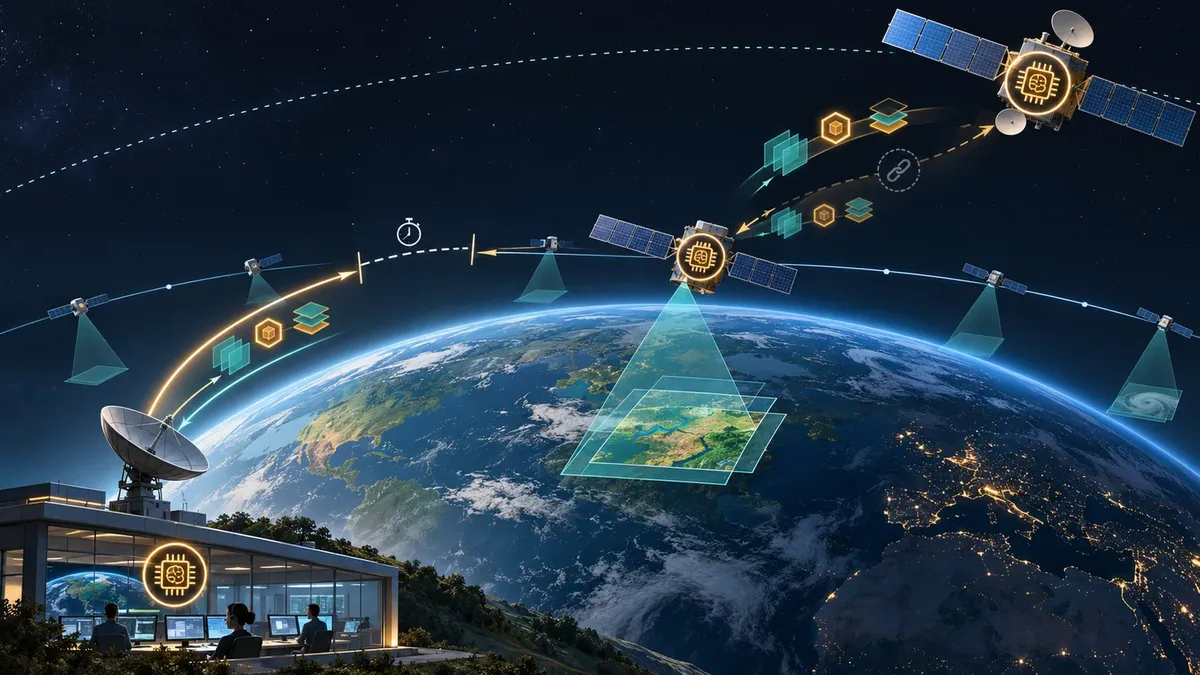
Ground-based computing, onboard inference and orbital model training each face different limits. A modeling study maps how telemetry, computing demands and intermittent links shape the trade-offs—without prescribing one placement for every satellite network.
A placement problem with different clocks
For satellite networks, deciding where AI should run involves more than computing speed. Ground infrastructure can provide substantial computing capacity, but sending data and decisions between Earth and orbit takes time and uses link resources. Low Earth orbit (LEO) satellites can process information near users, but their onboard power and computing capacity are constrained. Geostationary (GEO) satellites offer another possible training location, though their links and computing costs bring their own trade-offs.
Daniele Tarchi’s study examines how to distribute AI functions in Open Radio Access Network (O-RAN) systems across these locations. It distinguishes frequent, latency-sensitive inference—using a trained model to make a decision—from periodic training and model refresh. The analysis asks how placements compare on three separate measures: energy used by spaceborne equipment over a model lifecycle, latency for an individual control action, and time needed to make a refreshed model available.
Three arrangements, modeled
The paper compares three representative designs. In the ground-centric option, training and inference take place on Earth, while the LEO satellite sends telemetry to the ground and receives control decisions. In the Ground–LEO Split-RIC option, inference runs aboard the LEO satellite and training remains on the ground; data and refreshed models are transferred when ground contact permits. In the GEO–LEO option, inference still runs in LEO, while a GEO satellite hosts training and exchanges data and models with LEO over an inter-satellite link (ISL).
Rather than test a live network or propose an automatic placement algorithm, the author derives equations for energy and the two latency measures. The models account for repeated inference, data and model transfers, orbital waiting time, and limits on power-feasible satellite computing. Numerical sensitivity analyses vary telemetry volume, inference workload, feeder-link conditions, model longevity and contact waiting time.
No single winner
The preferred arrangement depends on the workload and operating constraints. Sending inference inputs to Earth can use less space-segment energy when telemetry is small or onboard inference is demanding. But repeatedly transmitting large inputs can make local LEO inference more energy-efficient by avoiding those recurring feeder-link transfers.
For the paper’s illustrative baseline, a 1-GFLOP-per-inference workload reaches a modeled energy crossover between ground-centric and Ground–LEO operation at about 83 kB of input telemetry. The calculation uses the study’s reference assumptions, including a 500 Mbit/s feeder link and a model evaluated over 100,000 inference events. With a 5 MB input under the same setup, the energy crossover occurs at about 60 GFLOP per inference. These are scenario-specific energy comparisons, not universal thresholds or limits on what a satellite can compute. The paper evaluates control-deadline feasibility separately.
Local inference avoids routing each control action through the ground link. In the model, the two LEO-inference designs therefore have the same near-real-time control latency; they differ in how training and model updates are handled. GEO-assisted training can avoid waiting for ground-station contact, but the baseline model-refresh time is about five minutes and assumes the ISL is available during the refresh. Under the baseline distinct-pass assumption for Ground–LEO updates, GEO becomes faster when ground-contact waiting exceeds about 2.32 minutes. If the updated model can return during the same ground-station pass, that crossover is about 4.64 minutes instead.
What the results do—and do not—show
The results depend on assumed workloads, hardware, link rates and energy-accounting boundaries. The numerical evaluation models a representative path with one LEO node, not a full constellation, and does not establish that any deployment is ready for service. The assumed GEO–LEO link availability is not guaranteed in practice. Optical terminals can add acquisition time as well as mass, power and scheduling demands; those full terminal and platform overheads are not included in the baseline energy figures. The paper gives an illustrative acquisition-delay analysis, but does not validate a specific operational GEO–LEO system. Nor does the analysis establish application-level model accuracy, which would need testing with a specific model and dataset.
The study offers parameter-dependent equations and feasibility maps that could inform future network-management decisions, rather than a fixed prescription for satellite AI placement. The paper says it has been submitted to IEEE for possible publication. This version is a preprint, not evidence of peer-reviewed validation or field performance.
- satellite networks
- O-RAN
- artificial intelligence
- LEO satellites
- GEO satellites
- edge computing
- model lifecycle
Reviewed cross-references
These connections were reviewed by a model, not independently fact-checked by a human. Similarity does not imply agreement; consult the original papers and the evidence below.
Can Wi-Fi edge AI keep up with city traffic?
Supporting evidence: Both papers describe a workload-dependent trade-off between processing locally and sending data to a more capable processor: the NTN study says onboard inference avoids repeated telemetry transmission but adds satellite compute energy, while the Wi-Fi traffic study reports that local processing handled only lightweight models at low frame rates and GPU offloading supported more complex models. This supports the bounded point that placement feasibility depends on compute workload and communication costs; the systems, workloads, and performance measures differ, so the Wi-Fi results do not validate the NTN model.
Model review: · openai-codex/gpt-6-luna
Evidence and provenance
Selected excerpts, not complete papers. PDF extraction can omit figures or damage equations, tables and reading order; sources may be preprints.
2603.23252v2 — Original paper
Excerpt reference:
static/papers/2603.23252v2.md:336-402
Basis: Paper text
Source SHA-256:29de09c566fef809cd1c4c1615903f168e97cbafdfd21def53f1ae54dcdc98f62611.32517v1 — Original paper
Excerpt reference:
static/papers/2611.32517v1.md:773-822
Basis: Paper text
Source SHA-256:d8606418a6ed19b11cb44d70fafe8306a871194fed961e387d7c04997db64e43
Related reading
Automatically matched by shared topic keywords. These links do not imply that the sources agree or establish a consensus.
Getting language models onto small devices takes more than shrinking them
Source published
Shared keywords: edge computing
Reserving resources for AI agents when their workloads are unknown
Source published
Shared keywords: edge computing
HyVox pairs two kinds of chips to cut speaker-identification energy
Source published
Shared keywords: edge computing
Can language-model feedback help edge servers share resources?
Source published
Shared keywords: edge computing
When an adaptive security detector stops adapting
Source published
Shared keywords: edge computing