TRANSMISSION // 2603.21676v3
Can AI Think Deeper Without Using More Memory?
Source published
A preprint tests Transformers that add hidden reasoning steps without generating tokens. Results vary by task: strong on structured problems, weaker on relational text, and limited at greater depths.
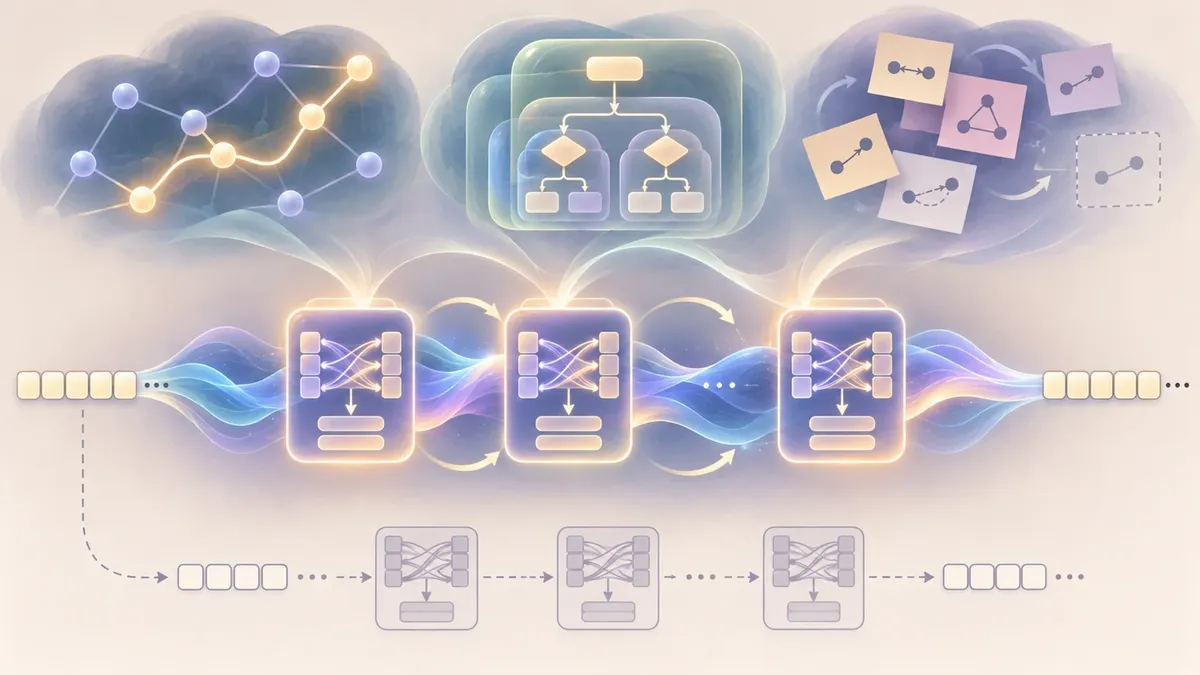
When a model writes out reasoning, each new token extends its sequence. This preprint explores a different approach: repeatedly refine hidden representations instead. Tests on three designed tasks show that extra computation can help, but performance depends on task structure and does not keep rising indefinitely.
The question: more computation without more tokens
Many language models generate intermediate reasoning as text. Each token extends the sequence the model processes. Hung-Hsuan Chen’s preprint explores another approach: repeatedly apply the same Transformer block to its internal representations. The author calls this “vertical” chain-of-thought. Its intermediate steps are continuous hidden states, not generated words.
The goal is to add computational depth without adding model parameters or lengthening the sequence. In the paper’s analysis, the recurrent core’s peak inference memory stays flat as the number of reasoning steps increases, while computation time grows linearly. These are architectural scaling claims, not a demonstration of an advantage in every real-world deployment.
How the method was tested
The study evaluates three compositional tasks, with different amounts of structure built into the model’s input processing.
In graph reachability, the model determines whether a directed path connects two nodes. An attention mask limits information flow to adjacent nodes, creating a strict structural constraint. In nested Boolean logic, it evaluates expressions with parentheses and logical operators. The model uses rotary positional embeddings (RoPE), which provide a soft positional bias—not an explicit encoding of the expression’s logical structure. The paper argues that this bias can allow some information to travel across multiple levels in one step, helping explain why performance declines gradually rather than abruptly.
In relational composition, the model answers questions about relationships stated in shuffled sentences. The task was engineered to resist shortcuts: chains use a fixed “Apex Routing Strategy,” and parity-matched hard negatives prevent answers based just on a simple parity cue. The task provides no positional signal that reveals the underlying relationship path, but it is still a carefully designed synthetic test, not unrestricted language understanding.
For each task, a shared-weight Transformer block was run repeatedly, and researchers varied the number of repetitions, or “thinking steps.” They tested task difficulties both within and beyond the training range. Training used “silent thinking”: the model was supervised on its final answer, not on an answer at every intermediate step. LayerScale initialization and a gate biased toward preserving the previous hidden state were intended to stabilize repeated computation.
The paper compares the recurrent model with fixed-depth Transformers and other weight-sharing approaches. Several reported comparisons average results across three random seeds; a separate supervision experiment averages five runs.
What the study found
The relationship between computation and accuracy differed across tasks. On graph reachability, accuracy rose sharply when the number of steps was sufficient for information to travel along the path. The tested model generalized perfectly up to eight hops, but its performance dropped sharply at greater depths. On nested logic, the decline was more gradual: the model maintained above 90% accuracy at depth 14, beyond the training range of depths 1–8. On relational text, the model remained above chance on some unseen chain depths, but accuracy approached chance by depth 9. Extra steps did not remove this limit.
The author calls the pattern a “computational frontier”: performance depends on both task complexity and the available number of steps, while the shape of the boundary depends on the task’s structure. More computation can help, but does not guarantee a correct answer.
For the two sequence tasks, the paper reports out-of-distribution results within two percentage points of fixed-depth Transformer baselines that used 4–6.4 times more parameters. This comparison applies to those reported task results, not to every condition or to general-purpose language models. On graph reachability, the recurrent model extrapolated farther than the fixed-depth models tested, but it too failed at greater depths in the tested configuration.
A separate graph-task experiment found that supervising intermediate answers harmed longer-path generalization in the tested settings. The comparison included widths of 128, 256, and 384; the authors report that intermediate supervision prevented the wider models from solving 10-hop paths, while silent thinking did. They suggest that pressure to answer correctly after too few steps may encourage shortcuts instead of deeper information propagation. This finding is specific to the experiment and does not establish a general rule for iterative models.
What remains uncertain
These controlled tasks do not show that the method improves general-purpose language models or real-world reasoning. Each task uses a different, hand-designed perception interface, a limitation the author acknowledges. The number of steps is also set externally at inference time. Automatically assigning more computation to harder examples remains an open problem; the adaptive-halting approach tested in the paper did not reliably increase computation enough for out-of-distribution graph problems.
The reasoning cores are small, allowing the experiments to isolate recurrence, but the author says it remains unknown whether the proposed stability techniques will suffice at much larger scales. The memory analysis describes how the architecture scales; practical costs and benefits may depend on hardware, workload, and model design.
This article is based on an arXiv preprint; the available source does not establish whether it has undergone peer review. The author reports using AI tools to assist with implementation, experiments, manuscript work, and literature searches, and says the author formulated the questions, determined the final claims, and approved the content. Code is released for reproducibility, but independent replication and evaluation on broader tasks remain important. The results support a research direction, not a general claim that models can reason reliably simply by thinking longer internally.
- Transformers
- AI reasoning
- recurrent neural networks
- chain of thought
- compositional generalization
- machine learning
Reviewed cross-references
These connections were reviewed by a model, not independently fact-checked by a human. Similarity does not imply agreement; consult the original papers and the evidence below.
A Transformer That Stops When Its Reasoning Settles
Shared method: Both papers add computation by repeatedly applying a shared Transformer block. Chen uses an externally specified recurrence count, whereas Movahedi et al. use fixed-point convergence as the halting signal; this is a methodological connection, not evidence of equivalent performance across their different tasks.
Model review: · openai-codex/gpt-6-luna
Evidence and provenance
Selected excerpts, not complete papers. PDF extraction can omit figures or damage equations, tables and reading order; sources may be preprints.
2603.21676v3 — Original paper
Excerpt reference:
static/papers/2603.21676v3.md:73-116
Basis: Paper text
Source SHA-256:16e8e74a4103d0798c5bb821e9ca0d16f3fdc34bc614175f32c401f8beb13ad22606.18206v2 — Original paper
Excerpt reference:
static/papers/2606.18206v2.md:13-116
Basis: Paper text
Source SHA-256:4e1f553af638f157739f4b02fd4ac9fd5f962b22235e38073d75782ff1196084
Why Recurrent AI Models Still Struggle With Longer Tasks
Shared method: Both papers use recurrent Transformers that repeatedly apply a shared block to increase computation without adding parameters at each step. Chen studies compositional tasks with a specified thinking-step count; Jung et al. study synthetic state tracking and length generalization, so the shared method does not imply comparable results across tasks.
Model review: · openai-codex/gpt-6-luna
Evidence and provenance
Selected excerpts, not complete papers. PDF extraction can omit figures or damage equations, tables and reading order; sources may be preprints.
2603.21676v3 — Original paper
Excerpt reference:
static/papers/2603.21676v3.md:73-116
Basis: Paper text
Source SHA-256:16e8e74a4103d0798c5bb821e9ca0d16f3fdc34bc614175f32c401f8beb13ad22611.29171v1 — Original paper
Excerpt reference:
static/papers/2611.29171v1.md:131-199
Basis: Paper text
Source SHA-256:67e3cd3f59892e4e587f7cb1b8e08b0c319e0a33dea5633814725cb49eacd5b7
Related reading
Automatically matched by shared topic keywords. These links do not imply that the sources agree or establish a consensus.
AI reasoning can be shorter by reusing familiar phrases
Source published
Shared keywords: ai reasoning, machine learning
AI reasoning needs more than a correct answer
Source published
Shared keywords: ai reasoning, chain of thought
The words that quietly steer AI reasoning
Source published
Shared keywords: ai reasoning, chain of thought
Could the shape of word connections help evaluate AI reasoning?
Source published
Shared keywords: ai reasoning, chain of thought
When AI reasoning fails, useful clues may remain hidden
Source published
Shared keywords: chain of thought