TRANSMISSION // 2603.21496v2
Robots Build and Realign a Laser Cavity
Source published
A robotic system assembled and aligned a tabletop laser cavity from scattered components, then restored its signal in tests of two induced disturbances.
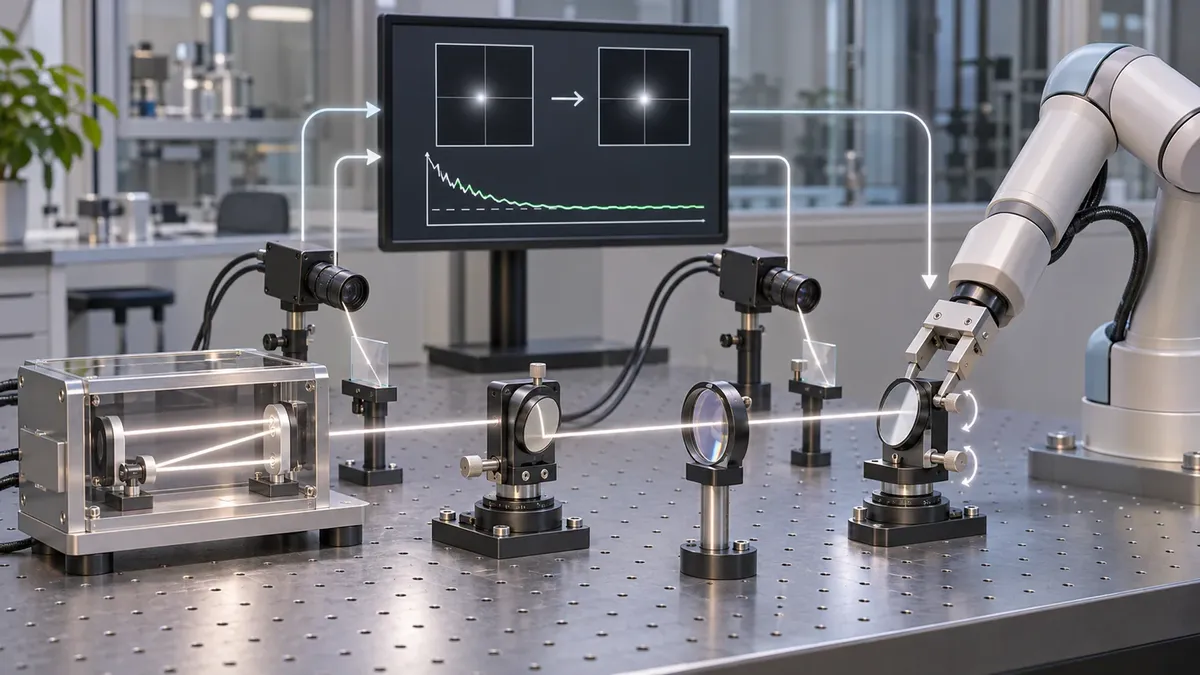
Optical experiments can hinge on tiny adjustments that are difficult to automate. In an arXiv preprint, researchers describe a robot that builds a tabletop laser cavity, tunes its beams and responds to selected disruptions. The demonstration is promising, but it concerns one defined laboratory setup, not automation across optics more broadly.
Free-space optics—the arrangement of mirrors, lenses and other components that guide light through open space—often depends on painstaking manual adjustments. Small shifts or rotations can disrupt a beam, and the right correction depends on what an experiment is trying to achieve. A robot must therefore do more than place parts: it must measure the light and use those measurements to guide its next move.
A team led by Seou Choi reports a system designed to do this in a feedback loop. In their demonstration, the robot assembled and aligned a tabletop laser cavity from components placed randomly on an optical table. A laser cavity uses mirrors to send light repeatedly through a gain medium; here, that medium was a crystal.
A robot that checks its work
The setup combines a seven-degree-of-freedom robotic arm with cameras and a custom motorized tool. Overhead stereo cameras help locate components and monitor the work area. A camera near the robot’s gripper supports handling, while beam-detection cameras provide feedback during alignment. The custom tool turns fine-adjustment knobs on optical mounts, enabling small angular changes as well as component placement.
For spatial alignment, the system makes a small movement and measures how the beam shifts in the camera image. It uses that response to estimate a correction. For angular alignment of the cavity mirrors, it uses Bayesian optimization to reduce the distance between two beam spots. In practical terms, the system tests adjustments and uses the observed results to guide subsequent ones.
The full assembly involved more than placing parts in sequence. The system first mapped the pump laser’s path, then positioned cameras, filters, mirrors and a lens. It aligned the mirrors to form a resonator, placed the crystal, and tuned the cavity to favor a chosen laser mode. The authors report observing the expected threshold in laser power and optimizing toward the fundamental mode, which has an approximately Gaussian beam profile.
Testing responses to disturbances
The researchers report two specific disturbance tests. In one, they displaced the lens by about a centimeter. The system measured the positions of key components, repositioned the lens and, when needed, performed further alignment. The laser signal was restored in all 10 trials.
In the other test, the researchers randomly rotated the mirror-adjustment knobs to misalign the resonator. The system used an optimization routine to seek alignment again. It restored the laser signal in 9 of 10 trials. These outcomes concern signal restoration under the tested conditions; they do not show that every aspect of the setup’s operation can recover from arbitrary faults.
The paper also reports a separate angular-alignment test: the system successfully overlapped two beams from 10 different starting positions. That result measures alignment performance, not repeated full construction of the cavity.
What the demonstration shows—and what remains open
The work presents an integrated workflow for assembling a particular laser cavity, aligning it, selecting a mode and responding to specified disturbances. The components were placed in standardized 3D-printed housings, and the system followed a user-provided layout. The study does not establish that the robot can design arbitrary experiments or handle every type of optical component and failure.
The authors suggest that the framework could support autonomous optical experiments in multiple scientific fields. That is a potential direction, rather than a result tested across those fields. Whether the approach transfers to other setups, operates reliably over longer periods or handles a broader range of disturbances remains uncertain.
The source is an arXiv preprint. This account is based on the supplied paper text, and extracted text may not preserve every detail in figures or tables. The reported results are best understood as a proof of concept in a defined laboratory setup, not evidence that optics laboratories can already be automated generally.
- robotics
- optics
- laser cavity
- laboratory automation
- closed-loop control
- computer vision
Reviewed cross-references
These connections were reviewed by a model, not independently fact-checked by a human. Similarity does not imply agreement; consult the original papers and the evidence below.
A robotic laboratory links experiment planning with hands-on chemistry
Supporting evidence: Both papers report robot systems completing physical laboratory tasks through feedback: Choi et al. demonstrate laser-cavity construction, alignment and recovery, while Chen et al. report autonomous wastewater-treatment optimization over 15 rounds. These are separate demonstrations in different domains, not evidence that either system generalizes to the other.
Model review: · openai-codex/gpt-6-luna
Evidence and provenance
Selected excerpts, not complete papers. PDF extraction can omit figures or damage equations, tables and reading order; sources may be preprints.
2603.21496v2 — Original paper
Excerpt reference:
static/papers/2603.21496v2.md:631-710
Basis: Paper text
Source SHA-256:f7015ccc048552a3cdda8da79ae7dc878b8d17fdc584735cfdf1441a8ac905d42611.12958v1 — Original paper
Excerpt reference:
static/papers/2611.12958v1.md:191-248
Basis: Paper text
Source SHA-256:0ec36552bf3dbe1a03e63f8dd56685725471d786f59ed5b4be9a22c210f253f12611.12958v1 — Original paper
Excerpt reference:
static/papers/2611.12958v1.md:893-976
Basis: Paper text
Source SHA-256:0ec36552bf3dbe1a03e63f8dd56685725471d786f59ed5b4be9a22c210f253f1
Related reading
Automatically matched by shared topic keywords. These links do not imply that the sources agree or establish a consensus.
A robot reads the recipe—and finds its ingredients
Source published
Shared keywords: computer vision, laboratory automation
How Embodied-VGGT keeps long 3D reconstructions aligned
Source published
Shared keywords: computer vision
Refocusing a photo without rebuilding it for every edit
Source published
Shared keywords: computer vision
How a drone can move to get a better look
Source published
Shared keywords: computer vision
ADEPT lets a depth model help tune its camera
Source published
Shared keywords: computer vision