TRANSMISSION // 2603.18066v3
A Neural-Network Chip Design Puts Learning Inside Each Neuron
Source published
A preprint proposes digital hardware for predictive coding, with a separate local-computing core for each neuron. Its analysis suggests fewer clock cycles for updates under a highly parallel design, but does not establish faster end-to-end training on a built system.
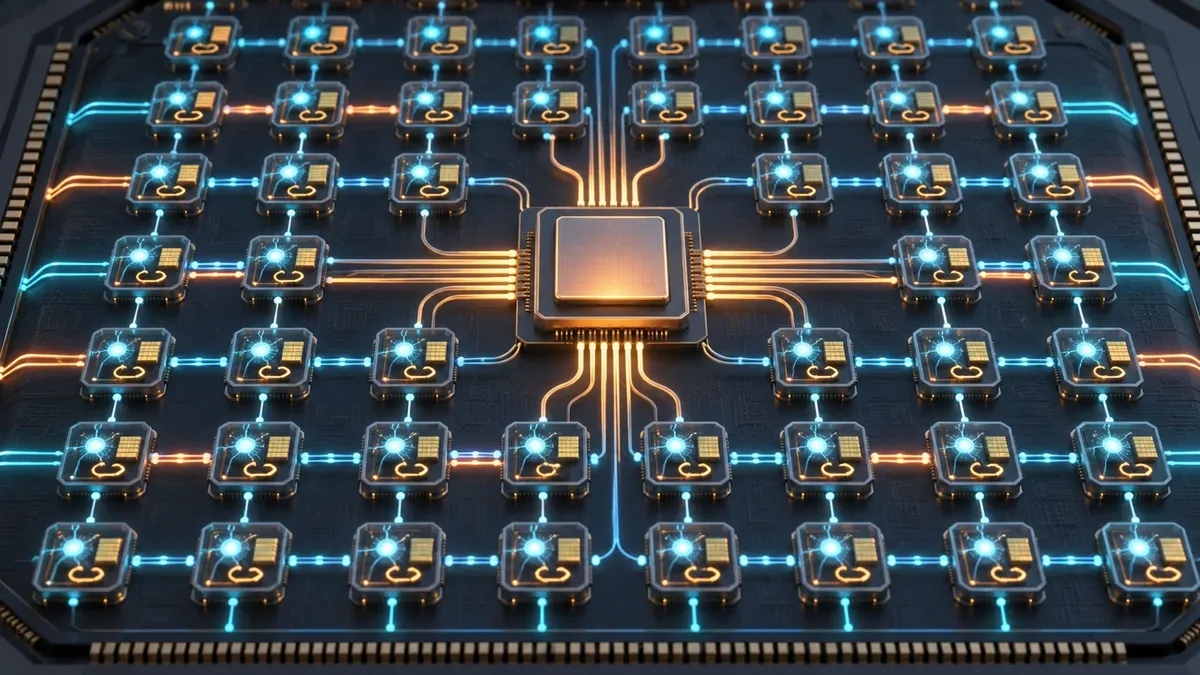
Could a neural network learn without sending error signals through a centralized processor? Timothy Oh’s preprint explores a hardware design based on predictive coding, where neurons exchange local signals and update their own weights. The proposed architecture points to a possible speed advantage in clock cycles, but that is not yet evidence that it trains real-world models faster than backpropagation.
Backpropagation is a standard way to train neural networks: after a network makes a prediction, an error signal is propagated backward to help adjust its weights. The method works well on conventional computers, but its separate computational phases and movement of data between memory and processors can be awkward to reproduce in hardware designed for local, ongoing learning.
Timothy Oh’s preprint asks whether predictive coding could better suit such hardware. In predictive coding, neurons make predictions and use the differences between predictions and signals to adjust their activity and weights. The paper focuses on implementing this process in a digital circuit—not on showing that it outperforms backpropagation across practical machine-learning tasks.
A core for each neuron
The proposed design gives each predictive-coding neuron its own physical hardware core. Each core stores its activity and weights, communicates with connected cores, and performs local updates. The cores are designed to run in parallel, with memory and computation colocated rather than relying on a central processor to repeatedly move weights between memory and computing units.
The implementation uses incremental predictive coding, a version that combines inference and learning in a repeating update. That differs from canonical predictive coding, which separates those phases. The preprint notes that incremental predictive coding does not produce a weight update exactly equivalent to backpropagation, though it can approximate it and still learn useful behavior.
To assess learning, the paper reports Python simulations on five regression functions generated by teacher networks, ranging from a linear mapping to nonlinear functions. Prediction error decreased on the tested training points. Separately, the authors took a neuron core and a small network through a digital hardware design flow, producing GDS layouts that passed the reported layout-versus-schematic and design-rule checks. These are distinct demonstrations: the learning results came from a software model of the update equations, while the hardware results concern the design and layout flow. The paper does not report fabrication or testing of a physical chip.
The speed claim is about cycles
The paper’s central performance claim comes from analyzing how many clock cycles an update would require. If a neuron connects to J neurons in one neighboring layer and K in another, its update takes a number of cycles that grows with J + K. Because the neuron cores operate concurrently, the network’s update time is determined by the largest such connection counts. For dense layers of width n, the authors describe this as O(n) cycles per update, compared with O(n²) connection operations when those operations are processed serially.
That comparison concerns a proposed, highly parallel hardware architecture and a count of update cycles. It does not establish that a fabricated system trains faster in elapsed time, uses less energy, or matches the accuracy of a backpropagation system. The preprint argues that the theoretical scaling holds for larger networks, but says empirical scaling remains to be established. It also does not report a head-to-head benchmark against backpropagation on equivalent hardware and tasks.
There are practical trade-offs. Giving every neuron its own core restricts what the hardware can do: unlike a general-purpose CPU or GPU, it is built specifically to carry out predictive-coding updates. The paper also describes substantial connection requirements between cores. Those design choices support the proposal’s emphasis on local computation and parallelism, but their consequences for larger systems need further testing.
The article is an arXiv preprint marked “under review,” so its claims should be treated as provisional. Its simulations and layout checks offer an initial demonstration, not proof that predictive coding is generally faster than backpropagation. A key next step is to test whether larger implementations can retain the predicted cycle advantage under real hardware constraints and on useful learning tasks.
- predictive coding
- backpropagation
- neuromorphic hardware
- machine learning
- digital circuits
- parallel computing
Related reading
Automatically matched by shared topic keywords. These links do not imply that the sources agree or establish a consensus.
How atoms could learn the big picture from spin data
Source published
Shared keywords: machine learning
Teaching AI to write better parallel code
Source published
Shared keywords: parallel computing
How should an AI assistant decide what to remember?
Source published
Shared keywords: predictive coding
A simple learning rule may help digit recognition withstand image corruption
Source published
Shared keywords: machine learning
A shared test bench for predicting how LLMs train
Source published
Shared keywords: parallel computing