TRANSMISSION // 2603.17530v2
A compact vision model for defects across product lines
Source published
AdapTS uses a shared frozen backbone and small task-specific adapters to detect defects across product categories and as new categories arrive. Tests on two benchmark datasets suggest a memory-efficient approach, with important limits to consider.
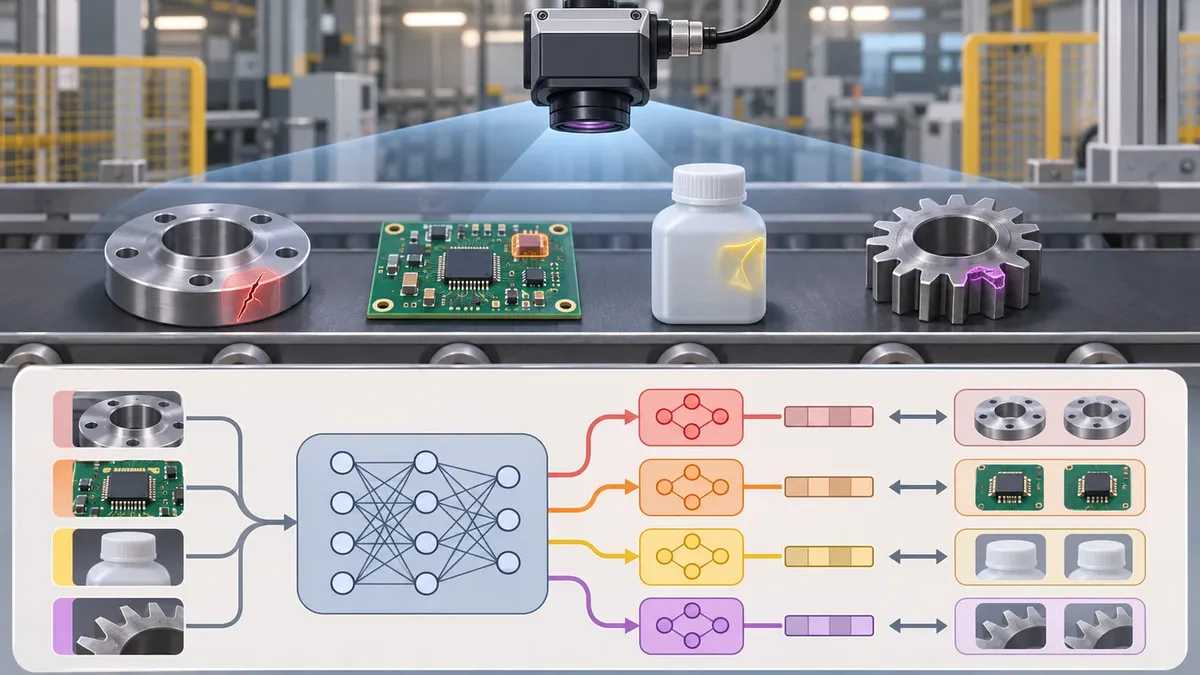
Industrial inspection systems may need to recognize defects across many products, while new products arrive and old training images cannot always be retained. AdapTS is a proposed teacher–student approach designed for those conditions. The authors report promising benchmark results, but the method’s performance depends on correctly identifying each product category.
A scratch, stain or missing component can matter on a factory line, but an inspection system must first learn what normal looks like for each product. Many visual anomaly detection methods are built for one category at a time. That can mean separate models to train, store and maintain. A further challenge arises when categories are introduced sequentially: a system must learn about new products without losing what it learned before, ideally without keeping old images on hand.
In a preprint, Manuel Barusco and colleagues at the University of Padova present AdapTS, a teacher–student method intended to handle both multi-category inspection and continual learning with limited memory. They evaluate it on MVTec AD and VisA, two image datasets used for visual anomaly detection.
One backbone, with adapters for each category
Teacher–student systems commonly compare features from a fixed teacher network with those from a student network trained on normal images. An unusual input may produce a larger difference between the two, which can serve as an anomaly signal. In the established STFPM approach, teacher and student are separate networks, so the student adds to the model’s memory requirements.
AdapTS instead uses one frozen pretrained backbone for both roles. Small trainable modules called adapters are inserted into the network; only these adapters are trained for a category, while the shared backbone remains unchanged. The authors also train the adapters using synthetic defects made from Perlin noise and random textures. A segmentation head learns from the synthetic defect masks, but is removed after training. At inference, the anomaly map comes from differences between the teacher and adapted pathways, not from that head.
The system must choose which category’s adapters to use for an incoming image. AdapTS compares a feature descriptor of the image with a stored prototype for each category and selects the closest one. The authors report task-identification accuracy above 99% on both datasets. This step matters: although adapters for earlier categories are not updated, a wrong category choice can still affect the result.
Benchmark results and trade-offs
On MVTec AD, the authors report that AdapTS-M improves image-level AUROC by 11 percentage points over STFPM in the multi-class setting, while using less memory. The smaller AdapTS-S uses 23 MB in the reported setup. In the continual setting on MVTec AD, AdapTS-M reaches pixel-level average precision of 0.50, with reported forgetting of 0.1% and no replay buffer. “Forgetting” here measures a drop in performance on earlier categories as later ones are learned.
The results are not best on every measure. In continual MVTec AD tests, some competing continual-learning methods score higher on image-level AUROC; ContCore also has higher pixel-level AUROC, though the paper says comparable pixel-level F1 and average precision are not available for it. The authors emphasize localization metrics and memory efficiency, rather than claiming AdapTS leads across the board. Each new category also adds adapter parameters and a prototype: the paper gives a memory increase of 2.5 MB per category for AdapTS-M and 0.5 MB for AdapTS-S.
The team also tests a MobileNetV2 version, reporting total memory of 6–7 MB and better results than a MobileNet-based STFPM comparison on the reported metrics. On VisA, results vary by metric too: AdapTS-M has higher pixel-level average precision but slightly lower image-level AUROC than RD4AD, according to the paper.
What the evidence does—and does not—show
These are evaluations on two benchmarks, not a demonstration on a live production line. Results may depend on the datasets, model choices and evaluation protocol. The method also assumes that incoming images belong to categories with stored prototypes; the authors identify detection of unseen categories as future work. And while it avoids retaining past images, its category-specific adapters still accumulate as categories are added.
The article is based on an arXiv preprint, which is not necessarily peer-reviewed. Its comparisons therefore warrant independent replication, especially in real inspection settings and across larger, changing product ranges. AdapTS offers a specific engineering trade-off: share most of the network, keep small category-specific modules, and use feature matching to select among them. Whether that balance is useful in practice remains an open question.
- visual anomaly detection
- industrial inspection
- continual learning
- teacher–student models
- edge AI
- computer vision
Related reading
Automatically matched by shared topic keywords. These links do not imply that the sources agree or establish a consensus.
A smart charger gives edge AI a place to learn while it sleeps
Source published
Shared keywords: continual learning, edge ai
Why Shape-Aware Matching May Help Spot Surface Defects
Source published
Shared keywords: computer vision, industrial inspection
How SCRA-CLIP Tries to Spot Subtle Image Anomalies
Source published
Shared keywords: computer vision, industrial inspection
Shrinking video memories without retraining the model
Source published
Shared keywords: computer vision, edge ai
PruneNAS searches for smaller neural networks by pruning
Source published
Shared keywords: computer vision, edge ai