TRANSMISSION // 2603.16568v3
How a chosen geometry can shape an AI’s latent map
Source published
A distance-matching regularizer lets autoencoders inherit a chosen data geometry. Tests across 15 datasets show strong global structure, with trade-offs and important limits.
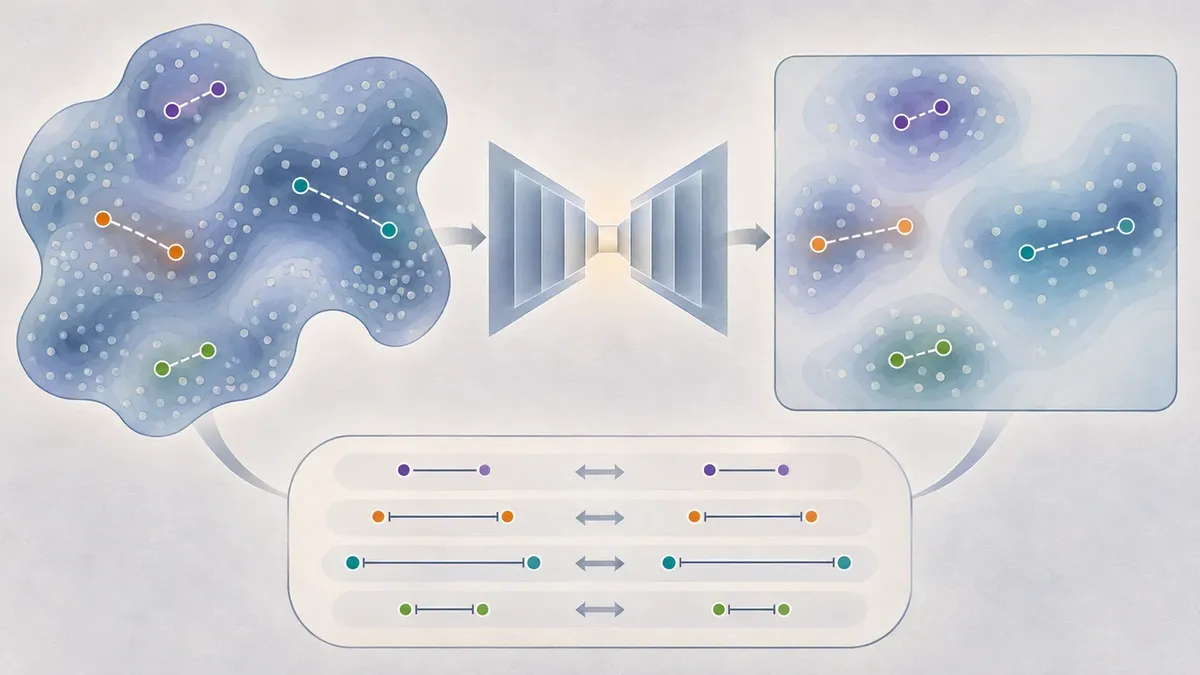
Autoencoders compress data, but reconstruction alone does not say how points should be arranged in their compressed representation. Manifold Matching adds a rule: make distances between compressed points resemble distances in a chosen reference. Its results suggest this can preserve broad structure efficiently—but what counts as “faithful” depends on the reference and the task.
A two-dimensional map can make a complicated dataset easier to inspect. But its positions can be misleading: an autoencoder trained only to reconstruct its inputs has no direct reason to keep nearby items close together, or distant items far apart, in its compressed representation. The map’s geometry may be an accident of training rather than a useful reflection of the data.
In Manifold-Matching Autoencoders, Laurent Cheret and colleagues propose a way to guide that geometry. They choose a reference representation, compare distances between points in that reference with distances between their compressed codes, and penalize mismatches. The autoencoder still aims to reconstruct its input; the added loss encourages its latent space to inherit the reference’s pattern of distances.
Choosing the map’s geometry
The reference need not have the same number of dimensions as the autoencoder’s bottleneck. A two-dimensional latent space, for example, can be guided by distances measured in a much higher-dimensional representation. The method does not require labels: it uses reference distances, not category names, to shape the embedding.
That reference is a substantive choice. The authors test raw input distances, distances after principal component analysis (PCA), and estimates of distances along the data manifold using Isomap. These can preserve different things. Straight-line distances through space may differ from distances that follow a curved surface; a useful layout for one purpose may be a poor one for another.
In a separate experiment, the researchers use Manifold Matching to train encoders that reproduce existing layouts, including t-SNE, UMAP, Isomap and PHATE. Some embedding methods create maps for a fixed dataset without providing a general-purpose encoder for placing new points. On four datasets, the learned encoder closely reproduced each selected reference on training data and placed held-out points in broadly consistent positions. For this experiment, the references were computed using the full datasets, so held-out points helped define the target layouts, even though the encoder was trained on the training split. That distinction matters when interpreting the out-of-sample results.
What the comparisons found
In a broader benchmark, the authors evaluated methods on 15 datasets: synthetic geometric examples, image collections and two single-cell gene-expression datasets. For this benchmark, all methods used the same basic neural-network architecture and a two-dimensional bottleneck. The researchers assessed global distance relationships, local neighborhoods, topological features such as loops, and how density is distributed in the map.
No method led on every measure. Manifold Matching performed strongly on global distance measures, but this needs context: matching distances is its training objective, so success on distance-based scores is partly built into the method. The authors report that it was statistically tied with RTD-AE, a persistence-based autoencoder, on global distance correlation and triplet accuracy. It remained competitive on local and topological measures, where other methods sometimes did better. For one topological score, the tests found no statistically significant differences among methods.
A synthetic “nested spheres” example illustrates what the reference can change. The challenge is to arrange small spheres inside a larger enclosing shell in a two-dimensional map. Matching distances from the original, higher-dimensional data recovered this nesting in the reported experiments. But the result depended on the reference: when it contained too little information about relevant distances, the nesting was not recovered. The authors also caution that distance-correlation values in one illustrative comparison were low for all methods, making that figure a weak standalone quantitative test.
A useful tool, not a universal map
The training loss compares pairwise distances within each batch, so its added training cost is described as similar to that of a plain autoencoder. That does not make every use free: constructing a reference such as an Isomap or UMAP layout can itself require substantial computation. Nor does a low average distance error guarantee that every pair is preserved or that topology is preserved in the worst case. The paper distinguishes its empirical results from mathematical guarantees that would require stronger conditions.
There are practical trade-offs, too. In a controlled comparison, adding distance matching improved geometric measures but increased reconstruction error relative to a reconstruction-only autoencoder. And preserving data geometry is not always desirable: a classifier may benefit from rearranging data to separate classes rather than keeping their original relationships intact.
The study’s scope is limited. Every experiment used a two-dimensional bottleneck, and the authors did not test whether the method improves interpolation or generation. The work is an arXiv preprint, so its claims should be read as reported research findings, not settled consensus. Its main contribution is a flexible way to choose what a compressed map tries to preserve—not proof that one geometry is right for every dataset or task.
- autoencoders
- machine learning
- dimensionality reduction
- latent spaces
- data visualization
- manifold learning
- representation learning
Related reading
Automatically matched by shared topic keywords. These links do not imply that the sources agree or establish a consensus.
A projection method that keeps hyperbolic geometry in view
Source published
Shared keywords: dimensionality reduction, machine learning, representation learning
How Federated AI Can Learn Across Different Representations
Source published
Shared keywords: machine learning, representation learning
Can a model’s future features be spotted early?
Source published
Shared keywords: machine learning, representation learning
One Energy Lens for Many Kinds of Machine Learning
Source published
Shared keywords: machine learning, representation learning
Why sparse autoencoders hit different limits in different layers
Source published
Shared keywords: representation learning