TRANSMISSION // 2603.16220v2
Nuclear pasta may reshape a young neutron star’s crust
Source published
Models of hot neutron-star matter suggest that nuclear pasta depends strongly on the symmetry energy and may modestly enlarge proto-neutron stars in calculations.
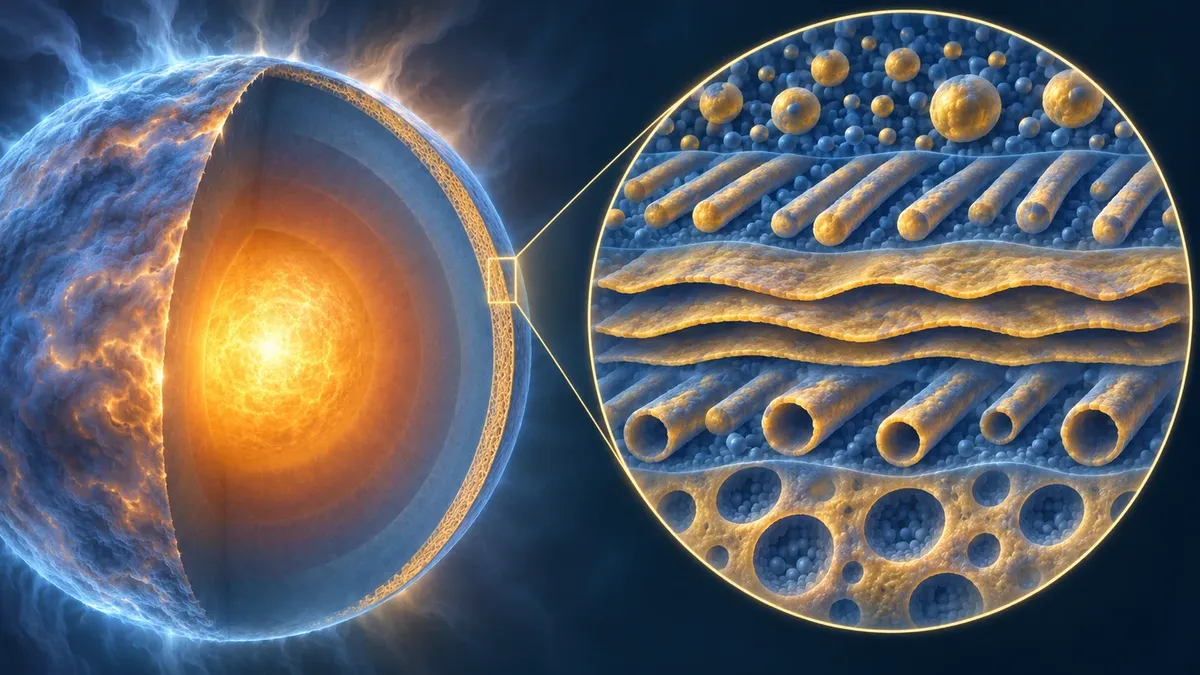
In a young neutron star, nuclear matter may arrange itself into shapes resembling droplets, rods, slabs and bubbles. A model study finds that which shapes appear depends on assumptions about nuclear interactions—and that including these structures changes the calculated crust and stellar radius.
In the dense outer layers of a neutron star, matter may not remain uniform. As density rises, nuclear material can form droplets, rods, slabs, tubes or bubbles, with dilute matter between them. These shapes are collectively called nuclear pasta. They are difficult to study directly, but may affect how heat and neutrinos move through a young neutron star.
A new study asks two related questions: which pasta shapes are favored in hot neutron-star matter, and what difference might they make to a proto-neutron star (PNS), the hot remnant left after a massive star’s core collapses?
A model of competing shapes
The researchers used a compressible liquid-drop model, which treats each repeating cell of matter as a dense nuclear liquid surrounded by a dilute gas. The two regions meet at a sharp boundary. For each possible geometry, the team calculated the free energy—including contributions from the boundary’s surface energy and from electric charge—and identified the lowest-energy configuration.
To describe nuclear interactions, they used relativistic mean-field models. These models differ in the slope of the symmetry energy, a quantity that describes how the energy of nuclear matter changes when it contains more neutrons than protons. The researchers compared two pairs of models, adjusting the slope while keeping other properties within each pair the same. This comparison helps isolate how the symmetry-energy behavior affects the predicted pasta.
The calculation also accounts for temperature-dependent surface tension. Rather than repeatedly calculating it from scratch, the authors used a parameterized expression fitted to results from the Thomas–Fermi approximation, a more detailed method for describing the density profile of nuclear matter.
The shapes depend on the nuclear model
At low temperatures, models with smaller symmetry-energy slopes produced several pasta shapes as density increased. Models with larger slopes produced only droplets before matter reached the transition to the uniform core. In all the models, the range of densities containing nonuniform matter narrowed as temperature rose; above a critical temperature, the model no longer favored pasta.
The study also found that including surface and electric-charge effects reduced the range of nonuniform matter compared with calculations that neglect those finite-size contributions. The details varied between models, so the results do not establish one definitive pasta sequence for real neutron stars.
To explore the stellar consequences, the researchers built equations of state—relationships between pressure, density and energy—for matter at fixed entropy per baryon. They then used these in the Tolman–Oppenheimer–Volkoff equations, which describe the structure of a spherical star in general relativity. In their calculations, pasta could occupy the inner crust, which was about 1.0–1.2 kilometres thick for the example considered. Including pasta made the calculated PNS radii slightly larger than when the crust was treated as uniform matter, with a more noticeable difference for lower-mass stars.
What the result can—and cannot—tell us
These are theoretical results, not a direct observation of nuclear pasta. They depend on the chosen nuclear models, the liquid-drop picture and its sharp interface, and the fitted surface-tension prescription. The authors also model a particular stage of PNS evolution: neutrino-free matter in beta equilibrium, using fixed entropy. They say that matter with trapped neutrinos remains to be studied. The paper notes that pasta could influence thermal conductivity and, in turn, a star’s thermal evolution, but the calculations reported here do not establish a specific cooling history.
The comparison is useful because it shows how changing one aspect of the nuclear interaction can change the predicted shapes and their extent. But the study’s four model parametrizations do not span every plausible description of nuclear matter. Its calculated radii and crust structure should therefore be read as model-dependent predictions, not measurements or settled properties of young neutron stars.
The source is the arXiv preprint Nuclear pasta in hot neutron-star matter and proto-neutron stars by Jian Zhou, Junbo Pang, Hong Shen and Jinniu Hu (version 2). A preprint is a publicly shared research manuscript and may not have undergone peer review; the source provided here does not establish its peer-review status. The findings are best understood as a contribution to ongoing modeling of matter under extreme conditions, rather than a final answer about the interiors of real stars.
- nuclear pasta
- neutron stars
- proto-neutron stars
- nuclear physics
- symmetry energy
- astrophysics
Related reading
Automatically matched by shared topic keywords. These links do not imply that the sources agree or establish a consensus.
New method sorts newborn neutron stars’ vibrations by their physics
Source published
Shared keywords: proto neutron stars
Why nuclear measurements may not settle neutron-star tides
Source published
Shared keywords: neutron stars, nuclear physics
A hot-matter test for neutron-star equations of state
Source published
Shared keywords: neutron stars
Could dark matter help hold unusual compact objects together?
Source published
Shared keywords: neutron stars
Nuclear symmetry breaking rearranges where correlations live
Source published
Shared keywords: nuclear physics