TRANSMISSION // 2603.05438v2
Eight tokens to help a world model plan
Source published
CompACT compresses images into as few as eight discrete tokens, aiming to make action-conditioned world models faster to use for planning. In benchmark tests, the authors report substantially lower planning latency while retaining comparable navigation accuracy, but the results do not establish real-world readiness.
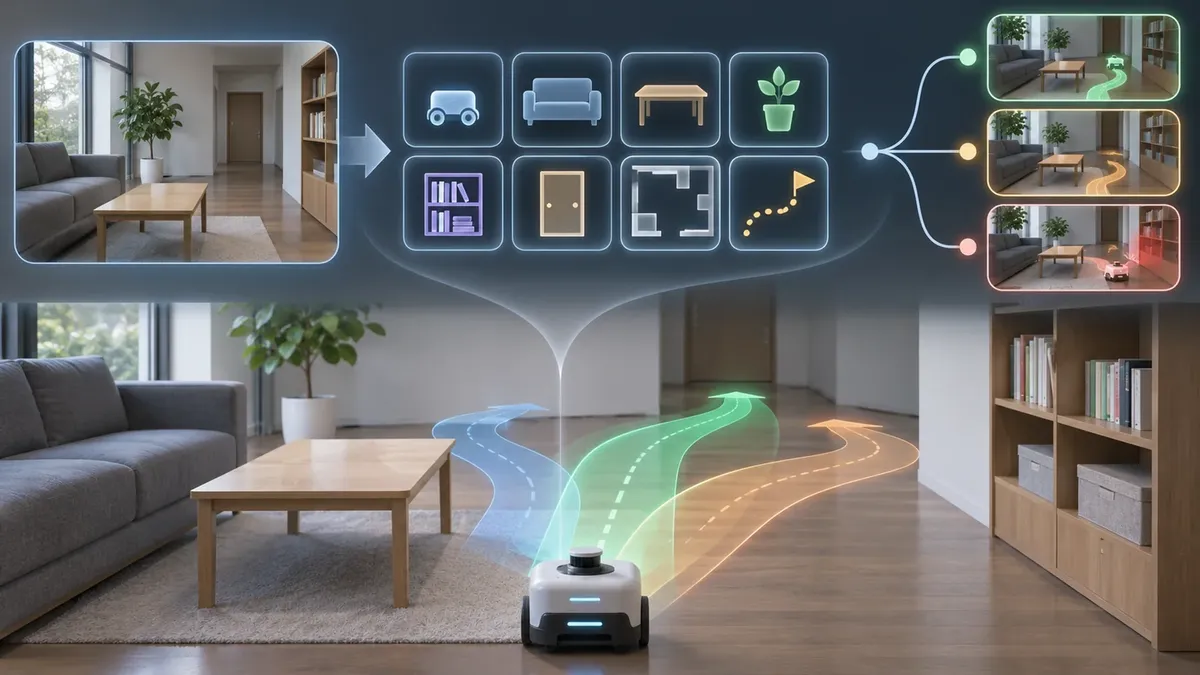
A world model lets an AI system simulate what might happen after an action before it acts. But repeatedly predicting futures from image representations containing hundreds of tokens can be slow. CompACT, a new image tokenizer, asks whether a model can plan with far fewer visual details—and what it must retain to do so.
A robot or navigation system could benefit from trying out possible actions in an internal simulation before committing to one. This is the promise of a world model: a learned system that predicts how an environment may change in response to actions. In practice, those predictions can be costly. Images are often represented by hundreds of tokens, and a planner may need to run its model repeatedly while comparing candidate paths.
In Planning in 8 Tokens: A Compact Discrete Tokenizer for Latent World Model, Dongwon Kim and colleagues propose CompACT, a way to represent each image with as few as eight discrete tokens. Their central question is whether such extreme compression can preserve the information needed for planning, even if it loses visual details that matter for faithful image reconstruction.
Keep the scene’s meaning, not every pixel
CompACT uses a pretrained vision model, DINOv3, to extract image features. The authors keep that encoder frozen and use a learned module to distill its features into a small set of tokens, which are then discretized. Their rationale is that planning may depend more on object identities, positions and spatial relationships than on textures, shadows or lighting.
The method also separates planning from visual reconstruction. Because a handful of tokens cannot specify every pixel, a generative decoder uses them to produce a plausible, more detailed image representation. That output is a synthesis, not a faithful recovery of visual information discarded during compression.
The researchers train action-conditioned world models on these compact representations. Given recent observations and actions, a model predicts future latent states. A planner can compare candidate action sequences by rolling the model forward and evaluating how close the predicted outcome is to a goal. The experiments cover image reconstruction on ImageNet, visual navigation using the RECON, SCAND and HuRoN datasets, and action-conditioned video prediction using RoboNet. The paper compares CompACT with, among other systems, a 784-token SD-VAE representation and FlexTok at 16 and 64 tokens.
Faster planning, with trade-offs
For navigation on RECON, the authors report planning latencies of 5.78 seconds for CompACT with 16 tokens and 4.83 seconds for the 8-token version, compared with 178.78 seconds for the 784-token SD-VAE baseline. Thus, the 8-token result is the one corresponding to the paper’s approximate 40-fold speedup; the 16-token result is about 31 times faster. The 8-token model’s trajectory-error metrics were somewhat worse than the 16-token version. These are results on specified benchmarks and hardware, not a general guarantee that fewer tokens improve planning.
In RoboNet experiments, an inverse-dynamics model trained using CompACT representations performed comparably to or better than the tested 256-token baseline on the reported action-prediction measures. The authors also report faster action-conditioned video generation and lower action-prediction error for CompACT in that setup. A supplementary closed-loop robot-manipulation test on the RoboMimic Lift task reported the same success rate for CompACT and the target-tokenizer comparison, with fewer action steps for CompACT. The paper describes this experiment as preliminary and its setup as minimal.
Compression has a clear cost: CompACT does not retain all the detail needed to reconstruct the original image exactly. Its decoder supplies plausible detail, so a generated rollout can look coherent without proving that every physical detail is correct. The paper’s results support the narrower claim that the representation retained useful information for the tested planning and prediction tasks.
What remains uncertain
The reported speed figures depend on the task, planning procedure, hardware and cost function. For example, evaluating candidate plans directly in latent space can avoid image decoding and make planning faster, but the paper reports a marginal accuracy degradation compared with its pixel-space cost. The main navigation comparison also uses a particular planning setup and dataset selection; its supplementary material notes differences from the original Navigation World Models evaluation. These details matter when interpreting comparisons across papers or imagining other applications.
The authors include experiments in navigation and robot data, but that is not evidence that CompACT is ready for real-world deployment. Performance in unfamiliar environments, under changing viewpoints, or with safety-critical consequences is not established by the reported results. Nor does a compact representation necessarily preserve information that a different task might need.
This work is an arXiv preprint, and the source text does not establish that it has been peer reviewed. Its findings should therefore be treated as reported research results, not settled evidence. The paper offers a demonstration that carefully chosen visual abstractions can reduce computation in specific world-model planning experiments; broader claims about reliable real-time control will require further testing.
- world models
- robot planning
- image tokenization
- CompACT
- artificial intelligence
Reviewed cross-references
These connections were reviewed by a model, not independently fact-checked by a human. Similarity does not imply agreement; consult the original papers and the evidence below.
Fast-JEPA speeds planning in simulated visual-control tasks
Supporting evidence: Both studies report lower-cost world-model planning in their tested settings, using different methods: CompACT reduces visual tokens and reports about 40× lower planning latency on RECON navigation, while Fast-JEPA avoids recursive rollout when comparing candidate plans and reports 2.41× faster planning than INTACT across four tasks. These are separate benchmarks and baselines, not a direct comparison or evidence that either method generalizes beyond its evaluation.
Model review: · openai-codex/gpt-6-luna
Evidence and provenance
Selected excerpts, not complete papers. PDF extraction can omit figures or damage equations, tables and reading order; sources may be preprints.
2603.05438v2 — Original paper
Excerpt reference:
static/papers/2603.05438v2.md:145-201
Basis: Paper text
Source SHA-256:b762fa37aaa0edca7900fd1c512080bf2516bc92c5d88da1923d27ccef7049412611.25927v2 — Original paper
Excerpt reference:
static/papers/2611.25927v2.md:85-143
Basis: Paper text
Source SHA-256:16d6a72e4e28c7144135436452fdf0c44889388b091957966fe7a25a852cfbce2611.25927v2 — Original paper
Excerpt reference:
static/papers/2611.25927v2.md:688-813
Basis: Paper text
Source SHA-256:16d6a72e4e28c7144135436452fdf0c44889388b091957966fe7a25a852cfbce
Related reading
Automatically matched by shared topic keywords. These links do not imply that the sources agree or establish a consensus.
Why more accurate world models may not plan better
Source published
Shared keywords: artificial intelligence, robot planning
Teaching World Models Which Actions Matter
Source published
Shared keywords: robot planning, world models
A Recurrent State Helps AI Plan Its Next Moves
Source published
Shared keywords: artificial intelligence, robot planning
PhiJEPA tests whether AI can infer hidden visual features
Source published
Shared keywords: robot planning
A smoother way for robot AI to imagine what actions do
Source published
Shared keywords: world models