TRANSMISSION // 2603.03168v2
How scientists assess data unfolding
Source published
Detectors can make measured distributions differ from the underlying ones. An arXiv abstract describes ways to assess statistical reconstructions when an external reference is difficult to define.
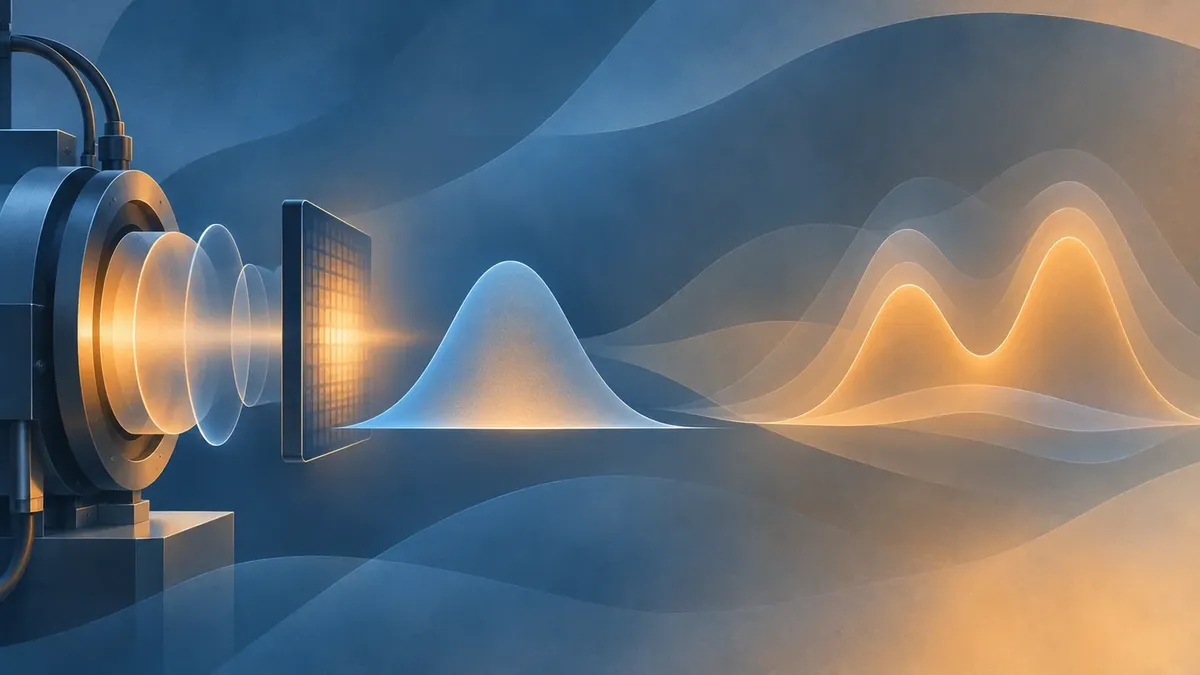
Measurements are shaped by the instruments that collect them. In several areas of physics, researchers use a method called unfolding to estimate the underlying probability distribution—and need ways to assess that estimate, especially when no external quality check is available.
Estimating what a measurement represents
Experimental facilities use sensors, electronics and software to collect data. Their measurements can differ from the underlying probability distributions because of effects such as limited resolution, bias and imperfect efficiency. In particle and nuclear physics, for example, researchers may work with measured spectra or cross sections and seek to estimate the distribution that would describe the underlying process.
That estimation is called unfolding. The resulting distributions can be important when scientists test theoretical models, compare measurements from different experiments or combine results from different research efforts. But an estimate is useful only if researchers can also consider how good it is and what may affect its quality.
Nikolay D. Gagunashvili’s paper, Data Unfolding: From Problem Formulation to Result Assessment, addresses that broader task. Its abstract describes applications in particle and nuclear physics, particle astrophysics and radiation-protection dosimetry. It frames unfolding as estimating an unknown true probability distribution from a measured one affected by experimental effects.
Assessing a result without an external answer
In some reconstruction problems, an external quality check is available. The abstract offers the deconvolution of a blurred image as an example: the sharpness of the restored image can indicate quality. For experimental measurements, defining an external criterion can be more challenging, particularly when a measurement has not been performed before.
The paper discusses internal criteria for assessing an unfolded result independently of external information. It also considers factors that influence the quality of the unfolded distribution. The available abstract does not identify the criteria or factors in detail, so it cannot support a description of particular tests or how they are calculated.
Internal assessment is not the same as directly knowing the true distribution. Rather, it addresses how a result may be evaluated when external information about the answer is unavailable or difficult to define. The abstract presents this as part of the wider problem of formulating an unfolding task and judging its result.
Why assessment matters
Unfolded distributions are used beyond the calculation itself: they can inform comparisons across experiments and tests of theoretical models. Understanding how an estimate is assessed—and what might influence its quality—is therefore relevant to interpreting those uses. The abstract points to both external and internal forms of assessment, while emphasizing that suitable external criteria are not always easy to define.
The source record provides an abstract, not the paper’s full methods or results. It does not specify which internal criteria are discussed, give worked examples, or explain how the factors affecting quality are examined. Nor does the abstract provide numerical findings or a comparison showing that one assessment approach is better than another. Those details should not be inferred from the summary alone.
The source is identified as an arXiv paper. The supplied information does not establish its peer-review or publication status, so no conclusion about that status is warranted. These limits matter: this account summarizes the paper’s stated scope, not a detailed evaluation of its methods or evidence.
The central question is practical: how should researchers judge an estimate of an underlying distribution when measured data have been affected by an instrument and a direct external reference may be hard to define? Gagunashvili’s abstract describes a discussion of internal assessment criteria and factors affecting result quality. The specific answers require consulting the full paper.
- data unfolding
- experimental measurements
- detector effects
- probability distributions
- particle physics
- measurement assessment
Reviewed cross-references
These connections were reviewed by a model, not independently fact-checked by a human. Similarity does not imply agreement; consult the original papers and the evidence below.
Reading the first moment of a cosmic-ray shower
Supporting evidence: Both papers address how detector effects bear on inference about an underlying distribution. The unfolding paper identifies resolution, bias and efficiency as reasons measured distributions can differ from true ones and discusses assessing results; the air-shower study demonstrates that selection efficiency can bias an inferred interaction length and that fiducial cuts reduce the bias in its simulated setting. This is a specific example, not a test of the unfolding criteria, and the shower results depend on the study’s models and selection assumptions.
Model review: · openai-codex/gpt-6-luna
Evidence and provenance
Selected excerpts, not complete papers. PDF extraction can omit figures or damage equations, tables and reading order; sources may be preprints.
2603.03168v2 — Original paper
Excerpt reference:
content/articles/2603.03168v2.md#extra.abstract
Basis: Abstract only; full paper text was not used for this evidence
Source SHA-256:9b5bbfc4c901dff227724abf02f3a56c89424d190e61440183d7a773a5f8f2292611.30661v1 — Original paper
Excerpt reference:
static/papers/2611.30661v1.md:1288-1327
Basis: Paper text
Source SHA-256:1a46b80382ba6207ba932f8d7e64cf4f79e3d6b663b7998463d53118edc66a062611.30661v1 — Original paper
Excerpt reference:
static/papers/2611.30661v1.md:1328-1378
Basis: Paper text
Source SHA-256:1a46b80382ba6207ba932f8d7e64cf4f79e3d6b663b7998463d53118edc66a06
Related reading
Automatically matched by shared topic keywords. These links do not imply that the sources agree or establish a consensus.
How a tiny particle exposed a flaw in a physics AI
Source published
Shared keywords: particle physics
Inside a neutrino AI, useful physics can sit unused
Source published
Shared keywords: particle physics
When Scattering Can Produce Quantum Magic
Source published
Shared keywords: particle physics
How surviving gamma rays constrain hidden particle decays
Source published
Shared keywords: particle physics
How precisely can neutrino oscillations be measured?
Source published
Shared keywords: particle physics