TRANSMISSION // 2602.23915v4
Neutrino fingerprints may refine the recipe for the universe’s first elements
Source published
A study finds that tracking how unusual neutrino–electron interactions reshape neutrino energy distributions is important for predicting primordial helium—not just tracking their total radiation energy.
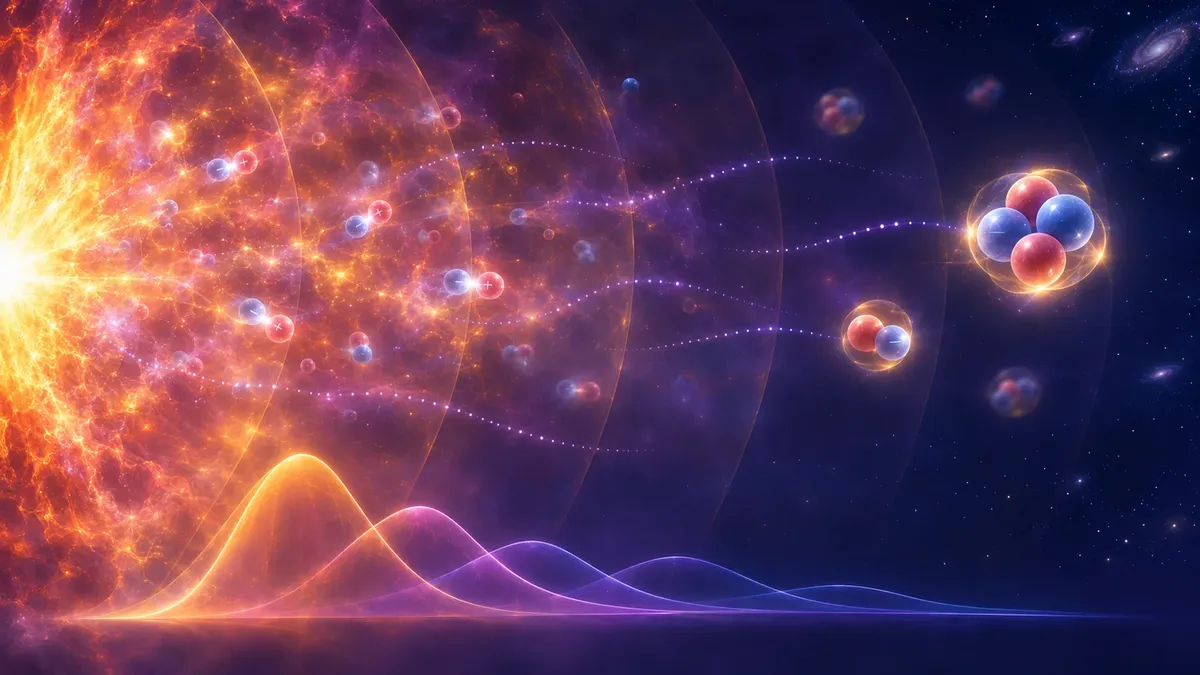
In the first minutes after the Big Bang, the young universe made light elements, including helium and deuterium. A new theoretical analysis asks whether hypothetical changes to how neutrinos interact with electrons could alter those primordial abundances—and whether the element abundances offer information that measurements of cosmic radiation alone would miss.
Neutrinos are famously elusive, but in the early universe they helped set the conditions for making the first atomic nuclei. The paper by Julien Froustey and colleagues examines what might happen if neutrinos interacted with electrons in ways that go beyond the Standard Model of particle physics. Such non-standard interactions are theoretical possibilities, not established discoveries.
The key question is whether their effects on Big Bang Nucleosynthesis (BBN)—the production of light elements in the first few minutes—can be captured simply by tracking how much energy neutrinos contribute to the universe. The authors find that this shortcut misses an important part of the story for helium-4.
Following neutrinos through the early universe
At temperatures of roughly a few million electronvolts, neutrinos gradually stop exchanging energy efficiently with the surrounding plasma of electrons, positrons and photons. This process, called neutrino decoupling, leaves behind a background of relic neutrinos. If their interactions with electrons differ from the Standard Model prediction, both the timing of decoupling and the neutrinos’ energy distributions can change.
The team modeled these changes using quantum kinetic equations, which track neutrino flavours, oscillations and momentum distributions as the universe expands. Their calculations used the public FortEPiaNO code. They then supplied the resulting, time-dependent neutrino distributions to a modified version of the PArthENoPE code, which calculates light-element production. The paper says the authors checked that the broad pattern of abundance changes also appears with the independent PRIMAT BBN code, although the precise values differ with choices such as deuterium-burning rates.
The analysis considered both non-universal interactions, which affect neutrino flavours differently, and flavour-changing interactions. It explored individual interaction parameters as well as selected pairs, then compared predictions with measurements of helium-4, deuterium and the effective number of relativistic species, known as Neff. That last quantity summarizes the radiation energy density in neutrino-like particles.
Helium carries more than an energy-density signal
Changes in neutrino energy density affect the universe’s expansion rate. That, in turn, influences when the reactions converting neutrons into protons stop keeping pace with expansion, and how much time remains for neutrons to decay. These changes affect the final element abundances. In the study’s calculations, deuterium responds mainly to this altered expansion history and tracks Neff relatively closely.
Helium-4 has an additional sensitivity. Electron neutrinos and antineutrinos participate directly in neutron–proton conversion. If non-standard interactions reshape their energy distributions, the rates of those reactions can change even beyond the effect of a different expansion rate. The authors’ comparison of model scenarios shows that simply inserting a changed Neff into a standard BBN calculation does not reproduce the full helium prediction. Following the neutrino distributions is therefore needed for an accurate result.
The paper combines cosmological measurements in several ways, including different choices of Neff data and primordial-abundance measurements. It reports that the resulting cosmological constraints on the interaction parameters are substantially weaker than the corresponding terrestrial bounds used for comparison. The authors nevertheless describe cosmology as an independent probe: it tests neutrino interactions under the very different conditions of the early universe.
A result shaped by data choices
These constraints are not a single, dataset-independent verdict. Their strength depends on which helium and deuterium measurements are adopted, and on the Neff dataset. The authors note that one combination of cosmic microwave background measurements prefers an Neff value below the standard prediction, creating tension with the values produced in the parameter scan. In that case, a tighter-looking interval can reflect disagreement between data and model predictions, rather than a clean gain in constraining power. Their statistical analysis also uses a specified flat prior over a finite parameter range, so the inferred intervals should be understood in that context.
The work is a theoretical analysis posted as an arXiv preprint, prepared for submission to the Journal of Cosmology and Astroparticle Physics. A preprint is a research manuscript made publicly available before journal peer review; its conclusions may be revised or assessed further. The available source does not establish that non-standard interactions exist. Instead, it shows how carefully modeling neutrino spectra could make primordial helium a complementary test of such possibilities, alongside measurements of the universe’s radiation content.
- neutrinos
- Big Bang nucleosynthesis
- primordial helium
- deuterium
- early universe
- non-standard interactions
- cosmology
Reviewed cross-references
These connections were reviewed by a model, not independently fact-checked by a human. Similarity does not imply agreement; consult the original papers and the evidence below.
How a tiny change in a particle-physics parameter could affect the early universe’s neutrons
Supporting evidence: Both papers identify neutron–proton conversion rates as relevant to the neutron inventory for BBN: Froustey et al. describe how altered electron-neutrino distributions affect helium through these rates, while Yang and Rafelski examine how weak reaction rates shape neutron abundance before BBN. This supports the bounded point that neutron–proton kinetics matter to BBN predictions, not a direct cross-check: the studies vary different physics, and Yang and Rafelski present a sensitivity study rather than an NSI abundance analysis.
Model review: · openai-codex/gpt-6-luna
Evidence and provenance
Selected excerpts, not complete papers. PDF extraction can omit figures or damage equations, tables and reading order; sources may be preprints.
2602.23915v4 — Original paper
Excerpt reference:
static/papers/2602.23915v4.md:3305-3402
Basis: Paper text
Source SHA-256:ce3cc12c95aa543e0ae83282d21bb7a9fb1d1962d18665657beec808401d31d82603.02652v3 — Original paper
Excerpt reference:
static/papers/2603.02652v3.md:1611-1737
Basis: Paper text
Source SHA-256:51b313bed0133440b140208afe71ff7a8f7905193573f8d7a4aad405a3ba07792603.02652v3 — Original paper
Excerpt reference:
static/papers/2603.02652v3.md:2657-2736
Basis: Paper text
Source SHA-256:51b313bed0133440b140208afe71ff7a8f7905193573f8d7a4aad405a3ba0779
Related reading
Automatically matched by shared topic keywords. These links do not imply that the sources agree or establish a consensus.
Tiny primordial black holes may leave a many-peaked gravitational-wave signal
Source published
Shared keywords: early universe
How a tiny change in a particle-physics parameter could affect the early universe’s neutrons
Source published
Shared keywords: big bang nucleosynthesis, early universe
Could Little Red Dots Help Explain IceCube’s Neutrinos?
Source published
Shared keywords: early universe
A shared origin for dark matter and the universe’s matter imbalance?
Source published
Shared keywords: early universe
When cosmic strings change tension, do their networks still settle down?
Source published
Shared keywords: early universe