TRANSMISSION // 2602.23458v2
Could Nearby Radio Galaxies Explain the Highest-Energy Cosmic Rays?
Source published
A model fits Auger’s highest-energy cosmic-ray spectrum using nearby radio galaxies, but its source estimates depend on fit range and assumptions.
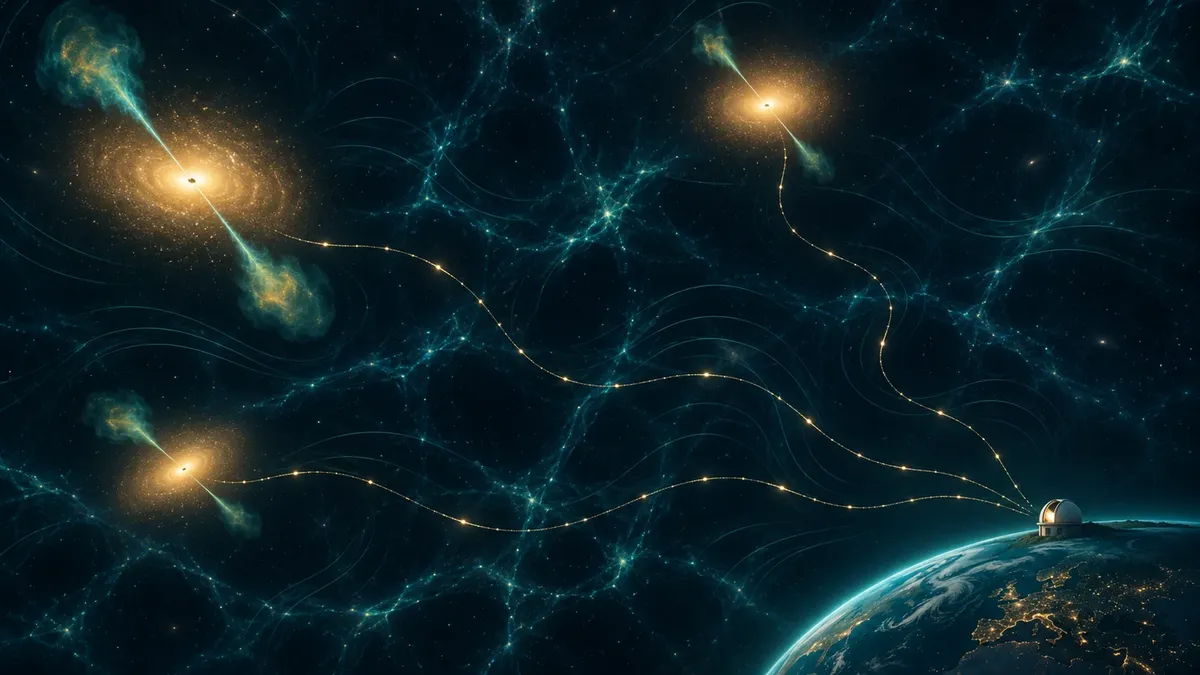
Where do the most energetic particles in nature come from? A source-by-source model finds that three nearby radio galaxies can account for much of the highest-energy cosmic-ray spectrum over selected fit ranges. The result is conditional: the simulations omit magnetic fields, and the model is not fitted to every measured property of the particles.
Ultra-high-energy cosmic rays arrive at Earth with energies above roughly 10¹⁸ electronvolts. Their sources remain uncertain. Because the particles are charged, magnetic fields can bend their paths and make it harder to trace them back to their origin. The study discussed here does not simulate those magnetic deflections; it leaves them out to examine source energetics and spectra under simplified propagation assumptions.
Andressa Colaço and colleagues ask whether three nearby Fanaroff–Riley Class I radio galaxies—Centaurus A, Virgo A and Fornax A—could account for much of the highest-energy cosmic-ray flux measured by the Pierre Auger Observatory. They model the three galaxies individually and add the combined contribution of more distant radio galaxies as a background.
From jet models to cosmic-ray measurements
The researchers combine acceleration spectra based on jet models with computer simulations of cosmic rays travelling through space. The simulations use CRPropa and a one-dimensional geometry without magnetic fields. They include interactions with the cosmic microwave background and extragalactic background light: photo-pion production, photo-pair production and the breakup of nuclei, as well as nuclear decay and energy losses from cosmic expansion.
The team fits the model to Auger’s measured energy spectrum, varying the relative contributions of the three nearby sources and the distant background. The fits cover different energy ranges, depending on the scenario. The researchers use the spectrum alone to set the model parameters. They then compare the predicted mix of particle masses with composition measurements as a separate check; composition is not used to tune the fit.
That distinction matters. Matching the spectrum does not automatically explain cosmic rays’ composition or arrival directions. Those provide additional tests, not evidence built into the fitting procedure.
Results vary by scenario
Across the scenarios examined, the fitted spectrum can be described largely by nearby galaxies, with the distant background contributing no more than about 20 percent within the relevant fit ranges. The exact fractions depend on the assumed shape of the injected spectrum and on which energy range is fitted. Centaurus A contributes substantially in every scenario. Fornax A is important in several; Virgo A’s fitted contribution is consistent with zero in most scenarios, but is larger in another. The paper also notes that some scenarios fit the data less accurately than others.
These results do not establish a definitive ranking of the galaxies or identify the sources of individual detected particles. The fit describes the overall spectrum under the model’s assumptions. In particular, the reported source fractions are effective contributions at Earth in a calculation without magnetic fields—not precise measurements of each galaxy’s intrinsic cosmic-ray output.
The study checks the resulting mass-composition trends after fitting. Some scenarios are broadly consistent with measurements at the highest energies. A solar-like composition did not fit the spectrum well in the tested scenarios, so the authors use a Wolf–Rayet-inspired composition for their remaining results. This is an assumption for those calculations, not proof that the galaxies emit that composition. In the model, it is rich in helium and nitrogen and contains negligible protons.
What the efficiency estimate means
The paper reports fitted normalization values typically around 10⁻³ to 10⁻². These should not be read as direct measurements of the fraction of jet power converted into cosmic rays. The authors describe the parameter as an effective normalization: jet powers are estimated indirectly, sources can vary over time, and magnetic fields could alter the flux reaching Earth. The number therefore reflects the model and its uncertainties as well as the connection between estimated jet power and observed flux.
Other simplifying choices matter too. The model assumes steady emission, although particles arriving now may reflect past activity. The authors suggest that Fornax A’s past activity or delays in its radio lobes could help explain its fitted contribution, but the analysis does not establish either explanation. A more complete treatment would need to model magnetic fields and time-dependent sources, among other factors.
The researchers also calculate secondary neutrinos produced as cosmic rays interact with background radiation. For the local-source scenarios discussed with the assumed Wolf–Rayet composition, the predicted flux is reported to be three to four orders of magnitude below the sensitivities of future experiments. Scenarios that include distant sources can predict higher fluxes. These are model-dependent predictions, not detections; the paper notes that neutrino estimates depend strongly on composition and assumptions about the distant population.
The study offers a physically motivated way to test individual radio galaxies against cosmic-ray data. Its conclusion is limited but useful: nearby radio galaxies can reproduce the measured highest-energy spectrum over specified ranges in some model scenarios. Whether they are the actual sources—and how much each contributes—requires further tests, including propagation models with magnetic fields, fits that use composition data and analyses of arrival directions.
The paper’s version note says it was accepted after peer review, while also stating that this is not the final version of record and may not include later corrections or improvements. That publication-status statement is reported here as the authors’ note. The authors say their data and code are available from the corresponding author on reasonable request.
- ultra-high-energy cosmic rays
- radio galaxies
- Centaurus A
- Fornax A
- Virgo A
- Pierre Auger Observatory
- cosmic-ray propagation
- astrophysics
Reviewed cross-references
These connections were reviewed by a model, not independently fact-checked by a human. Similarity does not imply agreement; consult the original papers and the evidence below.
Auger searches cosmic-ray directions for patterns at different scales
Supporting evidence: Colaço et al. find Centaurus A is a major contributor in their viable spectrum-fit scenarios; the Pierre Auger Collaboration analysis reports an intermediate-scale overdensity in the Centaurus region above 32 EeV. This is tentative, geographically compatible evidence for considering nearby sources in that region, not identification of Centaurus A as the excess’s source. The model uses one-dimensional propagation without magnetic fields, which its authors say may alter inferred source contributions; the studies use different analyses, and both are preprints based here on selected excerpts.
Model review: · openai-codex/gpt-6-luna
Evidence and provenance
Selected excerpts, not complete papers. PDF extraction can omit figures or damage equations, tables and reading order; sources may be preprints.
2602.23458v2 — Original paper
Excerpt reference:
static/papers/2602.23458v2.md:1700-1777
Basis: Paper text
Source SHA-256:2bc557fdb9975f168a1fed6c412c6e0a0e14f5ca5f57ab74b70de0135053987d2602.23458v2 — Original paper
Excerpt reference:
static/papers/2602.23458v2.md:126-181
Basis: Paper text
Source SHA-256:2bc557fdb9975f168a1fed6c412c6e0a0e14f5ca5f57ab74b70de0135053987d2611.14233v1 — Original paper
Excerpt reference:
static/papers/2611.14233v1.md:855-941
Basis: Paper text
Source SHA-256:5400a4fa2403ea024aedb81a3aab0b8bdeeef6ee49464999559bcde62fbafc38
Related reading
Automatically matched by shared topic keywords. These links do not imply that the sources agree or establish a consensus.
Auger searches cosmic-ray directions for patterns at different scales
Source published
Shared keywords: pierre auger observatory, ultra high energy cosmic rays
Why ultra-high-energy cosmic rays may need metal-rich sources
Source published
Shared keywords: pierre auger observatory, ultra high energy cosmic rays
Radio galaxies offer an independent test of cosmic birefringence
Source published
Shared keywords: radio galaxies
Reading the first moment of a cosmic-ray shower
Source published
Shared keywords: ultra high energy cosmic rays
How Gas and Radio Structures Relate in 3C Galaxies
Source published
Shared keywords: radio galaxies