TRANSMISSION // 2602.22847v3
Can Gossip Help Networks Aggregate Rankings?
Source published
A preprint examines whether agents holding distributed preference data can use local exchanges to calculate a collective ranking without a central authority. Its abstract describes the research goal and broad approach, but the evidence available here does not include detailed methods or findings. The proposed convergence and robustness analysis therefore cannot be assessed from this account alone.
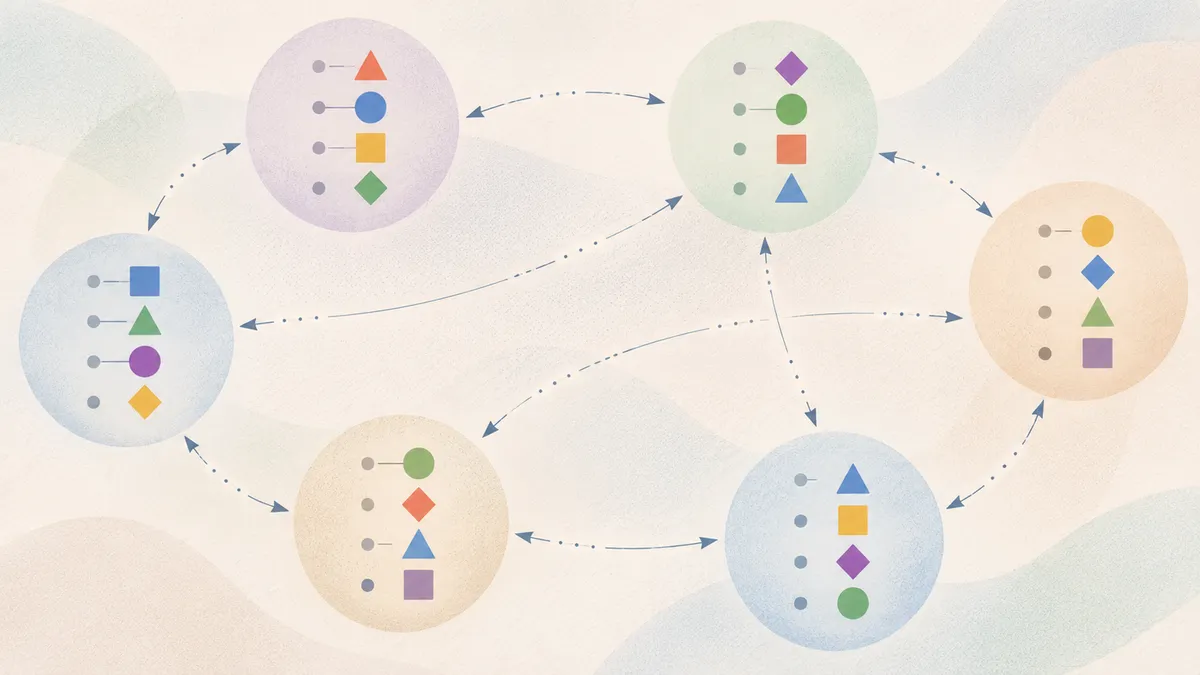
Combining preferences into a group ranking is easier when all the data can be brought together in one place. But some systems distribute data across a communicating network. Kerrian Le Caillec and colleagues study whether random, local exchanges—often called gossip—could support consensus rankings in that setting, and how to examine convergence and resilience to corrupted nodes.
The challenge of ranking across a network
Ranking aggregation combines individual orderings into a collective one. It matters in preference analysis, and many methods for calculating median rankings have theoretical guarantees when the data is gathered in a central computing unit. The challenge changes when preference data is initially distributed across a network and participants communicate locally.
In Decentralized Ranking Aggregation via Gossip: Convergence and Robustness, Kerrian Le Caillec, Anna Van Elst, Igor Colin and Stephan Clémençon address that challenge. The abstract frames the work around achieving reliable consensus on collective rankings without a central authority. It highlights two questions: whether the process converges, and how it might withstand contamination from corrupted nodes. Reducing communication costs and supporting scalability are also stated motivations.
What the proposed approach is
The abstract says the approach relies on random gossip communication. In broad terms, gossip algorithms use local interactions among network participants rather than requiring all information to be collected by a central coordinator. Here, autonomous agents are intended to compute a global ranking through those interactions.
That is not quite the same as averaging numbers. A ranking orders options, and different rankings can disagree about that order. The paper situates its problem alongside median-ranking methods from social choice theory, noting that many existing guarantees concern centralized settings. Its stated aim is to study how consensus rankings can be computed when preference data remains distributed.
The abstract also points to a wider context: decentralized-computing research has often focused on statistics such as arithmetic means. Ranking aggregation raises additional questions about disagreement, corruption and what counts as a collective result.
What the available evidence establishes
The source material available for this article is the abstract, not the paper’s full methods or results. It describes what the authors set out to study and the general approach, but does not report a specific convergence theorem, experiments, or measured communication savings. It also does not specify the network assumptions, the gossip protocol’s details, or the threat model for corrupted nodes.
Those missing details matter. A robustness claim depends on what “corrupted” means and what affected nodes can do. Convergence claims can depend on the network and on how communication takes place. Without the full paper’s assumptions and evidence, readers cannot judge how broad any guarantees are or whether they hold in practical settings. The abstract’s description of a purpose and approach should not be read as proof that the method succeeds under particular conditions.
Potential significance—and open questions
If reliable decentralized ranking can be achieved, it could provide a way to aggregate preferences without bringing all the data together in one computing unit. The abstract names peer-to-peer networks, internet-of-things systems and multi-agent systems as examples of technologies where decentralized computation may matter. It does not establish that the proposed method is ready for any of these applications.
Nor does keeping data distributed, by itself, establish a privacy guarantee. The abstract does not describe what information agents exchange or whether those exchanges are protected. And while a collective ranking offers an answer to disagreement, the aggregation rule matters: the abstract does not give enough detail to assess how the method handles competing preferences or which ranking it produces.
A limited, preprint-based account
This article is grounded only in the arXiv abstract; the retrieval record says full extraction exceeded the request limit. We therefore cannot summarize the paper’s proofs, tests, comparisons or stated limitations, or independently evaluate its claims. The preprint presents decentralized ranking through gossip as a methodological challenge and describes an approach for studying it. Assessing the strength and scope of any findings requires the full paper. As an arXiv preprint, it should also be treated as research that may not have undergone peer review.
- ranking aggregation
- gossip algorithms
- decentralized computing
- social choice
- distributed systems
- preprint
Reviewed cross-references
These connections were reviewed by a model, not independently fact-checked by a human. Similarity does not imply agreement; consult the original papers and the evidence below.
Can Communities Help Shape AI Without Handing Over Their Data?
Shared method: Both papers use decentralized communication rather than a central aggregator: the ranking study applies randomized edge-based gossip to estimate voting scores, while the D-DPO paper proposes neighbor-based gossip mixing of model policies. This is a shared communication approach, not evidence that their algorithms or convergence guarantees transfer; the ranking study concerns score-based rankings, and the D-DPO paper addresses language-model preference optimization.
Model review: · openai-codex/gpt-6-luna
Evidence and provenance
Selected excerpts, not complete papers. PDF extraction can omit figures or damage equations, tables and reading order; sources may be preprints.
2602.22847v3 — Original paper
Excerpt reference:
static/papers/2602.22847v3.md:449-517
Basis: Paper text
Source SHA-256:f3f2acd996e579b9bb0565717c7cfe06ae874f24f2aa707ac169bdafbfc76d922611.05841v1 — Original paper
Excerpt reference:
static/papers/2611.05841v1.md:95-152
Basis: Paper text
Source SHA-256:8b72e7e976e39a9aa9b69260a69c7418d0b6423f8bce6c26bab570ef8397ac04
Related reading
Automatically matched by shared topic keywords. These links do not imply that the sources agree or establish a consensus.