TRANSMISSION // 2602.22567v3
A Raman amplifier uses feedback to quiet its own quantum noise
Source published
An atomic Raman amplifier recycles part of its Stokes-light output to create correlations that reduce amplification noise. The experiment reports up to 6 dB noise reduction and improved phase-signal readout at matched sensing intensity.
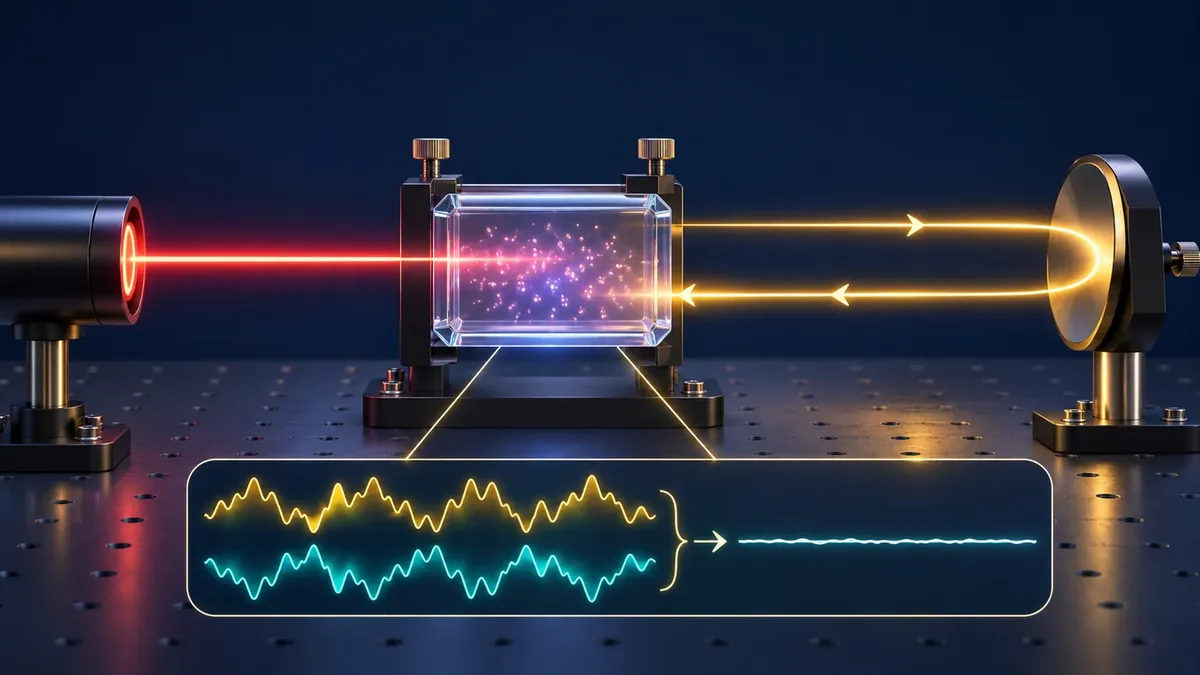
Amplifiers make faint signals easier to detect, but quantum physics sets a cost: amplification also adds noise. Jianmin Wang, Rong Zhu and Z. Y. Ou report an experiment that uses a Raman amplifier’s own output to create correlations with the atoms inside it, reducing that added noise. The work is described in an arXiv preprint, so its findings should be regarded as research not yet necessarily peer reviewed.
Amplifying a weak signal sounds straightforward: make it larger, then measure it. But an amplifier can also amplify fluctuations and add noise of its own. In quantum devices, some of that extra noise comes from internal degrees of freedom that participate in producing the gain. The challenge is to reduce those fluctuations without making the setup more complicated or relying on delicate correlations prepared elsewhere.
Jianmin Wang, Rong Zhu and Z. Y. Ou explore that challenge in a Raman amplifier, where light interacts with an ensemble of rubidium atoms. Their question is whether the amplifier can use correlations it creates internally to suppress its own added quantum noise—and whether that reduction can help detect a small phase change in a light signal.
Recycling light to create correlations
In this setup, a pump beam drives a Raman process in the atoms, producing Stokes light and a collective atomic excitation called a spin wave. The spin wave acts as an internal mode of the amplifier. Ordinarily, fluctuations associated with that mode contribute to the output noise.
The researchers split off part of the Stokes-light output and send it back into the same atomic ensemble. Because the light and atomic spin wave are correlated through the Raman process, feeding the light back lets those correlations influence a later stage of amplification. The aim is destructive interference between fluctuations: their contributions can partly cancel rather than simply add.
The experiment used a heated cell of rubidium-87 atoms. The team measured the light’s noise using balanced homodyne detection, which compares the signal with a reference light field to measure a chosen property, or quadrature, of the output. They varied the feedback phase, the fraction of light returned, and the feedback loss. For a separate sensing test, they encoded a small phase signal in the feedback loop and compared signal-to-noise ratios (SNRs) with and without feedback at matched sensing intensity.
What the experiment reports
With feedback, the authors observed a maximum 6 decibels (dB) reduction in amplified quantum noise. The amount depended on the operating conditions, including amplifier gain and feedback settings; 6 dB is the reported maximum, not a reduction guaranteed in every configuration. Their measurements also show that feedback loss does not necessarily erase the noise reduction: at one tested setting, the authors report that reduction remained 3 dB with loss of 6 dB. Their theoretical analysis predicts that, at high gain, the noise reduction becomes insensitive to feedback loss under the conditions considered.
The feedback phase matters. The returning light interferes with the field in the amplifier, so changing the phase changes the output response. In a phase-sensing test, the researchers compared feedback and no-feedback cases at the same sensing intensity. They report an SNR improvement of 4.4 ± 0.7 dB with feedback. Matching intensity is important here: feedback changes the sensing field as well as the noise, so comparing unmatched signals would not isolate the effect on readout performance.
The paper’s abstract also describes the phase signal as encoded in the feedback loop. This is a specific laboratory demonstration, not evidence that the approach improves every kind of measurement or amplifier. The authors suggest that the general idea may be extendable to integrated optics and fiber-optic systems, but those applications are prospects rather than results demonstrated in this experiment.
What remains uncertain
The reported loss-insensitivity applies to the high-gain regime and feedback arrangement studied; it should not be read as saying that optical loss is harmless in general. The experiment also reveals a practical trade-off: phase-sensitive interference means the feedback phase must be controlled, and the feedback fraction affects the operating point. The work demonstrates performance in a particular atomic Raman amplifier, not a finished sensing instrument or a universal replacement for other noise-reduction methods.
This account is based on the paper text supplied for arXiv:2602.22567v3. The paper is a preprint, and the evidence available here does not establish whether this version has undergone peer review. Results and interpretations may change with further scrutiny. The authors report theoretical analysis and experimental measurements, but broader claims about deployment in other platforms remain to be tested.
- quantum noise
- Raman amplifier
- coherent feedback
- atomic spin waves
- quantum sensing
- signal-to-noise ratio
Reviewed cross-references
These connections were reviewed by a model, not independently fact-checked by a human. Similarity does not imply agreement; consult the original papers and the evidence below.
Two microwave tones sharpen a quantum sensor in boron nitride
Supporting evidence: Both studies report improved signal-to-noise in quantum-sensing demonstrations: the Raman-amplifier study reports a 4.4 ± 0.7 dB improvement for a phase signal at matched sensing intensity, while the hBN study reports a 2.6-fold improvement in AC magnetometry under its stated comparison. These results support only the bounded point that different, platform-specific protocols can improve measured sensing SNR; they do not establish a shared mechanism or directly comparable performance.
Model review: · openai-codex/gpt-6-luna
Evidence and provenance
Selected excerpts, not complete papers. PDF extraction can omit figures or damage equations, tables and reading order; sources may be preprints.
2602.22567v3 — Original paper
Excerpt reference:
static/papers/2602.22567v3.md:1227-1339
Basis: Paper text
Source SHA-256:9fe45cd16d9d653dce4b187581fc415f735781c03dc5b9d75162d471e373438f2611.13447v1 — Original paper
Excerpt reference:
static/papers/2611.13447v1.md:12-63
Basis: Paper text
Source SHA-256:7743cb9ee8a5d8f0cecccc9ac68c42378a24284df8d6afa56f8e0d7f477eeb15
Related reading
Automatically matched by shared topic keywords. These links do not imply that the sources agree or establish a consensus.
Could Rydberg atoms detect atmospheric signals at 4.7 THz?
Source published
Shared keywords: quantum sensing
Two microwave tones sharpen a quantum sensor in boron nitride
Source published
Shared keywords: quantum sensing
Why an optically transparent medium can still carry quantum noise
Source published
Shared keywords: quantum noise
Quantum sensing algorithms target specific spectroscopy questions
Source published
Shared keywords: quantum sensing
A promising quantum optimization strategy loses its edge when noise enters
Source published
Shared keywords: quantum noise