TRANSMISSION // 2602.16651v2
Can 21-cm maps trace reionization’s changing pattern?
Source published
Simulations test whether the Largest Cluster Statistic distinguishes reionization scenarios in evolving 21-cm maps—and how observing conditions affect the inferred transition.
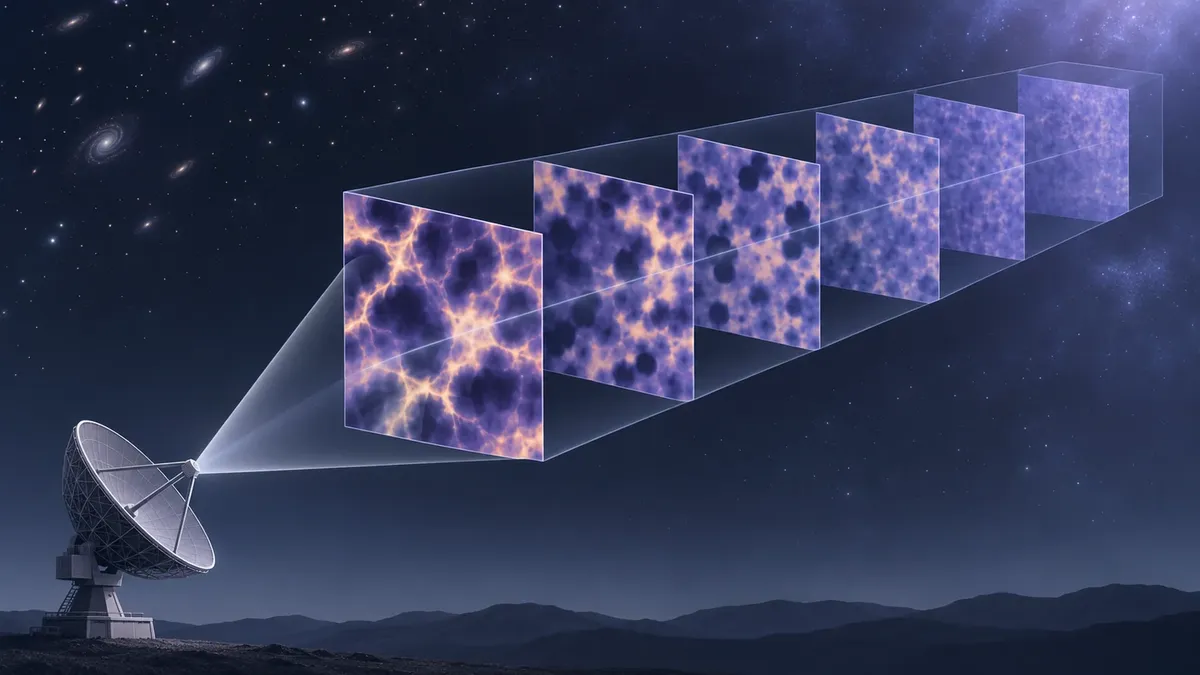
The early Universe’s shift from mostly neutral hydrogen to ionized gas left patterns that scientists hope to study with redshifted 21-cm signals. This work tests a way to track those patterns in simulated maps while accounting for the fact that a deep view spans different cosmic times.
The Epoch of Reionization was a period when the intergalactic medium changed from mostly neutral to ionized. Redshifted 21-cm emission from neutral hydrogen could help researchers investigate this history and the ionized regions that developed during it. But a map looking across great distances also looks back across time: its different parts can represent different stages of reionization. This variation along the line of sight is called the lightcone effect.
The study asks whether a statistic based on connected regions can help distinguish simulated reionization scenarios when this time evolution is included. It is the third paper in a series on interpreting hydrogen 21-cm cosmology maps. The evidence available for this article is the paper’s abstract, so details not included there cannot be independently examined here.
Tracking a connected region
A common way to summarize a fluctuating signal is the power spectrum, which describes fluctuation strength at different length scales. The abstract notes a limitation: Fourier statistics such as the power spectrum do not preserve phase information. An image-domain analysis can retain morphological information—the spatial patterns in a map—and its non-Gaussian characteristics.
The authors use the Largest Cluster Statistic (LCS) to study percolation. In this context, percolation means that multiple ionized regions coalesce into one contiguous region spanning the universe. The abstract says its onset is marked by a sharp rise in LCS as the statistic approaches unity. It does not provide a more detailed definition or normalization of LCS, so the statistic should not be interpreted here as a specific fraction of the map occupied by the largest region.
The team estimates LCS in subvolumes of different sizes in mock SKA-Low 21-cm lightcone maps. They follow its redshift evolution across several simulated reionization scenarios using a moving-volume approach. They also investigate how the inferred transition depends on the synthesized beam width and percentage gain calibration error. The abstract does not specify the simulation setup, scenario definitions, or tested instrumental values.
Volume size and observing conditions matter
The authors report that the moving-volume size that best reproduces the percolation transition from coeval maps—maps representing a single cosmic time—varies across reionization scenarios. Thus, the abstract does not point to one optimal volume size that works for every scenario. It also reports that LCS evolution remains distinct across the scenarios for a fixed moving-volume bandwidth.
The inferred percolation transition strongly depends on synthesized beam width and percentage gain calibration error. The authors describe it as tractable for an optimistic SKA-Low observational setup. That is a qualified result: the abstract does not establish how well the method performs across a wider range of conditions, nor does it give a detection threshold or numerical measure of the differences between scenarios.
What can be concluded
These findings concern simulated maps and an analysis method. They indicate that lightcone LCS evolution can differ among the scenarios studied, while the moving-volume size that reproduces the coeval-map transition is scenario-dependent. They do not identify which simulated history matches the real Universe or establish a detection from telescope data. The reported sensitivity to observing parameters also means the inferred transition depends on the assumed observational setup; the abstract does not explain the mechanism or say specifically how timing or sharpness changes.
This article is based on the abstract of an arXiv preprint. The supplied material does not establish whether the work has undergone peer review. Because the full paper was not available here, we cannot assess its detailed methods, uncertainties, assumptions, or instrumental tests. The results are best understood as a reported simulation study, rather than as confirmed observational evidence or a consensus conclusion.
- cosmic reionization
- 21-cm cosmology
- Largest Cluster Statistic
- percolation
- lightcone effect
- SKA-Low
Related reading
Automatically matched by shared topic keywords. These links do not imply that the sources agree or establish a consensus.
Could ancient magnetic fields have brought forward cosmic reionization?
Source published
Shared keywords: cosmic reionization
Which exoplanets could the SKA hear? A radio forecast with important caveats
Source published
Shared keywords: ska low
Small, bright galaxies offer a closer look at early star-forming systems
Source published
Shared keywords: cosmic reionization