TRANSMISSION // 2602.13385v3
A Faster Way to Follow Stars Escaping a Globular Cluster
Source published
A new simulation code aims to capture how a globular cluster’s internal dynamics shape its tidal stream without the full cost of tracking every star directly. In the abstract, KRIOS is reported to reproduce direct N-body cluster models and their streams more accurately than particle-spray methods, while running in a fraction of the time of the comparison code. The results also suggest that disagreements between methods are strongest on orbits where the cluster is tightly bound to its host galaxy.
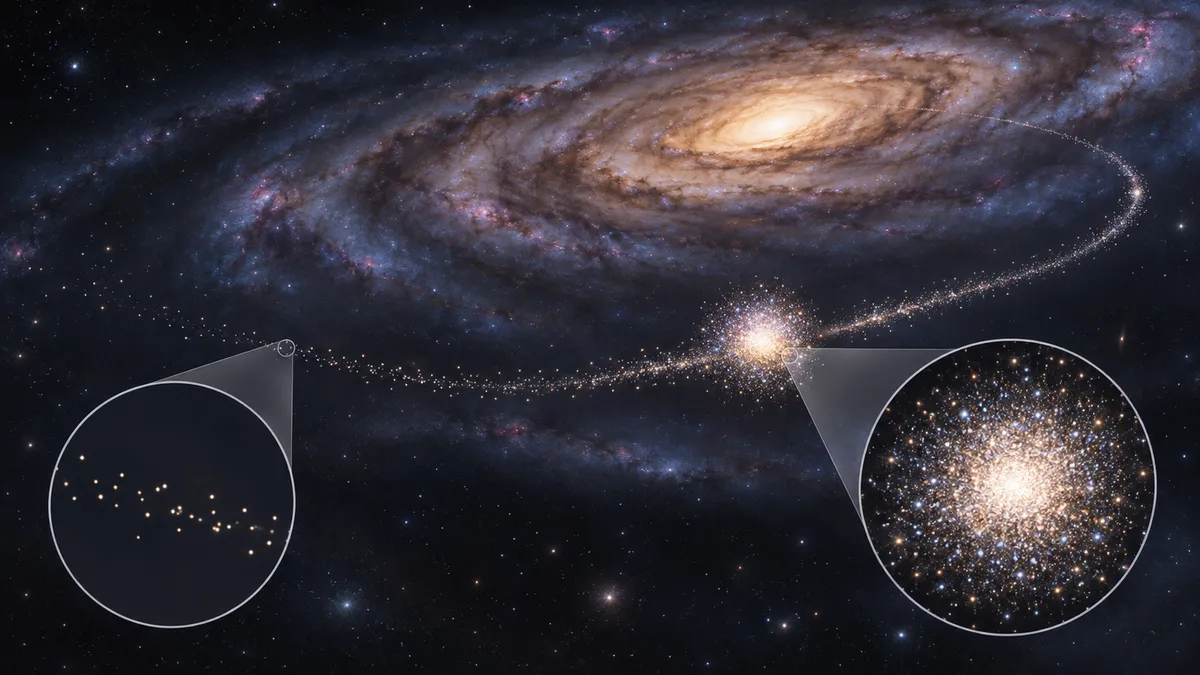
Long ribbons of stars can trail globular clusters as a galaxy’s gravity pulls stars away. These stellar streams offer clues to how galaxies formed and may help researchers investigate the distribution of dark matter. But predicting a stream is a computational balancing act: simplified models are fast, while detailed simulations can be costly.
A globular cluster is a dense collection of stars bound together by gravity. As it travels around a galaxy, the galaxy’s tidal forces can draw stars out of the cluster, stretching them into a stream. The stream’s shape and motions reflect both the cluster’s orbit and the process by which its stars escaped. That makes a stream a potential record of its surroundings—but only if simulations model its formation well enough.
The new study presents stream-modelling capabilities for KRIOS, a basis-expansion N-body code designed for collisional stellar dynamics. Its authors frame the problem as a trade-off between two common approaches. Particle-spray models release stars according to simplified assumptions about escape, rather than following the cluster’s internal dynamics in detail. Direct N-body simulations, which calculate the gravitational interactions of individual particles, can represent those dynamics but become prohibitively expensive for realistic systems with more than 100,000 particles.
KRIOS is intended to bridge that gap: retain more of the cluster’s internal physics than a particle-spray method while costing less than a direct calculation. The paper’s abstract reports two tests. First, the researchers compared KRIOS with models from NBODY6++GPU, a direct N-body code. They report that KRIOS reproduced those cluster models and their associated streams more accurately than particle spray, using a fraction of NBODY6++GPU’s wall-clock time. The abstract does not provide the size of that time saving or a numerical measure of the accuracy difference.
Next, the team compared KRIOS with several particle-spray methods on ten orbits chosen to resemble those of known Milky Way streams. The reported differences in stream shape and motion were greatest when the cluster was tightly bound to its host galaxy. Such systems are often exposed to stronger tidal forces, which can make details of how stars escape more important to the stream’s predicted properties.
This points to a practical lesson for modelling: a simplified escape prescription may be less adequate in some environments than others. The authors also discuss which aspects of the cluster’s internal physics matter most for predicting streams, and how those ingredients might be incorporated into particle-spray methods. The abstract does not list the specific ingredients, so it cannot establish which ones are most influential or how much each changes a prediction.
The work is a comparison of numerical models, not a direct measurement of dark matter or a demonstration that any particular stream reveals it. Better stream predictions could support future efforts to interpret observations, but the abstract alone does not show that KRIOS has improved constraints on the Milky Way’s dark matter distribution. Nor does it establish that the reported performance will hold for every cluster, orbit or modelling setup.
There are important limits to what can be assessed here. This account is based on the paper’s abstract because the full paper text was not available in the supplied source material. Details such as the exact simulated cluster properties, the accuracy metrics, computational hardware and sensitivity tests are therefore not reported. The work is an arXiv preprint; its publication and peer-review status are not established by the available material. The results are best read as a promising code comparison, not a final verdict on which stream-modelling method is best in all circumstances.
- globular clusters
- stellar streams
- N-body simulations
- KRIOS
- Milky Way
- computational astrophysics
Reviewed cross-references
These connections were reviewed by a model, not independently fact-checked by a human. Similarity does not imply agreement; consult the original papers and the evidence below.
Could nearby star clusters have helped populate the Milky Way’s crowded centre?
Shared method: Both studies use N-body simulations to model globular-cluster dynamics, but with different implementations and aims: Cook et al. describe KRIOS, a basis-expansion code with effective relaxation, and compare its stream models with NBODY6++GPU; Kalambay et al. use direct N-body simulations of three Terzan clusters to study stellar capture by the nuclear star cluster. This is a broad methodological connection, not a like-for-like comparison of results.
Model review: · openai-codex/gpt-6-luna
Evidence and provenance
Selected excerpts, not complete papers. PDF extraction can omit figures or damage equations, tables and reading order; sources may be preprints.
2602.13385v3 — Original paper
Excerpt reference:
static/papers/2602.13385v3.md:224-313
Basis: Paper text
Source SHA-256:630e111e19b45eca7172b2b90075d03782de9b99c9f647548574d577b3d76c3a2602.13385v3 — Original paper
Excerpt reference:
static/papers/2602.13385v3.md:1898-1960
Basis: Paper text
Source SHA-256:630e111e19b45eca7172b2b90075d03782de9b99c9f647548574d577b3d76c3a2611.12046v1 — Original paper
Excerpt reference:
static/papers/2611.12046v1.md:30-82
Basis: Paper text
Source SHA-256:633f44bab94c3dd82cf69dc2e144778feddc3f73002a1f5e23f53ab374fd28af
Related reading
Automatically matched by shared topic keywords. These links do not imply that the sources agree or establish a consensus.
A billion-star search maps the Milky Way’s nested structures
Source published
Shared keywords: milky way, stellar streams
Could nearby star clusters have helped populate the Milky Way’s crowded centre?
Source published
Shared keywords: globular clusters, milky way, n body simulations
A Proposed Infrared Instrument Could Trace the Milky Way’s History
Source published
Shared keywords: milky way, stellar streams
Aster brings flexible tools to simulations of gravitational systems
Source published
Shared keywords: computational astrophysics, n body simulations
How Decaying Dark Matter Could Puff Up a Galactic Halo
Source published
Shared keywords: computational astrophysics