TRANSMISSION // 2602.10065v2
DES cosmic shear sharpens a view of matter
Source published
Six years of Dark Energy Survey imaging yield a precise cosmic-shear measurement. The inferred matter-clustering value is consistent with several cosmic microwave background results within the uncertainties, but depends in part on how galaxy alignments and small-scale physics are modeled.
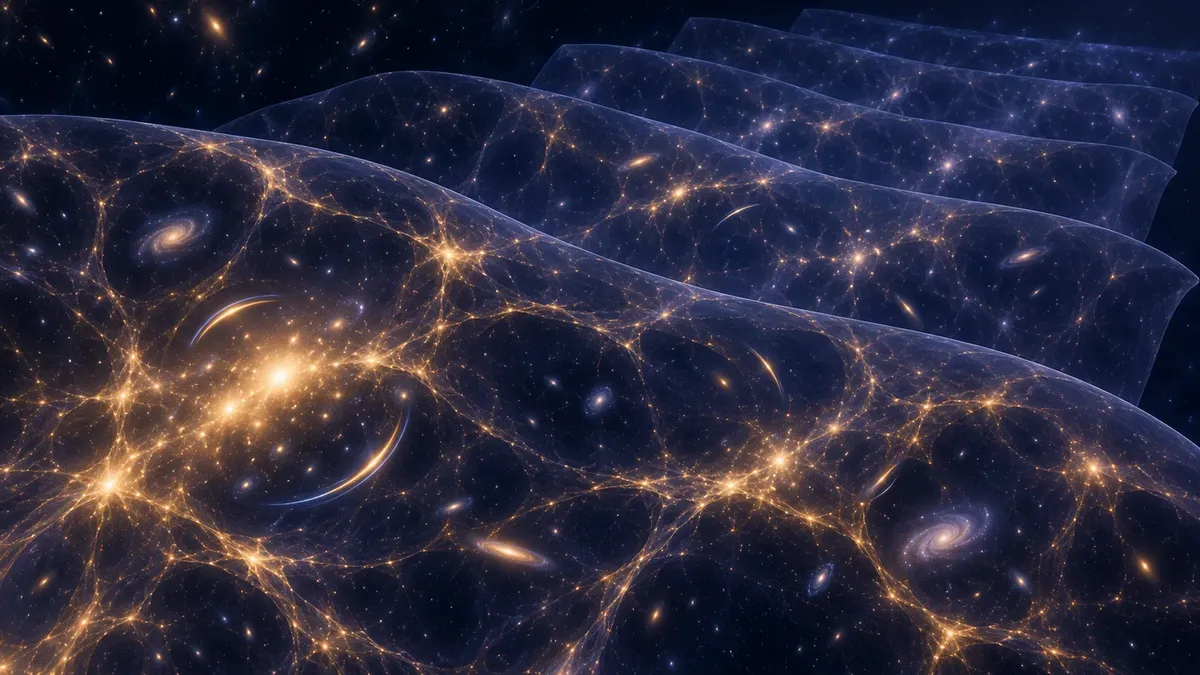
How strongly is matter clustered across the universe? The Dark Energy Survey’s Year 6 cosmic-shear analysis uses tiny distortions in distant galaxy shapes to estimate this quantity while accounting for important modeling uncertainties.
Reading the universe in galaxy shapes
Gravity bends light on its way to us. Matter along the line of sight very slightly distorts the apparent shapes of distant galaxies. By measuring patterns in those distortions across many galaxies, astronomers can infer how matter is distributed and how strongly it clusters. This technique is called cosmic shear.
The Dark Energy Survey (DES) team reports a cosmic-shear analysis using six years of imaging data. The study asks how well these observations constrain matter clustering within the standard cosmological model, and how the resulting constraints compare with estimates from the cosmic microwave background (CMB), relic light from the early universe.
How the measurement was made
The analysis uses shape measurements for about 140 million galaxies, divided into four bins by estimated distance, or redshift. The shear measurement has a reported signal-to-noise ratio of 83—twice that of the Year 3 analysis. This is a comparison of signal-to-noise, not a doubling of the galaxy count or of cosmological precision.
Turning galaxy shapes into cosmological parameters requires accounting for uncertainties in measured shear and galaxy distances. Researchers must also model intrinsic alignments: galaxies can have related shapes for reasons other than lensing. The team tests two prescriptions, called NLA and TATT. It also excludes measurements at small angular scales, where effects from ordinary matter inside and around galaxies, known as baryonic feedback, and other uncertainties are harder to model reliably.
The team conducted a blind analysis within the standard ΛCDM framework. Such an approach is intended to limit the influence of seeing the final answer while analysis choices are being made.
The result—and its dependence on assumptions
A key quantity is S₈, which combines the present-day matter density and the amplitude of matter fluctuations. With the NLA alignment model, the paper reports a marginalized mean of S₈ = 0.798, with a 68% confidence-level range of +0.014 and −0.015. With TATT, it reports 0.783, with a 68% confidence-level range of +0.019 and −0.015. The stated uncertainties are 1.8% and 2.5%, respectively.
The different estimates show that modeling choices matter. The abstract says that choices for intrinsic alignment and baryonic feedback can shift S₈ by as much as 1σ. The NLA result is preferred according to the paper’s Bayesian-evidence comparison; that preference does not remove the model dependence or establish that either prescription perfectly describes galaxies.
Compared with CMB constraints from Planck 2018, ACT DR6 and SPT-3G DR1, the DES results are reported as consistent in the full parameter space at 1.1σ for NLA and 1.7σ for TATT. For S₈ alone, the reported differences are 2.0σ and 2.3σ. These comparisons show some separation in this parameter, but do not establish a decisive disagreement or show that either measurement is wrong.
What remains uncertain
For the team’s fiducial models, excluding small angular scales and accounting for alignment parameters are the main reasons the S₈ constraints are less precise. Removing scales avoids relying on less certain physics, but also leaves some information unused. The abstract reports internal consistency and robustness to different calibration choices, while the difference between the alignment-model results illustrates that assumptions remain consequential.
This article is based on the paper’s abstract, not a full examination of its methods, figures or supplementary checks. The source is an arXiv preprint; the information available here does not establish its peer-review or publication status. The findings should therefore be understood in that limited source context, rather than as a final verdict on cosmology.
- Dark Energy Survey
- cosmic shear
- weak gravitational lensing
- S₈
- cosmology
- intrinsic alignments
Reviewed cross-references
These connections were reviewed by a model, not independently fact-checked by a human. Similarity does not imply agreement; consult the original papers and the evidence below.
DES Year 6 tests the cosmic picture
Shared method: Both analyses use cosmic shear, the correlation of galaxy-shape distortions, as a cosmological probe. The DES Y6 paper analyzes shear alone, while the Y6 3×2pt paper combines it with galaxy clustering and galaxy–galaxy lensing; their constraints therefore are not an apples-to-apples comparison of shear-only results.
Model review: · openai-codex/gpt-6-luna
Evidence and provenance
Selected excerpts, not complete papers. PDF extraction can omit figures or damage equations, tables and reading order; sources may be preprints.
2602.10065v2 — Original paper
Excerpt reference:
static/papers/2602.10065v2.md:212-264
Basis: Paper text
Source SHA-256:89cf16decd73ce531556caad8a7d26480aebab43a895803dc977060e8a2ef38d2601.14559v3 — Original paper
Excerpt reference:
static/papers/2601.14559v3.md:319-371
Basis: Paper text
Source SHA-256:d97066bff28481126b89bdadca63995461cecf06ad0bca1584b4c88bd4e4bbe3
Galaxy Distortions Put Limits on Giant Primordial Black Holes
Shared method: Both studies use cosmic-shear measurements to probe matter, but for different purposes: the DES Y6 analysis constrains ΛCDM parameters, whereas Zu and Kohri use DES Y3 shear data to set limits on a modeled primordial-black-hole contribution. Different data releases and modeling assumptions prevent a direct comparison of their numerical constraints.
Model review: · openai-codex/gpt-6-luna
Evidence and provenance
Selected excerpts, not complete papers. PDF extraction can omit figures or damage equations, tables and reading order; sources may be preprints.
2602.10065v2 — Original paper
Excerpt reference:
static/papers/2602.10065v2.md:212-264
Basis: Paper text
Source SHA-256:89cf16decd73ce531556caad8a7d26480aebab43a895803dc977060e8a2ef38d2611.07574v1 — Original paper
Excerpt reference:
static/papers/2611.07574v1.md:626-725
Basis: Paper text
Source SHA-256:c8565b6c698c323224cd2960478b7362dd33737ced9646d7be757d0de9df9f53
Related reading
Automatically matched by shared topic keywords. These links do not imply that the sources agree or establish a consensus.
Galaxy Distortions Put Limits on Giant Primordial Black Holes
Source published
Shared keywords: cosmic shear, dark energy survey, weak gravitational lensing
DES Year 6 tests the cosmic picture
Source published
Shared keywords: dark energy survey, weak gravitational lensing
How to measure cosmic shear without drawing galaxy shapes
Source published
Shared keywords: cosmic shear, weak gravitational lensing
A late-time dark-matter supply could soften a cosmological trade-off
Source published
Shared keywords: weak gravitational lensing
Can AI read cosmic structure without becoming overconfident?
Source published
Shared keywords: weak gravitational lensing