TRANSMISSION // 2602.09665v3
A Quantum Thermalization ‘Burst’ Can Be Built to Order
Source published
A numerical method creates a timed departure from thermal equilibrium in a model quantum spin chain, using a specially prepared low-entanglement state. The work also finds that such bursts become rare at long times under a separate random-circuit analysis.
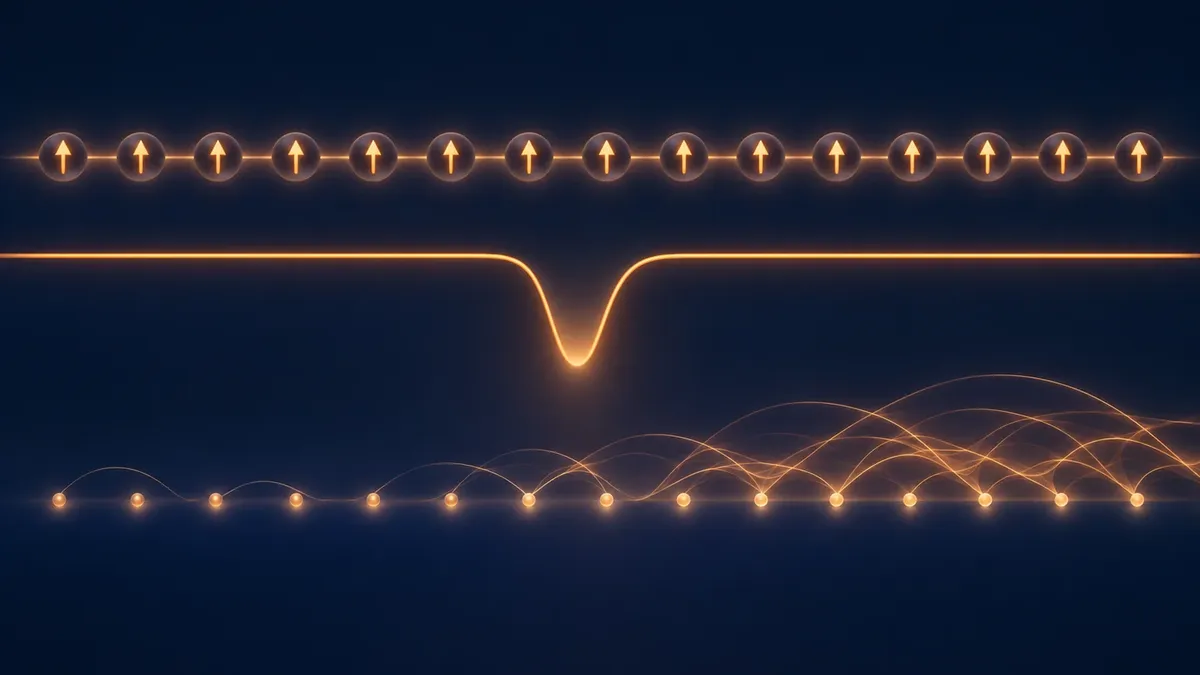
Thermalization need not look like a smooth slide toward equilibrium. In a theoretical study, researchers numerically designed simple initial states that make a quantum spin chain briefly depart from its thermal expectation at a chosen time. The result is a prediction for a model system—not an experimental observation—and its long-time probability estimate relies on a different, random-circuit framework.
In everyday experience, a hot drink cools toward room temperature without suddenly getting hotter again. Quantum systems can behave less smoothly: an observable may move close to its equilibrium value and then briefly veer away. This kind of transient departure is called a burst. A new theoretical study asks whether one can deliberately arrange such a burst in an isolated quantum system, and how long it can persist.
The authors study a one-dimensional mixed-field Ising chain, a model of interacting spin-½ particles. They focus on average magnetization, a measure of the spins’ overall alignment. The chain is nonintegrable in the parameter regime they examine, meaning its dynamics are not captured by the special simplifications of an integrable model. Although the system evolves according to reversible quantum mechanics, its local observables can approach values associated with thermal equilibrium.
Designing an initial state for a chosen time
Rather than start with a typical initial state, Shozo Yamada, Akihiro Hokkyo and Masahito Ueda develop a numerical procedure to construct one suited to a particular task. They represent candidate states as matrix product states, a compact description often used for low-entanglement states in one-dimensional systems. They then use a density matrix renormalization group (DMRG) optimization to find a state that makes the chosen observable differ from its thermal value at a specified future time.
The optimization includes an energy constraint: the researchers seek a large future deviation while keeping the initial state’s energy fluctuations under control. They can vary the target time, the state’s bond dimension (a parameter that limits the amount of entanglement the representation can capture), and the target energy. The study uses numerical time evolution with Trotter steps and truncated matrix-product representations; the authors report checks that truncation errors are small in their setup.
For a chain of 40 spins, the paper illustrates a pronounced dip in average magnetization at a selected time. The example uses a state with bond dimension 10, which the authors describe as low-entangled relative to a typical volume-law state. They also report that the entanglement entropy across half the chain grows slowly, and can decrease, before the burst. This is notable because entanglement growth often accompanies the spreading of quantum information. Here, the specially chosen state temporarily retains features that keep the system’s reduced state away from the thermal one.
In their numerical analysis, the burst remains sizable as system size increases at fixed, short target times, including cases where the initial bond dimension does not grow with system size. The authors also show that an approximate version of the state can be prepared by a shallow circuit of neighboring two-qubit gates; the burst remains, though its amplitude is somewhat reduced. An infinite matrix product state calculation provides evidence that a burst can survive in the thermodynamic limit for the construction examined there.
Why the burst does not last indefinitely
The paper finds that the burst gradually weakens as its target time is pushed later. The authors connect this trend to quantum scrambling: interactions spread information through the system, eventually making the carefully organized state harder to represent with a low bond dimension. They also report faster decay with increasing longitudinal field in the parameter range studied, while noting that the burst’s dependence on Hamiltonian properties is not fully understood.
A separate analytical argument addresses rarity at long times. It considers local random quantum circuits, which approximate certain features of complex dynamics, and bounds the probability of finding a large burst among low-bond-dimension states. Under that framework, the bound becomes very small at sufficiently long times. This is not a direct probability measurement for the specific, energy-conserving Ising-chain dynamics: the paper explicitly notes that extending the argument to circuits with energy conservation remains to be established. The result therefore supports a general long-time limitation under stated assumptions, rather than proving that every physical system loses bursts on the same schedule.
The study is numerical and theoretical, not a demonstration on a quantum processor. Its central message is that thermalization’s finite-time path depends on the initial state: an atypical but relatively simple state may produce a designed, temporary excursion from equilibrium before scrambling takes over. Programmable quantum simulators could test the prediction through quench experiments, in which a prepared state is allowed to evolve under a chosen Hamiltonian. The paper is an arXiv preprint, so its claims should be treated as research in progress rather than as independently validated experimental results.
- quantum thermalization
- quantum many-body physics
- quantum scrambling
- entanglement
- mixed-field Ising chain
- matrix product states
- quantum simulation
Related reading
Automatically matched by shared topic keywords. These links do not imply that the sources agree or establish a consensus.
A shortcut for studying sparse random quantum systems
Source published
Shared keywords: quantum many body physics, quantum simulation
How a Simulated Excitation Moves Through Coupled Cavities
Source published
Shared keywords: matrix product states, quantum simulation
PEPSKit.jl brings iPEPS methods together in Julia
Source published
Shared keywords: quantum many body physics, quantum simulation
A world model reads quantum dynamics to infer hidden interactions
Source published
Shared keywords: quantum many body physics, quantum simulation
When can quantum-state compression preserve an invariant?
Source published
Shared keywords: matrix product states, quantum simulation