TRANSMISSION // 2602.08009v2
A publish-subscribe network for coordinating AI agents
Source published
RAPS lets language-model agents exchange messages according to changing interests, while local reputation checks aim to filter unreliable peers. Its tests are promising, but limited.
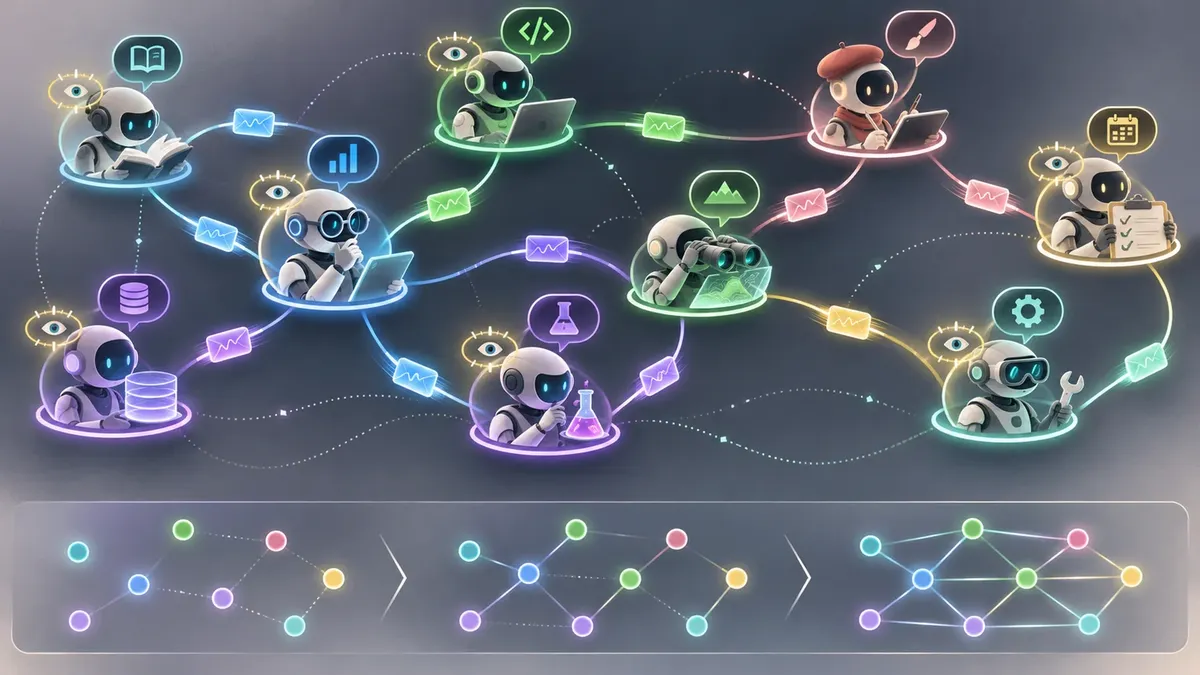
How can a team of AI agents share useful information without relying on a fixed workflow or a single coordinator? A preprint proposes RAPS, a networking-inspired approach that routes messages by their content and adds mechanisms for adapting agent roles and assessing peer reliability.
When several AI agents work on a task, coordination can become a task of its own. A fixed sequence of roles may not suit every question, while a central controller can become a bottleneck or a point of failure. Rui Li and colleagues propose a different approach: let agents exchange messages according to what they say they need, and adjust those interests as work unfolds.
Their framework, called RAPS, borrows from publish-subscribe computer networks. In such a system, a participant subscribes to topics of interest, while messages are published for matching subscribers rather than sent along a predetermined route. In RAPS, an agent’s subscription represents its current intent or role; its publication is a message it has produced. A broker matches the message’s content to agents’ declared interests, creating communication paths as the task develops.
The design adds two mechanisms. Reactive Subscription lets agents refine their stated interests in response to messages they receive. An agent might start with a broad role and then focus on a more specific subproblem. Bayesian Reputation gives each agent a local watchdog that assesses peers using direct observations and, optionally, reports from other agents. The framework is intended to down-rank or stop routing messages from peers judged unreliable, without putting a single central authority in charge.
What the researchers tested
The authors evaluated RAPS on five benchmarks: MMLU for general knowledge and reasoning, GSM8K, SVAMP and AQuA for mathematics, and HumanEval for code generation. They compared it with single-agent approaches and several kinds of multi-agent coordination, including fixed communication structures, methods that optimize workflows in advance, and systems with a central planner. Most multi-agent comparisons used five identically configured agents, according to the paper.
They also varied the number of agents on MMLU to examine scaling, and ran a stress test in which some agents were prompted to give misleading reasoning. An ablation study removed the reactive-subscription and reputation components in turn, to examine their individual contributions. The paper reports that the full RAPS system had the highest average score across its five benchmarks, at 90.0%, and generally outperformed the comparison methods in the reported experiments. The authors also report that removing either overlay reduced scores on the three benchmarks shown in their ablation table.
In the adversarial test, the authors report that RAPS retained higher MMLU accuracy than the listed alternatives as misleading agents were added to the pool. This is evidence for performance in that particular setup, not proof that the reputation mechanism can identify every form of deception. The attack was constructed by changing agents’ prompts, and the watchdog’s judgments also depend on language-model evaluation.
What the results do—and do not—show
The central idea is a change in how agents are connected: instead of deciding every communication link in advance, route messages according to their content and current subscriptions. That could make a workflow more flexible when the task changes. But the experiments do not establish that this approach will work equally well in other models, tasks, or real-world settings. The paper’s benchmark suite is specific, and its main experiments use one closed-source commercial language model as the backbone for agent functions. The results therefore cannot tell us how performance varies across a broad range of models.
The authors also identify a cold-start problem. At the beginning, watchdogs have little evidence about peers, so the system may be temporarily more exposed to unreliable messages. More fundamentally, RAPS changes information flow; it does not improve the underlying model’s reasoning ability. Poor answers from the model can still limit the whole team.
The source is an arXiv preprint, not evidence here of peer-reviewed publication. Its reported experiments are the authors’ own results, and benchmark scores should be read in light of the chosen datasets, model and test design. The available paper text also has extraction problems in some tables and figures, so this account avoids reconstructing details that are unclear. Independent replication and evaluation under varied conditions would help clarify how dependable the approach is beyond these tests.
- large language models
- AI agents
- multi-agent coordination
- publish-subscribe
- Bayesian reputation
- RAPS
Related reading
Automatically matched by shared topic keywords. These links do not imply that the sources agree or establish a consensus.
Why AI agents still struggle to work as a team
Source published
Shared keywords: ai agents, large language models, multi agent coordination
Why AI Agents Still Stumble on Complex Tasks
Source published
Shared keywords: ai agents, large language models
A shared task board for AI agents that need to wait
Source published
Shared keywords: ai agents, multi agent coordination
What Does Category Theory Say About AI Agents?
Source published
Shared keywords: ai agents, multi agent coordination
When Coding Agents Work Alone, Their Changes Can Clash
Source published
Shared keywords: multi agent coordination