TRANSMISSION // 2602.06109v2
A hybrid approach to calibrating radio arrays
Source published
CorrCal combines sky-based and redundant calibration in a covariance-based method. Its authors report unbiased calibration errors far below typical thermal-noise thresholds across tested modeling-error scenarios.
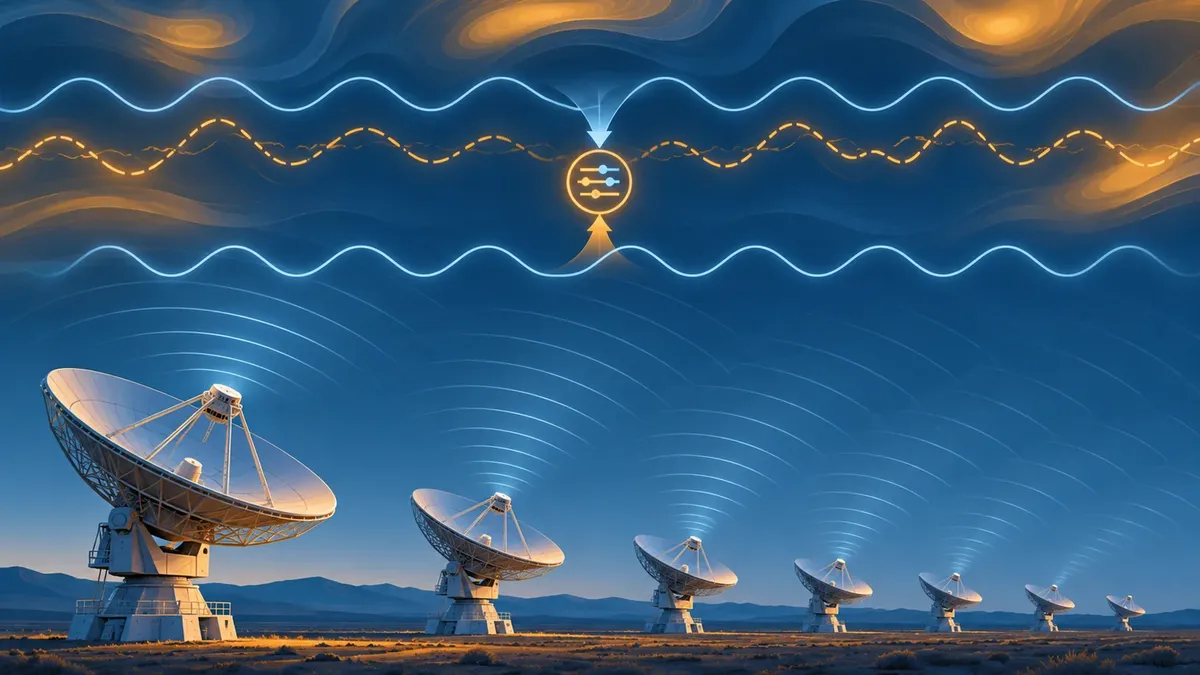
Radio interferometers must account for effects from each antenna’s signal chain before analyzing their measurements. CorrCal is a proposed method for handling calibration when sky or instrument models are imperfect, a challenge for drift-scanning arrays that cannot track a calibration source.
Radio interferometers combine measurements from multiple antennas to study radio signals from the universe. Before those measurements can be analyzed, researchers need to calibrate them for effects introduced by each antenna’s signal chain. For drift-scanning arrays, robust calibration is especially challenging because they lack the ability to track a calibration source. Strategies are also limited by knowledge of the radio sky and the instrument’s direction-dependent response.
The challenge matters for experiments seeking the universe’s faint 21-centimeter cosmological signal. The authors note that small calibration errors can overwhelm this signal. Robert Pascua, Jonathan Sievers and Adrian Liu present CorrCal, a strategy designed to be fairly insensitive to errors in sky or instrument models.
A hybrid calibration strategy
The authors describe CorrCal as combining sky-based calibration and redundant calibration through a covariance-based approach. The abstract presents it as a computationally efficient framework that draws on strengths of both methods. It does not provide further detail about the covariance calculations, so the method’s mechanics cannot be fully assessed from the abstract alone.
The goal is to improve calibration when models of the sky or instrument contain errors—not to eliminate the need for such models. That distinction matters for 21-centimeter cosmology, where residual calibration errors can interfere with the signal researchers hope to measure.
Findings reported by the authors
Across a wide range of modeling-error scenarios, the authors report that CorrCal’s calibration errors were unbiased and far below typical thermal-noise thresholds. The abstract provides no numerical error values. Because the evidence available here is only the abstract, it also does not describe how the scenarios were constructed; the full paper may contain those details.
The authors further report that their implementation can evaluate a likelihood and its gradient in less than a second for arrays in the 1,000-element class, using a single laptop core. This is a computation-time result for the implementation they describe. The abstract does not give additional benchmark details.
What the evidence can—and cannot—show
These are the authors’ reported findings, not a guarantee of performance for every telescope, dataset or observing condition. The abstract describes results across multiple modeling-error scenarios, but the limited evidence available here is not enough to judge their scope or how well they represent real observations. Assessing those questions requires the full paper and its methods.
The source is an arXiv preprint, a publicly available research manuscript. The supplied information does not establish whether it has been peer-reviewed. The authors anticipate that CorrCal could be useful for current and next-generation experiments targeting the cosmological 21-centimeter signal. That is a proposed application; the abstract does not report results from using the method on observational data.
- radio interferometry
- radio astronomy
- telescope calibration
- CorrCal
- 21-centimeter cosmology
- signal processing
Reviewed cross-references
These connections were reviewed by a model, not independently fact-checked by a human. Similarity does not imply agreement; consult the original papers and the evidence below.
A compact Bayesian model captures MeerKAT’s changing radio beam
Supporting evidence: Both papers identify instrument-response modeling as important to reliable radio-astronomy analysis: CorrCal’s discussion says sky-based calibration is vulnerable to errors in modeling the instrument response, while the MeerKAT study reports that inaccurate beam models can degrade imaging through systematic flux-scale distortions. The MeerKAT work models holographic Stokes I data and does not test CorrCal or demonstrate improved calibration, so this supports only the bounded relevance of beam accuracy, not a claim of combined performance.
Model review: · openai-codex/gpt-6-luna
Evidence and provenance
Selected excerpts, not complete papers. PDF extraction can omit figures or damage equations, tables and reading order; sources may be preprints.
2602.06109v2 — Original paper
Excerpt reference:
static/papers/2602.06109v2.md:87-139
Basis: Paper text
Source SHA-256:93ab5397775e191cc55e8a107d08d9e115beeaa5d67bdf0eeb3dd0e8e576f5fe2611.26713v1 — Original paper
Excerpt reference:
static/papers/2611.26713v1.md:59-118
Basis: Paper text
Source SHA-256:21a7b1a9c513214e949333a6779a29cf42e0728ce078970015f280f7f2735bfb
Related reading
Automatically matched by shared topic keywords. These links do not imply that the sources agree or establish a consensus.
A compact Bayesian model captures MeerKAT’s changing radio beam
Source published
Shared keywords: radio astronomy
How the Sun’s atmosphere blurs its own radio signals
Source published
Shared keywords: radio interferometry
AI Learns to Spot a Telescope’s Spectral Ripple—But Not Yet Remove It
Source published
Shared keywords: radio interferometry
A shared software toolkit for gravitational-wave analysis
Source published
Shared keywords: signal processing
Quieter satellites could protect radio astronomy and Earth-rotation measurements
Source published
Shared keywords: radio astronomy