TRANSMISSION // 2602.04987v2
How Galaxy Formation Shapes Cosmological Clues
Source published
Simulations explore how galaxy formation and sample selection affect bias measurements relevant to primordial non-Gaussianity. Specific star-formation-rate selections appear particularly robust in the models tested.
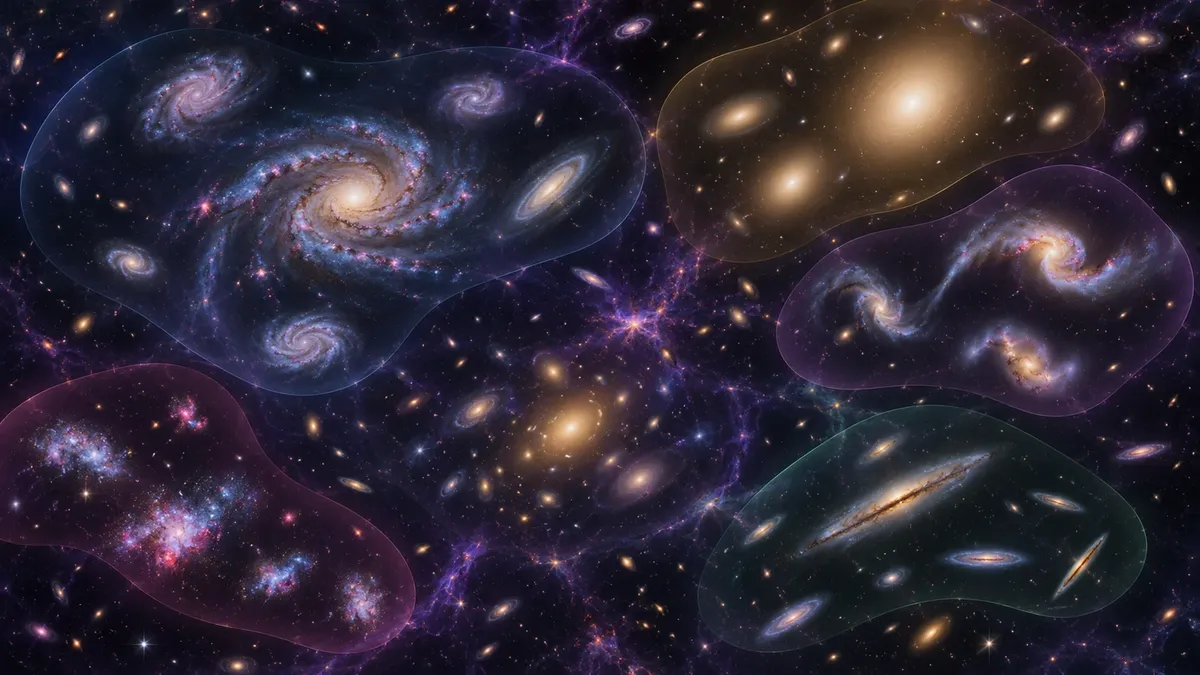
Galaxy surveys may help test ideas about the Universe’s earliest moments. Interpreting their clustering depends partly on how galaxies form and which galaxies researchers select.
The early Universe may have left clues in how galaxies cluster across vast distances. One quantity used to describe possible departures from Gaussian primordial fluctuations is the parameter fNL. Measuring it through galaxy clustering could help constrain models of inflation, the proposed rapid expansion of the very early Universe.
But galaxies do not trace the underlying matter and primordial potential in a simple, identical way. Researchers describe these connections with bias parameters, including b1 and bφ. Uncertainty in those parameters can complicate efforts to constrain fNL. A commonly used relation, bφ = 2δc(b1 − 1), has been found not to describe realistically simulated galaxies accurately in all cases; the relation depends on galaxy selection and modeling.
Testing the effects of galaxy formation
Lucia A. Perez and colleagues use the CAMELS-SAM pipeline to examine how changes in galaxy-formation modeling affect bφ and b1 for different galaxy selections. They run 55 versions of the Santa Cruz semi-analytic model, varying parameters related to stellar and active-galactic-nucleus feedback.
The researchers use separate-universe N-body simulations to measure bφ. They compare the resulting bias behavior across redshifts and selections. The abstract describes this approach and the broad findings, but does not provide enough detail to assess precisely how the measurements were implemented.
What the study finds
Within the Santa Cruz model, the evolution of the relationships between stellar mass, star-formation rate (SFR), or specific star-formation rate (sSFR) and halo mass tracks changes in b1 and in bφ as a function of b1. These patterns vary with redshift and sample selection. In other words, the modeled links between galaxy properties and their host halos track how the bias relationships change across the samples studied.
The range of bφ behavior produced by the model variations also encompasses behavior previously measured in IllustrisTNG, the Munich semi-analytic model, and Galacticus. The authors identify sSFR-based selections as particularly robust to varied galaxy modeling. This points to a potentially useful selection for analyses where modeling choices matter; it does not mean those choices cease to affect the results.
What the evidence can and cannot show
The work addresses a modeling challenge relevant to future constraints on primordial non-Gaussianity. Its abstract reports how galaxy-formation variations and sample choices relate to bias, rather than giving a direct interpretation of survey observations. The abstract alone does not establish whether the full paper includes additional analyses or measurements, so broader claims about its contents would require examining that paper.
The abstract provided here does not give numerical uncertainty estimates or detailed tests of sensitivity to each modeling assumption. It reports comparisons with several other modeling frameworks, but the abstract does not provide enough information to assess the full scope of models or tests in the paper.
This account is based on the abstract, not the full paper. The source is an arXiv preprint; the available information does not establish whether it has undergone peer review. The results are therefore best read as a simulation-based investigation of how galaxy modeling can shape bias measurements, not as a final assessment of future survey precision.
- galaxy bias
- primordial non-Gaussianity
- galaxy formation
- inflation
- cosmological simulations
- galaxy surveys
Related reading
Automatically matched by shared topic keywords. These links do not imply that the sources agree or establish a consensus.
Why Galaxy Bias Depends on How You Measure It
Source published
Shared keywords: cosmological simulations, galaxy bias, galaxy surveys
Reading the early universe through the cosmic web
Source published
Shared keywords: cosmological simulations, primordial non gaussianity
Can Reconstructed Galaxy Maps Yield More Cosmology?
Source published
Shared keywords: galaxy bias
Planck reanalysis finds a modest hint of inflation-era particle signatures
Source published
Shared keywords: primordial non gaussianity
Choosing galaxies could shape the science of a future giant telescope
Source published
Shared keywords: galaxy surveys