TRANSMISSION // 2602.04921v3
Estimating rare failures in simulated quantum error correction
Source published
ScaLER samples selected fault-weight groups and fits a curve to estimate logical error rates in simulated quantum error-correction circuits. Its large-distance results depend on extrapolation and a specific noise model.
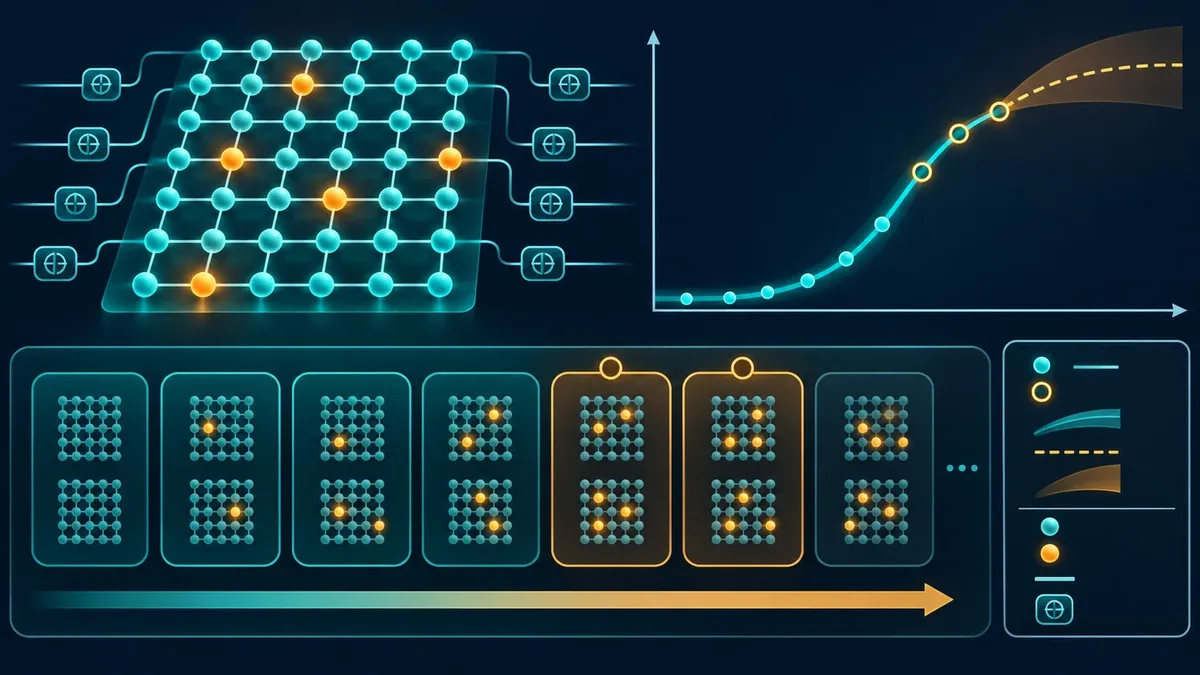
When simulated quantum error-correction circuits fail only rarely under a chosen noise model, ordinary random sampling may observe too few failures to estimate their rate reliably. John Zhuoyang Ye and Jens Palsberg introduce ScaLER, which samples faults grouped by weight and uses a fitted curve to estimate the rate across weights. Their tests reach larger code distances than the reported Monte Carlo benchmark, but the largest-distance estimate is model-based, not a direct count of failures.
Quantum error correction (QEC) encodes information across physical qubits so that errors can be detected and corrected. Researchers assess a QEC circuit partly by estimating its logical error rate: how often the encoded computation produces a wrong result under a specified noise model and decoder.
In the low-logical-error regime, direct simulation can be a statistical bottleneck. If failures are uncommon under the simulated conditions, random trials may need to run for a long time to observe enough failures for a reliable estimate. John Zhuoyang Ye and Jens Palsberg propose ScaLER as a way to estimate these rates for simulated QEC circuits.
Sampling faults by weight
The authors compare ScaLER with unconditional Monte Carlo sampling using Stim, a quantum-circuit simulator. Under the paper’s SID noise model and benchmark conditions, ordinary Monte Carlo draws faults according to their probabilities in that model. The resulting trials tend to include relatively few faults; at low weights, the tested circuits may produce few or no logical failures.
ScaLER instead groups fault sets by weight—the number of injected faults—and samples selected weight groups, including groups in which logical failures are easier to find. It measures logical-error rates within these strata and fits an S-shaped curve to the results. The fitted curve is then used to extrapolate rates across fault weights; those rates are combined with the assumed noise model to estimate an overall logical error rate. The estimate therefore depends not only on sampled outcomes but also on how well the curve represents the unobserved parts of the weight range.
What the benchmarks show
For the reported surface-code benchmark at physical error rate 0.0005, ScaLER estimated rates through distance 17 within a two-hour desktop time budget. At distance 17, its reported estimate was 1.51 × 10⁻¹¹, with a repeat-run spread of ±0.08 × 10⁻¹¹. This is an estimate from curve fitting and extrapolation, not a rate obtained by directly counting failures at that frequency.
The paper reports that, at the same stated physical error rate and time budget, Stim’s Monte Carlo benchmark observed zero logical errors at distance 13. Its table also reports zero at distances 15 and 17. A zero count can be reported as a zero Monte Carlo estimate, but it does not establish a zero failure probability or provide a reliable estimate of a very small nonzero rate. These results are a benchmark comparison, not evidence that every detail of the distance-17 runs was identical.
Where Monte Carlo produced enough failures for a useful comparison, ScaLER’s accuracy varied. The authors report discrepancies of about 30–40% in some distance-5 and distance-7 cases, and individual estimates can differ by as much as 60%. In tested cases, increasing the tuning parameter Γ could improve agreement by sampling more, but at higher computational cost; it is not a universal accuracy guarantee. The authors also found lower accuracy in some tested settings at lower physical error rates, where estimates rely more heavily on extrapolation toward low fault weights.
Limits and source context
The method was evaluated using the authors’ SID noise model, a variant of SD6 that assumes independent single-qubit depolarizing faults and excludes correlated Pauli errors. It is not a complete account of every error source in real quantum hardware. The benchmarks also use particular circuits and decoders, so the results should not be read as performance guarantees across hardware, noise models, or QEC implementations.
The authors observed S-shaped curves in their tested circuits, but say there is no general first-principles proof that all QEC test data have this shape. Other noise models, decoders, or circuit designs may need different models. At larger distances, Monte Carlo did not supply enough failures to serve as ground truth. Repeated ScaLER runs give a measure of variation, but the paper acknowledges that this spread can understate uncertainty in an extrapolated estimate.
The paper text states that it was accepted by Quantum on November 22, 2026, while the supplied record lists an arXiv posting date of February 4, 2026. These dates describe different stages and do not by themselves establish the current publication status; check the linked record for updates. The authors say ScaLER is open source, which makes the implementation available for inspection, but code availability is not independent validation of the distance-17 estimate.
- quantum error correction
- ScaLER
- rare-event estimation
- Monte Carlo simulation
- logical error rate
- fault injection
- quantum circuits
Reviewed cross-references
These connections were reviewed by a model, not independently fact-checked by a human. Similarity does not imply agreement; consult the original papers and the evidence below.
A compact proof for quantum error correction across code sizes
Supporting evidence: Ye and Palsberg state that ScaLER uses circuit-level distance to set an extrapolation cutoff, and present parametric distance guarantees for specified code families and extraction schemes. Those guarantees could provide the distance premise for ScaLER where the circuit and fault/readout contracts match; they do not by themselves establish decoder correctness or validate ScaLER’s estimates.
Model review: · openai-codex/gpt-6-luna
Evidence and provenance
Selected excerpts, not complete papers. PDF extraction can omit figures or damage equations, tables and reading order; sources may be preprints.
2602.04921v3 — Original paper
Excerpt reference:
static/papers/2602.04921v3.md:98-172
Basis: Paper text
Source SHA-256:dde168da5aa6f2394a53746a52b7399aa3d602039ede86844b7638c7626e90b82611.12985v1 — Original paper
Excerpt reference:
static/papers/2611.12985v1.md:13-61
Basis: Paper text
Source SHA-256:2d7433d42aeabb0a1af332982d9b7de6368cc5892e548549a25a5a535547d7b7
Related reading
Automatically matched by shared topic keywords. These links do not imply that the sources agree or establish a consensus.
A compact proof for quantum error correction across code sizes
Source published
Shared keywords: quantum circuits, quantum error correction
Small changes to a decoder’s assumptions improve quantum error correction in simulations
Source published
Shared keywords: logical error rate, quantum error correction
Can fresh encoders limit replayed faults in quantum error correction?
Source published
Shared keywords: fault injection, quantum error correction
For silicon quantum memory, the route can matter as much as the circuit
Source published
Shared keywords: quantum error correction
GeneCS Targets Leaner Quantum Code Surgery
Source published
Shared keywords: quantum error correction