TRANSMISSION // 2602.04633v2
When quantum jumps become classical probabilities
Source published
A theoretical study argues that rapid decoherence can make classical jump-based descriptions meaningful—but a probability equation alone does not establish that a quantum system occupies a definite state between observations.
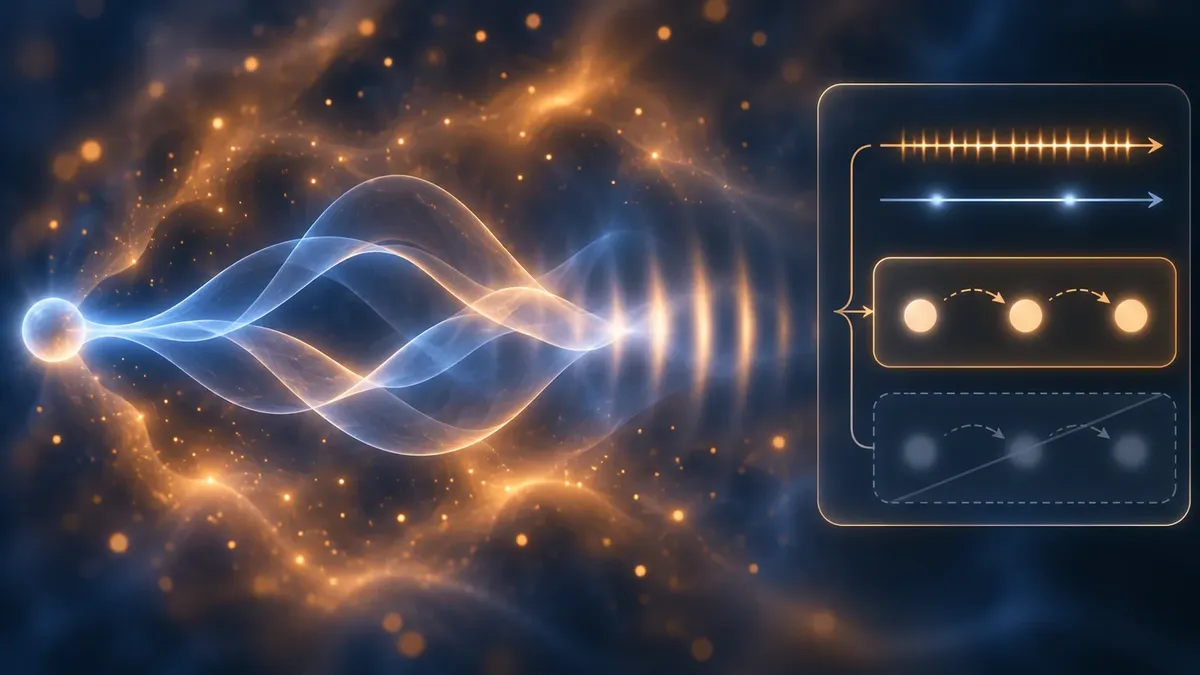
Quantum equations can describe how the probabilities of different states change. But does that mean a particle really occupies one state at each moment and jumps randomly between them? This paper says not automatically. It explores when rapid decoherence may make that classical picture useful and justified.
A quantum system can be described by probabilities for different outcomes without necessarily behaving like a tiny object that always occupies one definite state. That distinction matters when asking questions such as how long a particle stays in one place, or when it first reaches a destination. Those questions rely on tracking a sequence of states—not just knowing probabilities at the beginning and end.
In The emergence of classical stochasticity, Xuan Du Trinh, Ismaël Septembre and Hai-Chau Nguyen examine when that familiar, jump-based picture can be justified. Their central point is that a Pauli-type master equation, which describes how state probabilities change over time, does not by itself establish that the system occupies a definite state at every intermediate moment.
A probability equation is not a trajectory
In classical probability, it is natural to ask what happens next given that a system is currently in a particular state. This lets researchers define quantities such as a persistent time—how long a system remains in a state before leaving it—or a first-arrival time, when it first reaches a target.
Quantum mechanics complicates this reasoning. A system may be in a superposition, meaning its description includes multiple possible states, and a probability equation for selected outcomes does not necessarily settle what the system is doing between them. The authors argue that calculations of persistent and arrival times therefore need an additional justification: that treating the system as occupying definite states is appropriate in the situation being studied.
This also clarifies a subtle point about a standard derivation. The traditional route from Fermi’s Golden Rule to the Pauli master equation begins by treating the system as relatively stable in a definite state before calculating transitions to other states. The researchers show that a Pauli-type equation can be derived by a different route, without starting with that assumption. But the resulting equation still does not, on its own, establish the definite-state picture needed for classical trajectory-based questions.
The role of very fast decoherence
The proposed bridge is the ultradecoherence limit: a regime in which decoherence acts much faster than other relevant processes. Decoherence suppresses quantum coherence between states in a selected basis—the set of states that the environment effectively distinguishes.
The authors work with quantum master equations that include rapid dephasing, then mathematically eliminate the rapidly fading off-diagonal parts of the quantum state’s density matrix. In this approximation, the remaining probabilities obey classical-looking transition equations. Crucially, the authors distinguish that mathematical result from the further interpretation that the system occupies definite states. Their justification for that interpretation relies on timescales: if classical processes interact with the system much more slowly than decoherence acts, the system can be treated as occupying a definite state at the coarser times those processes resolve.
They develop this reasoning for a single particle and extend it to bosons and fermions—two kinds of identical particles with different quantum rules. For bosons, the derived transition rates include a factor associated with bosonic stimulation; for fermions, the rates reflect the restriction that a mode cannot be occupied by more than one fermion. The paper also considers transport along a one-dimensional chain with particle injection and removal. It uses analytical calculations for aspects of the dynamics and Monte Carlo simulations to examine arrival-time distributions. In this model, the authors report that fermionic exclusion can limit injection, while bosonic accumulation can lead to faster arrivals as the injection rate increases.
What the result does—and does not—say
The paper’s contribution is conceptual as well as mathematical: it separates having a classical-looking equation for probabilities from having grounds to interpret the system as following a classical stochastic trajectory. Under ultradecoherence, the authors argue, the separation of timescales provides those grounds in the settings they study. That makes classical notions such as persistent times and first-arrival distributions meaningful within that regime.
This is a conditional result, not a claim that quantum systems always possess definite states between observations. The authors identify incomplete decoherence and memory effects as areas requiring further study. Their examples are models and calculations, not evidence that every real-world system can be described this way. The paper also notes that its symmetric transition rates imply a uniform equilibrium distribution in the models considered; this should not be read as a universal statement about quantum systems.
The source is an arXiv preprint, so its findings should be treated as research that may not yet have undergone peer review. The available text supports the authors’ derivations and reported simulations, but does not establish how broadly the framework applies beyond the assumptions and examples examined.
- quantum decoherence
- classical stochasticity
- Pauli master equation
- quantum mechanics
- bosons and fermions
- arrival times
Reviewed cross-references
These connections were reviewed by a model, not independently fact-checked by a human. Similarity does not imply agreement; consult the original papers and the evidence below.
When quantum histories nearly decohere, which leave records?
Supporting evidence: Both papers caution that decoherence does not by itself warrant an unrestricted classical interpretation: Trinh, Septembre and Nguyen say a Pauli master equation alone does not establish definite intermediate states, while Strasberg and colleagues find that approximate decoherence can leave histories without reliable records. The comparison is conceptual, not a shared test: one concerns ultradecoherence and stochastic dynamics, the other approximate decoherence in isolated histories.
Model review: · openai-codex/gpt-6-luna
Evidence and provenance
Selected excerpts, not complete papers. PDF extraction can omit figures or damage equations, tables and reading order; sources may be preprints.
2602.04633v2 — Original paper
Excerpt reference:
static/papers/2602.04633v2.md:186-253
Basis: Paper text
Source SHA-256:02d4d7deb25d722f9f47260261e9874b72b1bc2c7ce5d10419fdc9388af2a41f2602.04633v2 — Original paper
Excerpt reference:
static/papers/2602.04633v2.md:7161-7247
Basis: Paper text
Source SHA-256:02d4d7deb25d722f9f47260261e9874b72b1bc2c7ce5d10419fdc9388af2a41f2601.19703v2 — Original paper
Excerpt reference:
static/papers/2601.19703v2.md:12-71
Basis: Paper text
Source SHA-256:8a9c5cbf6d9a79ae5fb25deeb57ef26cb010ed71a260fd64ade66eb6bfbb09882601.19703v2 — Original paper
Excerpt reference:
static/papers/2601.19703v2.md:72-123
Basis: Paper text
Source SHA-256:8a9c5cbf6d9a79ae5fb25deeb57ef26cb010ed71a260fd64ade66eb6bfbb0988
Related reading
Automatically matched by shared topic keywords. These links do not imply that the sources agree or establish a consensus.
When quantum histories nearly decohere, which leave records?
Source published
Shared keywords: quantum decoherence
A hybrid method brings huge spin baths within reach
Source published
Shared keywords: quantum decoherence
A more stable way to model quantum environments at finite temperature
Source published
Shared keywords: quantum decoherence
Why Quantum Theory’s Composition Rules Matter
Source published
Shared keywords: quantum mechanics
What counts as a physical degree of freedom in quantum mechanics?
Source published
Shared keywords: quantum mechanics