TRANSMISSION // 2602.04512v2
BrainVista tests whether AI can forecast changing brain states
Source published
BrainVista predicts future fMRI states using past brain activity and time-aligned stimulus information. Its abstract reports pattern-correlation improvements over the strongest baseline on two benchmarks, but does not specify the result for a third. Because the available evidence is the abstract of an arXiv preprint, the findings and their scope remain difficult to assess in detail.
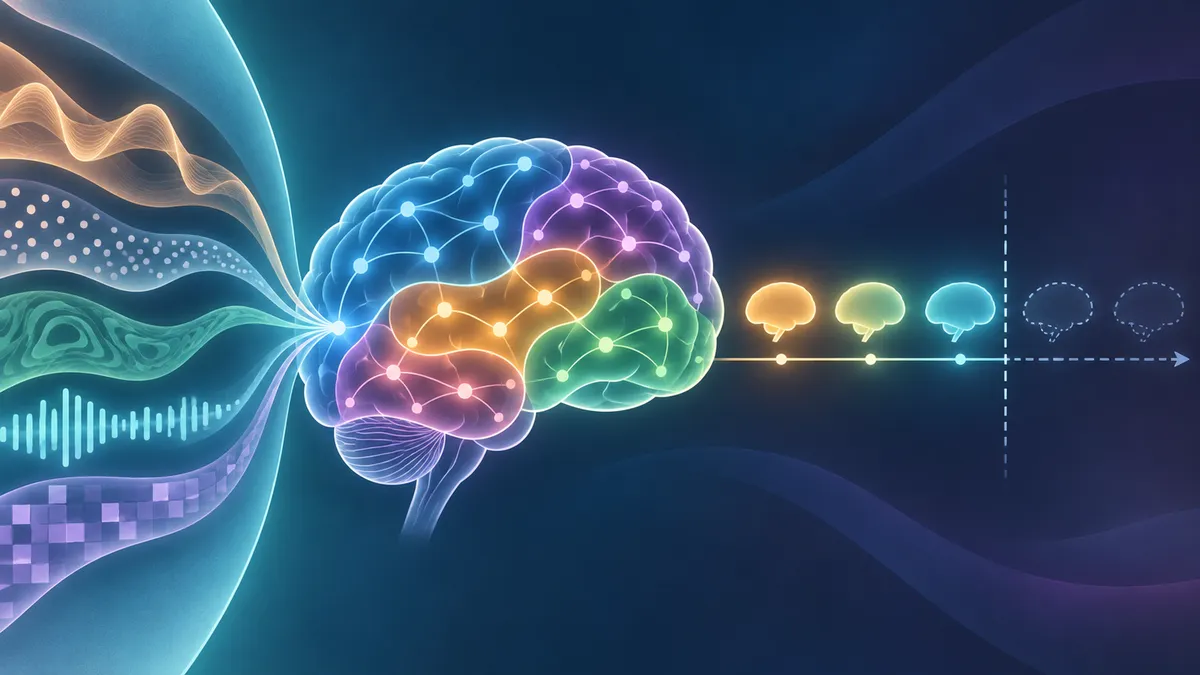
Brain activity changes over time, and sensory input changes along with it. Can a model forecast future fMRI measurements using both recent brain activity and information about the stimulus at the relevant time? BrainVista, a system described in a new preprint, is designed to test that question.
Forecasting brain states with stimulus context
BrainVista addresses a challenge in predicting fMRI during continuous experience: future brain states may depend both on earlier brain activity and on incoming sensory information. The authors also point to a timing mismatch: sensory streams can change quickly, while the blood-oxygen-level-dependent (BOLD) response measured by fMRI is sluggish. Their model aims to account for these factors while representing activity across functionally heterogeneous brain networks.
The system predicts future fMRI states from brain-activity history and stimulus tokens aligned in time with each prediction query. The authors call this observed-stimulus conditional forecasting. In this setup, stimulus information available at the prediction time can inform a forecast, but the model should not access future stimulus information or the future fMRI states it is trying to predict.
That timing constraint is central to the design. BrainVista uses Stimulus-to-Brain (S2B) masking, which the authors say preserves temporally causal conditioning and prevents future brain-state leakage and stimulus look-ahead. In other words, the model is meant to forecast from information available at the appropriate time, rather than from a glimpse of what comes next.
How the model is organized
BrainVista combines three components. Network-wise Tokenizers represent brain activity in functionally structured groups. A Spatial Mixer Head refines interactions across those groups. S2B masking controls how stimulus information is matched to brain-state predictions. Together, these components are intended to handle structured brain representations, interactions between networks, and the timing of stimulus input.
The authors evaluate the model on three naturalistic fMRI benchmarks: Algonauts 2025, CineBrain and HAD. They describe the evaluation as long-horizon conditional autoregressive forecasting, with recursive rollout within a run under continuing sensory input. The abstract says this rollout predicts without access to future ground-truth fMRI states. It does not provide further detail about the rollout procedure, so the exact sequence of model inputs and predictions cannot be reconstructed from the abstract alone.
What the abstract reports
The authors report pattern-correlation improvements of 10.8% on Algonauts 2025 and 9.4% on CineBrain, relative to the strongest baseline on each benchmark. The abstract characterizes BrainVista as consistently outperforming baselines, but gives these specific improvement figures for only those two benchmarks. It does not state the outcome for HAD, so no result for that benchmark should be inferred from the figures provided.
The abstract does not define how pattern correlation or the percentage improvements are calculated. Without that detail, the figures are best read as the authors’ reported comparisons, not as a complete measure of prediction accuracy. The abstract also does not supply the underlying scores or uncertainty estimates, which would help readers judge the size and reliability of the reported differences.
What remains uncertain
These results concern forecasting fMRI measurements in the named benchmark evaluations. They do not, by themselves, establish that the model explains the biological mechanisms behind brain activity or that it will work in settings beyond those evaluations. The abstract does not provide enough information to assess the detailed protocols, compare all results across benchmarks, or determine how much each model component contributes.
This account is based on the paper’s abstract, rather than a full analysis of its methods and results. The paper is an arXiv preprint; preprints may not have undergone peer review. The authors say code is available, but the abstract-level evidence here is not enough to verify the reported comparisons independently. The findings should therefore be treated as preliminary, pending closer examination of the full paper and further testing.
- BrainVista
- fMRI
- brain-state forecasting
- naturalistic neuroscience
- autoregressive models
- machine learning
Related reading
Automatically matched by shared topic keywords. These links do not imply that the sources agree or establish a consensus.
One Energy Lens for Many Kinds of Machine Learning
Source published
Shared keywords: machine learning
PlanAudio gives text-to-audio generation a sense of sequence
Source published
Shared keywords: autoregressive models
Machine learning connects atomic physics to simulations of stellar winds
Source published
Shared keywords: machine learning
PHISHREV+ uses explicit rules to reconsider phishing alerts
Source published
Shared keywords: machine learning
Satellite links detect rain better when neighboring receivers share information
Source published
Shared keywords: machine learning