TRANSMISSION // 2602.04361v3
SparVAR speeds up image generation by skipping less
Source published
A training-free method sparsifies attention in visual autoregressive models, aiming to cut generation time while keeping fine image details. Tests report faster inference on two model families, with important limits to the results.
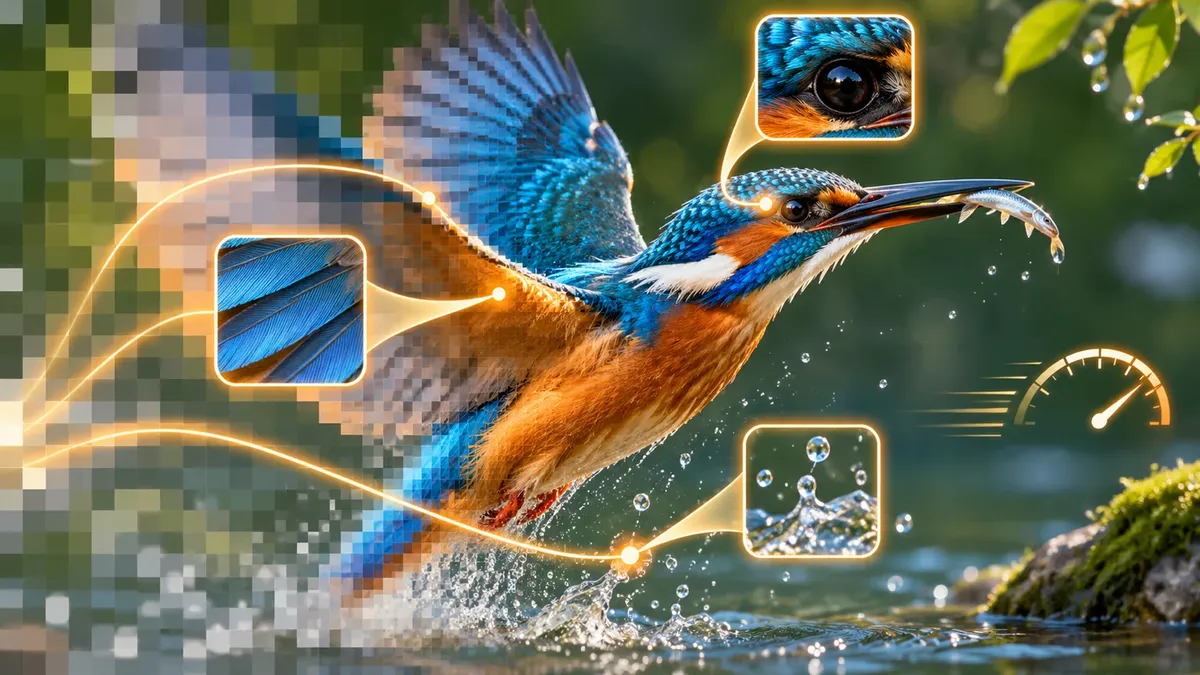
High-resolution image generators can spend much of their time deciding which earlier visual tokens to attend to. SparVAR tries to reduce that work without simply dropping the final, detail-refining stages.
Visual autoregressive (VAR) image models build pictures from coarse to fine. At each step, a model predicts a whole new resolution scale, using information from earlier scales to keep the image coherent. The approach can generate images efficiently, but attention—the operation that lets each token draw on other tokens—gets costly as the number of visual tokens grows.
A common shortcut is to skip some of the final, highest-resolution scales. That saves computation, but those stages also refine textures and small structures. The authors of SparVAR ask whether a VAR model can run faster without skipping those stages, by making its attention more selective instead.
Looking for repeated patterns in attention
The researchers first examined attention in Infinity, a text-to-image VAR model. They report three recurring patterns: a small set of early-scale tokens draws strong attention and acts as a global anchor; attention patterns at neighboring scales often look similar; and attention at larger scales tends to concentrate around nearby spatial locations.
SparVAR uses two sparse-attention methods based on these observations. One identifies important attention connections at a selected mid-scale, then maps that pattern onto later, higher-resolution scales. The other restricts attention to nearby regions across scales, while retaining selected early tokens to preserve global context. Its block-wise computation is designed to work efficiently on GPUs. “Training-free” means the method is applied at inference rather than requiring the underlying image model to be retrained.
The team tested SparVAR on Infinity models with 2 billion and 8 billion parameters, and also on the HART model. Their evaluations included image-generation speed, benchmark measures of prompt alignment and human preference, and image-fidelity measures comparing SparVAR’s output with the baseline. Experiments were run on NVIDIA H100 GPUs; the reported results are tied to the tested models, settings and hardware.
Faster in the reported tests, with scales intact
For Infinity-8B generating 1024-by-1024 images without scale skipping, the paper reports a generation time of 1.05 seconds, compared with 1.65 seconds for the Infinity baseline using FlashAttention—a reported 1.57-fold speed-up. The authors report that image-fidelity scores remained close to the baseline. In one comparison, PSNR was 29.481, SSIM was 0.920 and LPIPS was 0.073; these metrics compare generated images with baseline outputs and do not, by themselves, establish that viewers will prefer every result.
The paper also reports that combining SparVAR with scale-skipping strategies produced speed-ups of up to 2.28-fold in its tested settings, while maintaining competitive benchmark results. That is a different operating point from the no-skipping result: skipping scales may still trade away some detail, even when SparVAR is added. Results on HART provide a further test beyond Infinity, but do not show that the approach will work equally well across all VAR architectures or image-generation systems.
The speed figures should be read as experimental measurements, not a guarantee of one-second generation on any device. The paper’s setup specifies GPU hardware and a batch size of one for throughput measurements. Real-world performance can vary with hardware, software, model configuration and workload. The paper also notes that SparVAR primarily targets inference latency, rather than minimizing memory use; it is not a general solution to every deployment bottleneck.
What remains uncertain
The work is an arXiv preprint, so its claims should be treated as research findings awaiting independent scrutiny, not as settled results. The evidence described here comes from the paper’s experiments and comparisons, rather than an independent replication. Its small blind user study included seven participants; that is limited evidence about human preferences, not a broad assessment. Automated image metrics also capture only particular aspects of quality, and comparisons against baseline outputs are not the same as a comprehensive judgment of image usefulness or aesthetics.
The central idea is that attention in these models may contain predictable structure: if later scales reuse some of the same patterns, a model may avoid recomputing every connection. SparVAR’s results suggest this can reduce latency in the tested systems while retaining the final refinement scales. Whether the same trade-off holds for other models, hardware and prompts remains an open question. The authors provide code, which may help others check and extend the results.
- SparVAR
- visual autoregressive models
- image generation
- sparse attention
- AI acceleration
- high-resolution images
Related reading
Automatically matched by shared topic keywords. These links do not imply that the sources agree or establish a consensus.
Can Reinforcement Learning Teach an Image Model to Paint?
Source published
Shared keywords: image generation, visual autoregressive models
EAGLE helps image models connect tiny details to the whole scene
Source published
Shared keywords: high resolution images
Training visual agents to look, not guess
Source published
Shared keywords: high resolution images
When AI Chooses Where to Look
Source published
Shared keywords: high resolution images
A Head-by-Head Approach to Faster AI Attention
Source published
Shared keywords: sparse attention