TRANSMISSION // 2602.04269v2
Could quantum computers help correlate radio telescope data?
Source published
A proposed quantum pipeline reproduces a small simulated VLBI correlation task, but data loading and real-world scaling remain major hurdles.
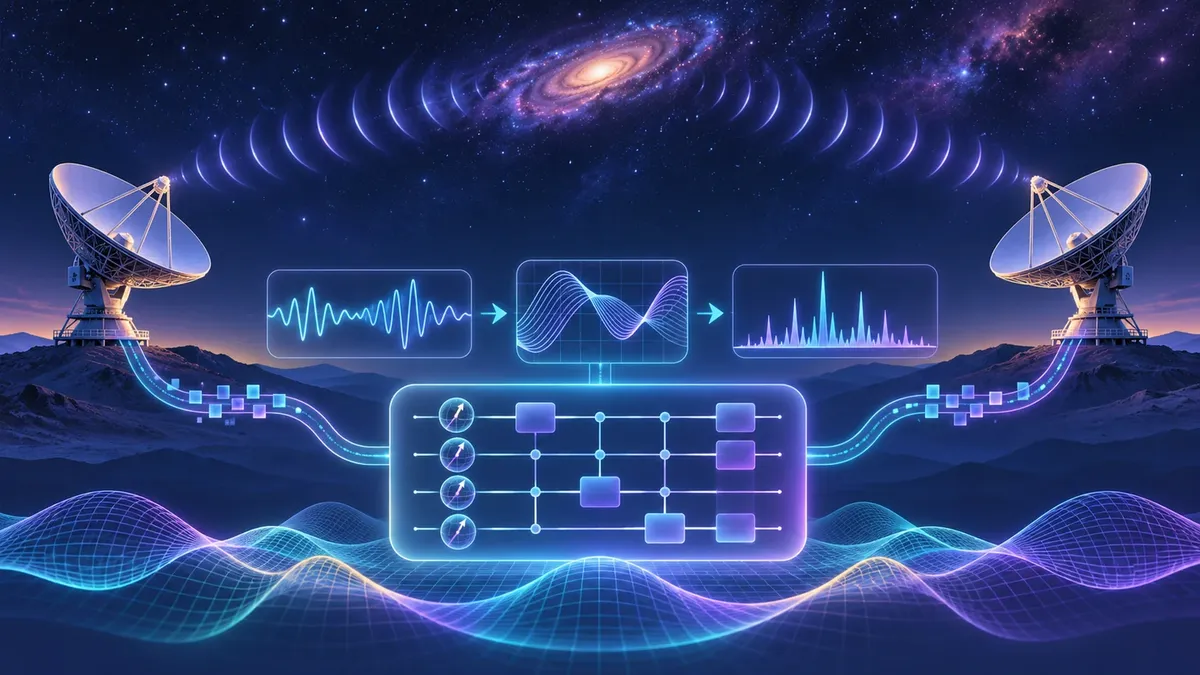
Very Long Baseline Interferometry combines signals from widely separated radio telescopes to study the sky with exceptional detail. A new framework explores whether quantum algorithms could handle parts of the computation that aligns and correlates those signals. Its demonstration is a limited test on simulated data—not evidence that quantum machines can process operational telescope data faster or better.
Why look to quantum computing for telescope signals?
Very Long Baseline Interferometry (VLBI) links radio telescopes separated by large distances. Comparing signals recorded at different sites lets astronomers and geodesists study radio sources and measure positions and delays. This comparison, called correlation, uses the original sampled signals, and the data volumes can be substantial.
Lei Liu’s proposed framework asks whether quantum algorithms could perform parts of this processing. The paper describes a pipeline for one pair of stations, or baseline, and compares it with a classical pipeline. Its stated focus is geodetic VLBI, where delay estimates matter. This is a theoretical and algorithmic demonstration, not a deployment at working observatories.
Encoding signals and comparing them
The central idea is amplitude encoding: represent a normalized list of signal samples as the amplitudes of a quantum state. In principle, a signal with N samples can be represented using log₂(N) qubits. That compact representation does not mean the samples are cheap to load: preparing an arbitrary state from classical data can itself require substantial work.
The proposed processing steps include fringe rotation, which aligns signal frequencies; a Fourier transform, which converts the signal from time to frequency; fractional sample-time correction, which adjusts delays; and fringe fitting, which searches for residual delay. The framework maps phase adjustments to quantum gates and uses the quantum Fourier transform for frequency conversion.
For correlation, the paper makes an important distinction. It does not claim that a quantum circuit directly outputs every value in the full cross-power spectrum at low cost. Instead, it represents the summed correlation as an inner product between two quantum states and estimates that quantity using a Hadamard test. This test measures an ancilla qubit repeatedly, so its estimate has statistical noise and depends on the number of measurement shots. The method does not return the individual value for every frequency bin.
What the demonstration found
The author implemented the pipeline in Qiskit and compared delay estimates with a classical calculation. The input was simulated real-valued data, with 256 unquantized samples per station. The paper describes the results as consistent within the margin of error, but this is a limited comparison on simulated data—not a robust validation of equivalent performance or uncertainty.
In the classical pipeline, the reported delay estimate was 2.734 ± 0.003 microseconds. The input residual delay was 2.7 microseconds, making the difference 0.034 microseconds—more than 11 times the reported uncertainty. The paper’s narrative says the classical result is within its three-sigma interval, but those stated values do not support that claim. This discrepancy makes the classical uncertainty comparison difficult to interpret.
For the quantum pipeline, the paper reports mean delay estimates and uncertainties across ten runs for each tested combination of measurement shots and delay-search resolution. More shots corresponded to smaller reported uncertainty. At all three tested shot counts, the reported uncertainty also decreased as the search spacing became finer. These are results from this particular simulated test; they do not establish how accuracy or uncertainty would behave with real observations or different setups.
The main bottlenecks—and what remains open
The paper identifies state preparation as a major obstacle. Although the encoded state uses few qubits, loading classical samples can require work proportional to the number of samples. VLBI data are typically quantized to one or two bits and may contain repeated patterns; the author suggests these features could help reduce preparation costs. That proposed improvement was not demonstrated with real raw recordings in this test.
The demonstration processes one Fourier-transform period, without the cross-spectrum integration used in practical VLBI correlation. Delay-rate searching is not validated either. The paper discusses ways these tasks might be incorporated but leaves them for future work. It also notes limits from approximating phase changes as linear over a data sequence, along with the need to account for measurement noise.
The evidence supports a narrow conclusion: the author constructed a quantum-algorithm pipeline and compared it with a classical one on simulated, single-baseline data. Whether data preparation, measurement, and other practical costs can be managed for real observations remains uncertain. The paper says its design and hardware are not ready for operational deployment, but the supplied description does not specify whether the test itself ran on a simulator or quantum hardware.
This article is based on an arXiv preprint; the source provided does not establish peer-review status. Its claims should be read as a proposed framework and proof of concept, not as evidence of a practical advantage. The test uses simulated data rather than real VLBI baseband recordings.
- VLBI
- quantum computing
- radio astronomy
- signal processing
- amplitude encoding
- geodetic VLBI
Reviewed cross-references
These connections were reviewed by a model, not independently fact-checked by a human. Similarity does not imply agreement; consult the original papers and the evidence below.
Choosing a quantum data encoding, with help from an agent
Shared method: Both papers discuss amplitude encoding to represent classical data in quantum states. Liu’s VLBI pipeline treats loading large, quantized time series as a key bottleneck; Appel’s QML system includes amplitude encoding and describes its deep state-preparation cost. The applications and implementations differ, so this connection does not establish comparable performance or validate either pipeline.
Model review: · openai-codex/gpt-6-luna
Evidence and provenance
Selected excerpts, not complete papers. PDF extraction can omit figures or damage equations, tables and reading order; sources may be preprints.
2602.04269v2 — Original paper
Excerpt reference:
static/papers/2602.04269v2.md:13-37
Basis: Paper text
Source SHA-256:370edc7658c31f64810e4848c8702693d58f2787baf08a80308832b02ecb97fa2609.31902v2 — Original paper
Excerpt reference:
static/papers/2609.31902v2.md:81-141
Basis: Paper text
Source SHA-256:c86124b037e2102aa1e4aad08159a228570792b6ef42911dc47a3cc857fbcd5b
Related reading
Automatically matched by shared topic keywords. These links do not imply that the sources agree or establish a consensus.
Quieter satellites could protect radio astronomy and Earth-rotation measurements
Source published
Shared keywords: geodetic vlbi, radio astronomy
Radio galaxies vary—and geodesy needs to keep up
Source published
Shared keywords: geodetic vlbi, radio astronomy
Why Do Some Black Hole Jets Bend?
Source published
Shared keywords: radio astronomy
Radio galaxies masquerade as tiny gravitational lenses
Source published
Shared keywords: radio astronomy
Using Scintillation to Study the Double Pulsar
Source published
Shared keywords: radio astronomy