TRANSMISSION // 2602.03938v4
Making Mid-Circuit Quantum Measurements Easier to Understand
Source published
A new analysis method separates estimated mid-circuit measurement errors in a transmon qubit into physically meaningful contributions and examines how they vary with readout-pulse amplitude.
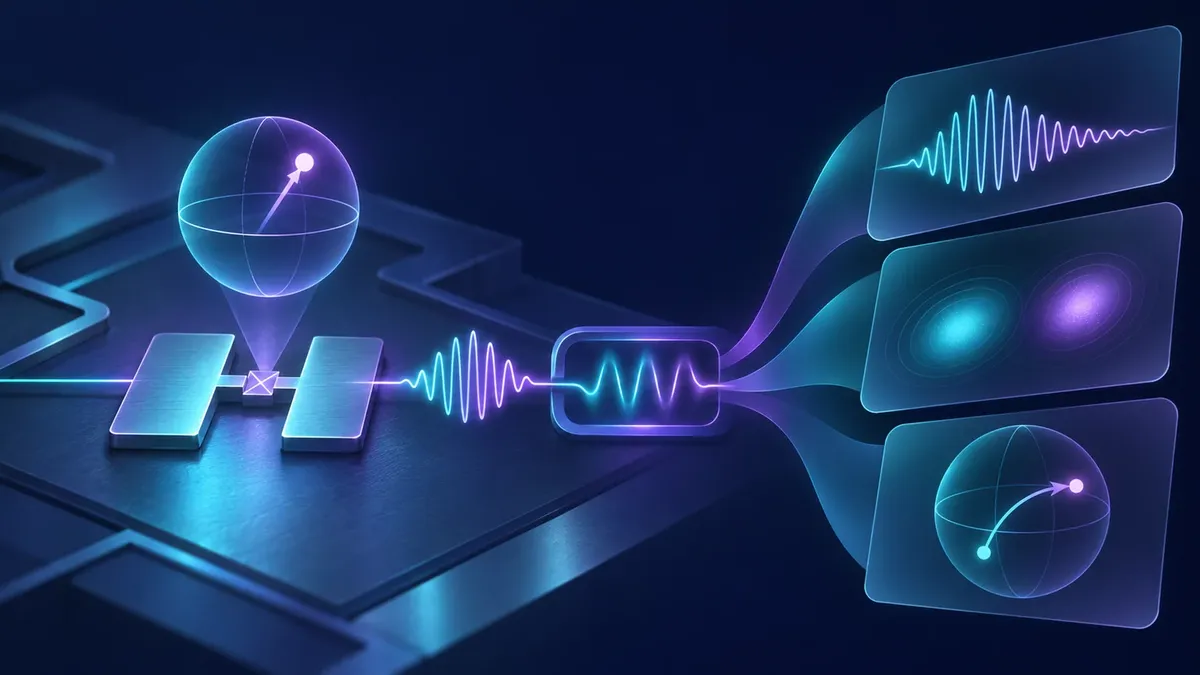
Quantum computers may need to measure qubits before a calculation is finished, including during error correction. A study proposes a way to interpret the errors in these mid-circuit measurements by connecting a mathematical description of the measurement to physically meaningful error contributions.
A quantum measurement does more than produce a result: it is part of the physical process acting on a qubit. In quantum error correction, measurements taken during a computation help track errors as they occur. Understanding how those measurements go wrong—and how the errors respond to device settings—could make their behavior easier to analyze.
In a preprint, Piper C. Wysocki and colleagues address a challenge in characterizing mid-circuit measurements: experimental estimates can be difficult to interpret in terms of device physics. They adapt an error-generator framework previously used to interpret noisy quantum gates, applying it to measurements on a transmon qubit, a type of superconducting qubit.
Turning a measurement model into interpretable contributions
The authors describe a mid-circuit measurement using a quantum instrument, a mathematical representation of a quantum process that includes its possible outcomes. The abstract says such instruments can be characterized self-consistently using gate set tomography. It does not give further details about the tomography procedure, so the practical meaning of that characterization cannot be assessed from the abstract alone.
The study’s main methodological step is to adapt the error-generator formalism to these measurement instruments. The authors use it to decompose an estimated measurement process into contributions associated with elementary errors. In their transmon experiment, they report teasing out and quantifying three mechanisms: amplitude damping, readout error, and imperfect collapse. The abstract names these mechanisms but does not define the specific model or physical interpretation used for each contribution.
Examining readout-pulse amplitude
The researchers examine how the magnitudes of the identified errors vary with readout-pulse amplitude. The abstract reports that the analysis recovers key features of dispersive readout predicted by theory and that these features can be modeled parsimoniously with a reduced model containing a few parameters.
That is a report about characterization and modeling, not evidence that the measurement errors have been eliminated or that the method improves a processor’s performance. The supplied abstract gives no numerical error rates, pulse-amplitude range, detailed description of the recovered features, or fit results. Those omissions mean readers cannot judge the size of the effects or how closely the reduced model matches the experimental data from this evidence alone.
The broader value of the approach is interpretive: instead of treating an estimated measurement as one hard-to-read object, the framework aims to describe it through physically meaningful error contributions. The authors’ results concern one transmon-qubit device; the abstract does not establish that the same contributions or their behavior apply to other devices or qubit designs.
What the evidence can—and cannot—show
This article is based on the paper’s abstract, not its full text. As a result, it cannot assess the experimental protocol, the data and uncertainty estimates, the assumptions behind the decomposition, or the evidence supporting the reduced model. The available material also does not establish how the method compares with other characterization approaches in practice.
The work is listed as an arXiv preprint. An arXiv listing indicates that a version of the research has been posted to the repository; it does not by itself establish whether the work has been peer reviewed or whether it has also appeared in a journal. The findings here should therefore be read as the authors’ reported method and results, not as independently verified evidence of improved quantum hardware.
For curious readers, the key idea is that measurement accuracy may be easier to understand when researchers can break an estimated process into interpretable contributions and track how those contributions change with a control setting. Whether this framework proves broadly useful will require evaluating the full methods and results, and testing its reach beyond the device described in the abstract.
- quantum computing
- mid-circuit measurement
- transmon qubit
- quantum error correction
- quantum measurement
- gate set tomography
Reviewed cross-references
These connections were reviewed by a model, not independently fact-checked by a human. Similarity does not imply agreement; consult the original papers and the evidence below.
Teleporting a logical qubit by joining code patches
Supporting evidence: Both studies show that measurement operations can materially affect quantum-error-correction performance: Wysocki et al. characterize mid-circuit measurement errors on a transmon, including readout error and imperfect collapse, while Hofele et al. report that repeated stabilizer measurements after merging surface-code patches restore fault tolerance and improve logical teleportation fidelity. These are complementary results from different experiments and methods, not a direct comparison of the same measurement process or device.
Model review: · openai-codex/gpt-6-luna
Evidence and provenance
Selected excerpts, not complete papers. PDF extraction can omit figures or damage equations, tables and reading order; sources may be preprints.
2602.03938v4 — Original paper
Excerpt reference:
static/papers/2602.03938v4.md:85-163
Basis: Paper text
Source SHA-256:843466a771ef2b7455c07b5778f08b5f97e7bdfd3c5c61cd5b9375a98635baab2602.03938v4 — Original paper
Excerpt reference:
static/papers/2602.03938v4.md:1575-1652
Basis: Paper text
Source SHA-256:843466a771ef2b7455c07b5778f08b5f97e7bdfd3c5c61cd5b9375a98635baab2611.23165v1 — Original paper
Excerpt reference:
static/papers/2611.23165v1.md:57-173
Basis: Paper text
Source SHA-256:62ec94363400544fb800c4f40983dab0db9d1b20501fff9af142f4d1107fb9422611.23165v1 — Original paper
Excerpt reference:
static/papers/2611.23165v1.md:609-666
Basis: Paper text
Source SHA-256:62ec94363400544fb800c4f40983dab0db9d1b20501fff9af142f4d1107fb942
Related reading
Automatically matched by shared topic keywords. These links do not imply that the sources agree or establish a consensus.
A quantum compiler that keeps error correction in view
Source published
Shared keywords: quantum error correction
Photodiode readout could identify neutral-atom qubits within 100 microseconds
Source published
Shared keywords: quantum computing
Quantum error correction that adapts as noise drifts
Source published
Shared keywords: quantum computing, quantum error correction
Adding a third layer to quantum error correction
Source published
Shared keywords: quantum computing, quantum error correction
A quantum decoder that learns to adapt to changing noise
Source published
Shared keywords: quantum computing, quantum error correction