TRANSMISSION // 2601.22644v2
Quantum memory may reshape a field in an expanding universe
Source published
A one-loop calculation finds that a test scalar field’s quantum dynamics can include causal memory and colored noise, alongside familiar local corrections. In a simplified massive φ⁴ example, the calculated infrared variance is suppressed, but the result depends on approximations.
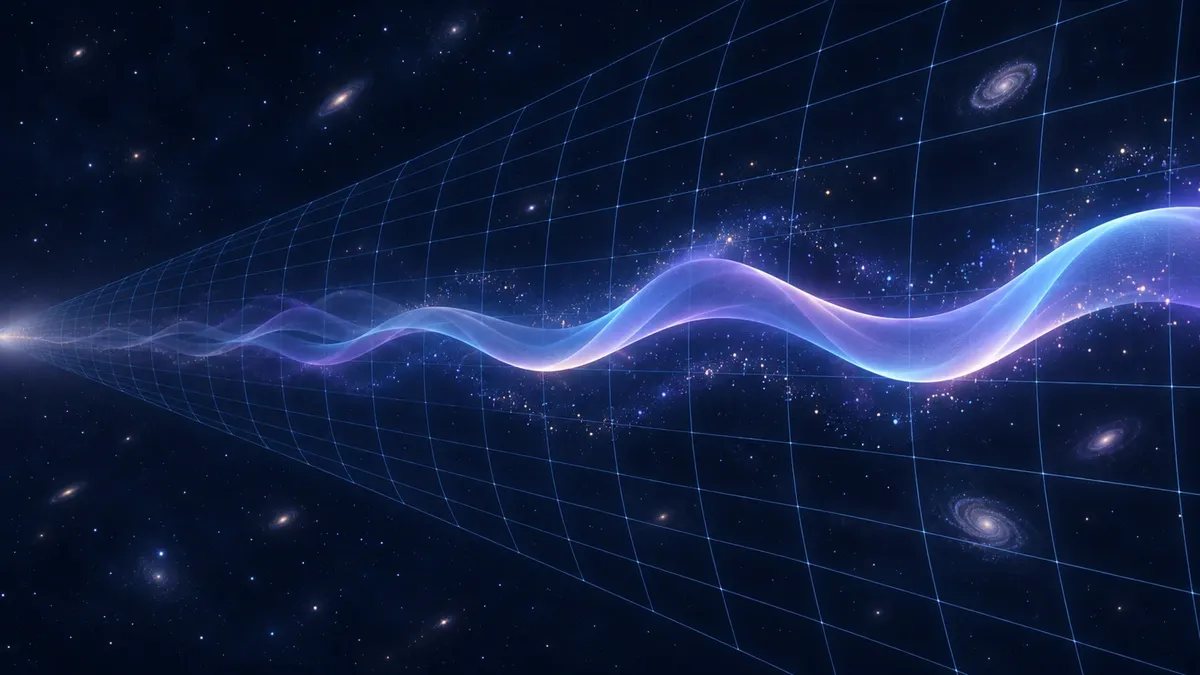
When a quantum field evolves as the universe expands, its present behavior may depend on more than its current value. Will Cerne and Teruaki Suyama calculate how interactions can introduce memory of earlier field values and a fluctuating noise term, then explore what those effects imply in a simplified model.
A field moving through an expanding universe is often described using local rules: its acceleration depends on its value and motion at that moment. But quantum fluctuations can carry information from earlier times. In a new theoretical study, Will Cerne and Teruaki Suyama ask how such effects enter the equation for the average value of a scalar field in an expanding cosmological background—and whether they change predictions for its long-wavelength fluctuations.
The researchers focus on a test field: a scalar field whose evolution is studied on a fixed spacetime, without allowing it to alter the expansion. This is a useful simplification, but it is not a complete model of the inflaton, the field thought to have driven cosmic inflation. The authors calculate quantum corrections at one-loop order, keeping terms through second order in the interaction strength.
Their main tool is the Schwinger–Keldysh, or “in-in,” formalism. Unlike calculations designed for transitions between an initial and final state, this approach is suited to finding expectation values as a system evolves in time. The authors use it to derive an equation for the field’s expectation value in a general Friedmann–Lemaître–Robertson–Walker (FLRW) background, the standard family of expanding-universe geometries.
The resulting equation contains familiar local corrections as well as two nonlocal effects. A memory term makes the field’s evolution depend on its earlier history. A noise term represents fluctuations associated with the quantum dynamics. The memory is retarded: only the past light cone contributes, so the calculation respects causality. The noise is “colored,” meaning its values at different times are correlated rather than independent in the way idealized white noise is.
Quantum calculations can produce ultraviolet divergences—contributions from very short-distance fluctuations that would otherwise make expressions infinite. The authors identify divergent pieces in the local and nonlocal terms and describe counterterms that absorb them into renormalized quantities. They report a finite equation of motion after this procedure, within the approximations used. Their analysis also finds that quantum corrections can generate curvature-dependent couplings, although they set certain higher-curvature contributions aside as negligible for the study.
To make the memory term easier to interpret, the researchers consider fields that vary slowly. In this local approximation, the history-dependent contribution can be represented as a correction to the field’s drift. For their de Sitter calculations, the coefficient they evaluate gives a negative contribution to the drift coefficient, which they describe as reducing the field’s friction. The approximation is intended for a weak-interaction regime; the authors note that it does not include parameter choices where the correction would overwhelm the positive friction.
They then apply the framework to a massive field with a quartic self-interaction, written as φ⁴. In this example, they calculate the field’s equilibrium variance in the infrared regime—roughly, the contribution from long-wavelength fluctuations—and find it is lower when the one-loop corrections are included than in the tree-level calculation. The paper interprets this as a consequence of increased effective restoring forces in the example.
That comparison comes with an important qualification. To construct and solve a standard Fokker–Planck equation, the authors modify the treatment: they remove infrared contributions from some loop terms by hand and add the usual white noise associated with stochastic inflation. They also neglect the new colored noise term in that calculation, citing the limits of the standard Fokker–Planck approach and the noise’s suppression in the weak-interaction regime. They suggest colored noise may partly offset the memory effect, but say a more complete treatment is needed to establish its impact. The reported variance suppression therefore belongs to this specific approximate setup; it does not establish a universal outcome for interacting fields.
The work is a theoretical calculation, not an observational detection. Its general equation applies to a test scalar at one loop and second order in the interaction, while the numerical application uses a particular potential and de Sitter background. The authors explicitly caution that the results cannot be transferred directly to the inflaton: doing so would require including metric perturbations and the field’s effect on cosmic expansion. The paper is an arXiv preprint, so its claims should also be read with the usual caveat that preprint publication alone does not establish peer review.
- quantum field theory
- cosmology
- de Sitter space
- scalar fields
- Schwinger-Keldysh formalism
- quantum fluctuations
Related reading
Automatically matched by shared topic keywords. These links do not imply that the sources agree or establish a consensus.
The ‘tail’ of early dark energy may matter for the Hubble tension
Source published
Shared keywords: scalar fields
Can gravity seed cosmic structure without an inflaton?
Source published
Shared keywords: de sitter space
How a trap may explain phase locking in a cold-atom quantum simulator
Source published
Shared keywords: quantum field theory
Could Entangled Spins Reveal Screened Dark Energy?
Source published
Shared keywords: scalar fields
A Rényi Route to Quantum Energy Bounds
Source published
Shared keywords: quantum field theory