TRANSMISSION // 2601.21499v2
Nuclear spins controlled without RF in silicon carbide
Source published
A silicon-carbide color center enables control of a nearby nuclear spin without a separate radio-frequency source, using a tilted magnetic field and microwave-controlled electron spin.
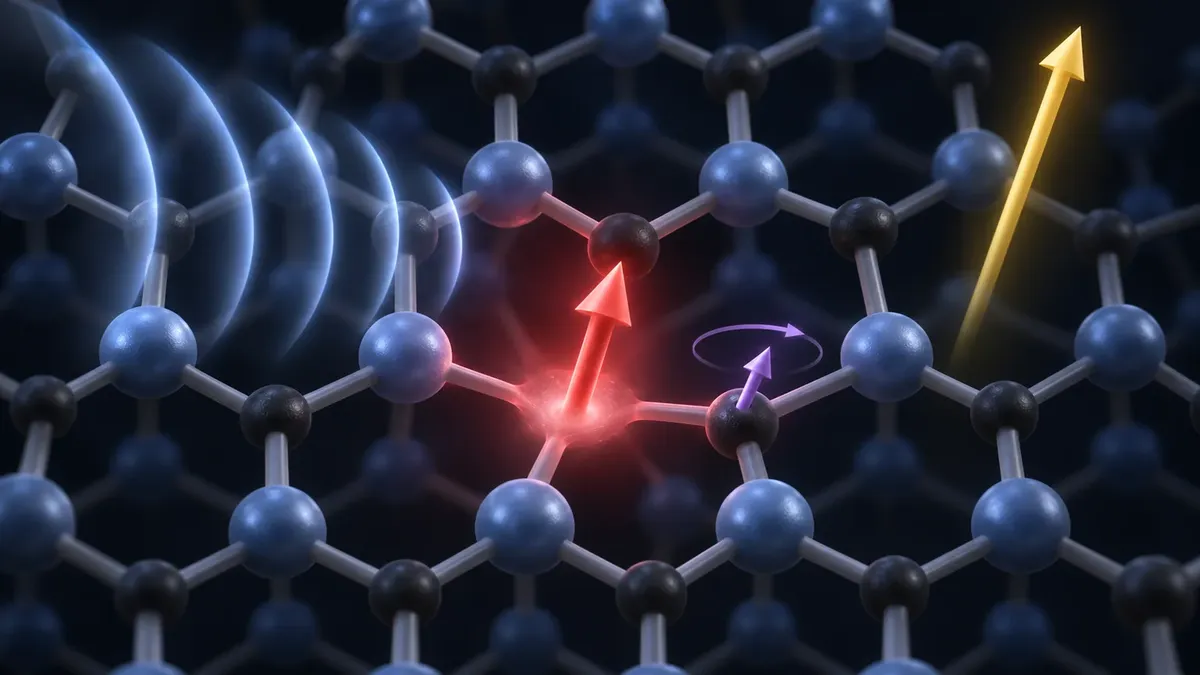
Nuclear spins can act as stores of quantum information, but controlling them conventionally often involves separate radio-frequency hardware. In a room-temperature experiment, researchers used a carefully tilted magnetic field and microwave control of an electron spin to produce and measure precession in a nearby nuclear spin—without applying RF pulses.
A different way to control a nuclear spin
Quantum devices can pair an electron spin with a nearby nuclear spin. The electron spin can be manipulated and read out optically, while a nuclear spin can serve as a quantum memory. Conventional nuclear-spin control often uses radio-frequency (RF) pulses, which require additional hardware. Could researchers instead work through the electron spin using microwaves (MW) and the interaction between the two spins?
Raphael Wörnle and colleagues investigated this question in a modified divacancy color center called PL6, hosted in silicon carbide (SiC). They report coherent control of a coupled nuclear spin without applying RF fields.
What the researchers did
The team studied individual PL6 centers in a SiC sample at room temperature. They characterized the centers’ optical and spin properties, then identified one center coupled to a nearby carbon-13 nucleus. The spins interact through the hyperfine interaction, which links the electron’s and nucleus’s spin states.
A key feature was the direction of an external magnetic field. When the field is tilted slightly relative to the defect’s axis, the coupled system develops an effective influence on the nuclear spin. In the researchers’ account, this hyperfine-mediated effect enables nuclear-spin precession. Microwave pulses manipulate the electron spin and are used in the control and measurement sequences; the reported precession does not depend on directly applying RF pulses to the nucleus.
The researchers used optical pulses to initialize the spins and fluorescence to read them out. They compared measured nuclear-spin oscillations with a model based on the system’s spin Hamiltonian. The model and measurements indicate that a small field tilt makes the nuclear oscillation more visible, while increasing the tilt can reduce electron-spin readout contrast. For the conditions studied, they report an optimum tilt of about 1.8 degrees. The nuclear oscillation also served as a sensitive indicator of the magnetic-field orientation.
What they found
The team observed nuclear-spin precession without a separate RF source. For the coupled center, they report a carbon-13 hyperfine coupling of about 6.7 MHz. Using a nuclear-spin echo sequence, they measured a coherence time of 151.0 ± 6.9 microseconds. A Ramsey measurement gave a dephasing time of 102.2 ± 7.2 microseconds. These are measurements under particular experimental sequences, not a general guarantee of how long a nuclear memory will preserve information in other settings. The authors describe the echo time as nearly limited by the electron spin’s relaxation time, T₁.
The researchers also used quantum-state tomography, which reconstructs a state from a set of measurements. They report 93% fidelity for a nuclear-spin state and 89% for a two-qubit state involving the electron and nucleus. These results show control and characterization in the studied system; they do not demonstrate a complete or scalable quantum processor.
What the result does—and does not—show
This is a proof of principle involving one strongly coupled nuclear spin near a PL6 center, with careful magnetic-field alignment. The authors suggest the approach could be extended to multiple nuclear spins, but do not demonstrate that extension in this work. They also note that further investigation is needed into the nuclear-spin control observed in their measurement configuration.
The findings are reported in an arXiv preprint, RF-free control of nuclear spins with color centers in silicon carbide (version 2). Preprints may not have undergone peer review. The paper says supporting data are available in a repository; the analysis code is available from the corresponding author on request, rather than publicly. The results establish an experimental demonstration in this specific system, while broader applications remain a possibility for future research.
- silicon carbide
- nuclear spin
- color centers
- quantum control
- microwave pulses
- PL6 defect
- quantum information
Reviewed cross-references
These connections were reviewed by a model, not independently fact-checked by a human. Similarity does not imply agreement; consult the original papers and the evidence below.
Two microwave tones sharpen a quantum sensor in boron nitride
Shared method: Both studies use microwave excitation for coherent spin control: Wörnle et al. drive the PL6 electron spin to manipulate a coupled nuclear spin indirectly, while Ru et al. simultaneously drive two transitions of an hBN boron-vacancy ensemble to control its double-quantum manifold. The shared method is microwave-driven spin control; the defects, spin targets and protocols differ, so this is not evidence of equivalent performance.
Model review: · openai-codex/gpt-6-luna
Evidence and provenance
Selected excerpts, not complete papers. PDF extraction can omit figures or damage equations, tables and reading order; sources may be preprints.
2601.21499v2 — Original paper
Excerpt reference:
static/papers/2601.21499v2.md:15-65
Basis: Paper text
Source SHA-256:ddcec242cb3e205c0b35f64b4662ab05a201ca92914dbfdf31f9c759991dcaa92611.13447v1 — Original paper
Excerpt reference:
static/papers/2611.13447v1.md:64-121
Basis: Paper text
Source SHA-256:7743cb9ee8a5d8f0cecccc9ac68c42378a24284df8d6afa56f8e0d7f477eeb15
Related reading
Automatically matched by shared topic keywords. These links do not imply that the sources agree or establish a consensus.
Voltage brings silicon-carbide quantum emitters into tune
Source published
Shared keywords: silicon carbide
A tunable interaction could broaden neutral-atom quantum gates
Source published
Shared keywords: quantum control
Using a superconducting cavity’s resonances to control quantum states
Source published
Shared keywords: quantum control
Why finite quantum circuits cannot reproduce the quantum switch
Source published
Shared keywords: quantum information
Shortened pulse sequences could make geometric quantum gates more resilient
Source published
Shared keywords: quantum control