TRANSMISSION // 2601.19123v2
How a compact object stirs a relativistic black-hole disc
Source published
A theoretical study models spiral waves in gas discs around spinning black holes and compares local torques with angular momentum carried through the disc.
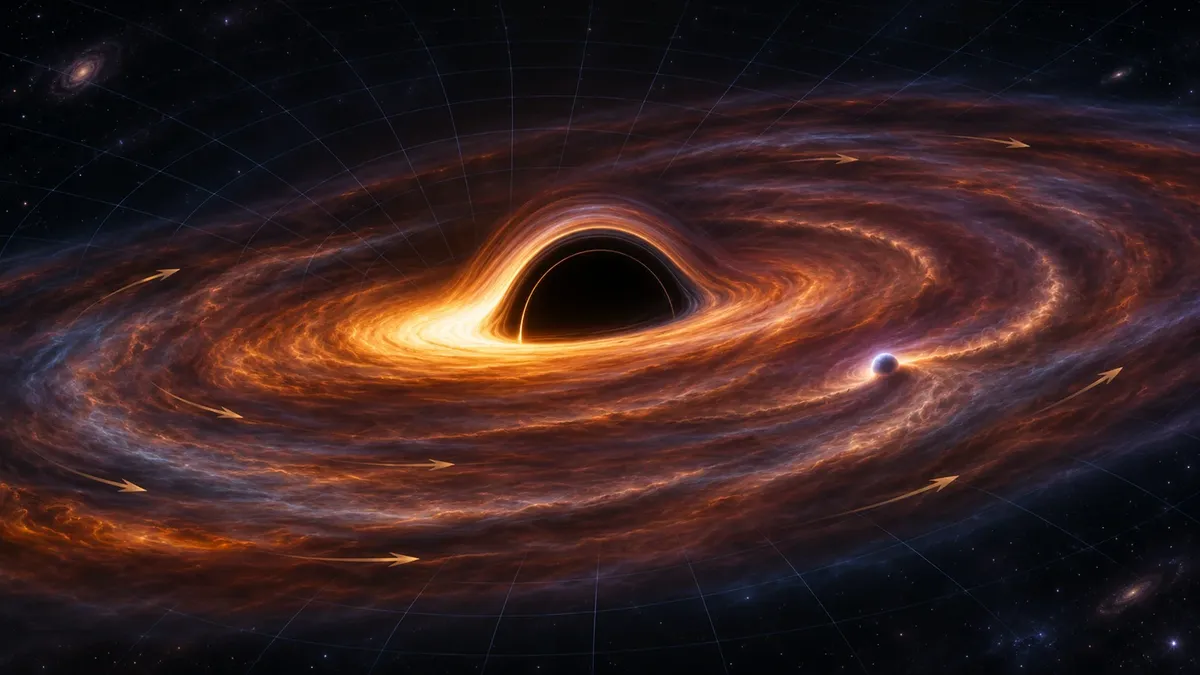
An object orbiting a massive black hole can perturb nearby gas, whose response may matter for understanding extreme-mass-ratio inspirals (EMRIs). Conor Dyson and Daniel J. D’Orazio develop a relativistic calculation of that response, including pressure effects, and report agreement between a torque-balance relation and the angular momentum advected through their example discs.
A compact object orbiting a massive black hole can disturb gas in a surrounding accretion disc. The resulting fluid response includes spiral density waves—patterns in the gas associated with the object’s gravitational influence. Understanding such interactions may help researchers model extreme-mass-ratio inspirals (EMRIs), a target for the planned space-based gravitational-wave observatory LISA.
The challenge is to describe the gas near a black hole, where gravity and motion are relativistic. Conor Dyson and Daniel J. D’Orazio say that existing models of disc–EMRI interactions often rely on simplified drag or on prescriptions adapted from Newtonian planet migration. Their study develops a relativistic approach for calculating how a disc responds to an EMRI’s perturbing potential around a rotating, or Kerr, black hole.
Calculating the disc response
The authors model the disc as a perfect fluid, a theoretical description that includes pressure. They use linearised fluid theory to calculate small changes from the unperturbed flow, representing those changes with a specially defined, enthalpy-like variable. From this, they reconstruct fluid perturbations and the associated spiral structure.
The work draws on methods from self-force theory, black-hole perturbation theory and relativistic stellar perturbation theory. Its proof-of-principle calculations cover a range of black-hole spin values in Kerr geometry. The abstract does not specify the exact range or provide enough detail to assess the full set of assumptions and calculations.
The authors also derive a relativistic torque-balance equation. Torque is a measure of how a force changes rotational motion. Their relation allows them to compare local torques with the angular momentum advected through the disc—that is, carried along by the flowing fluid. This comparison is not, by itself, a direct measurement of angular momentum exchanged between the disc and the orbiting object.
What the calculations report
Applied to the relativistic disc–EMRI solutions constructed in the study, the torque-balance relation gives what the authors describe as striking agreement with the angular momentum advected through the disc. This is a consistency check within those solutions and supports using the relation in those examples.
The finding does not show that the same agreement holds in every disc–EMRI system, or that the effects of a disc on an inspiral are fully understood. The authors present the work as a route toward establishing balance relations between integrated torques arising from fluid perturbations and forces acting on EMRIs. That broader connection remains a direction for further work, not a result established by the abstract.
What remains uncertain
This account is based on the paper’s abstract rather than its full text. The abstract outlines the method and headline result but does not supply the detail needed to evaluate the calculations fully, including the precise parameter ranges and how broadly the reported agreement applies. The authors characterize their calculations as proof of principle.
The source is an arXiv preprint. The available information does not establish whether it has been peer reviewed. The study is theoretical; the abstract reports no observational detection or test against data. Its contribution is a relativistic framework and a reported balance check in the solutions presented, not a prediction that a particular LISA observation will reveal a disc effect.
- extreme-mass-ratio inspirals
- Kerr black holes
- accretion discs
- relativistic fluid dynamics
- spiral density waves
- torque balance
- LISA
Related reading
Automatically matched by shared topic keywords. These links do not imply that the sources agree or establish a consensus.
When dark matter pushes back near a spinning black hole
Source published
Shared keywords: extreme mass ratio inspirals, kerr black holes
Two cosmic signals could reveal how massive black holes grow
Source published
Shared keywords: extreme mass ratio inspirals
How machine learning opened a route through an EMRI’s parameter maze
Source published
Shared keywords: extreme mass ratio inspirals
When does a black hole’s ringdown mode sum converge?
Source published
Shared keywords: kerr black holes
How a star’s magnetic field reshapes its accretion disc
Source published
Shared keywords: accretion discs