TRANSMISSION // 2601.16333v4
AI can see the play—but does it know what matters?
Source published
A football-video study finds that multimodal AI models often struggle to identify moments chosen for expert highlight reels. Combining video, audio and commentary did not consistently improve performance.
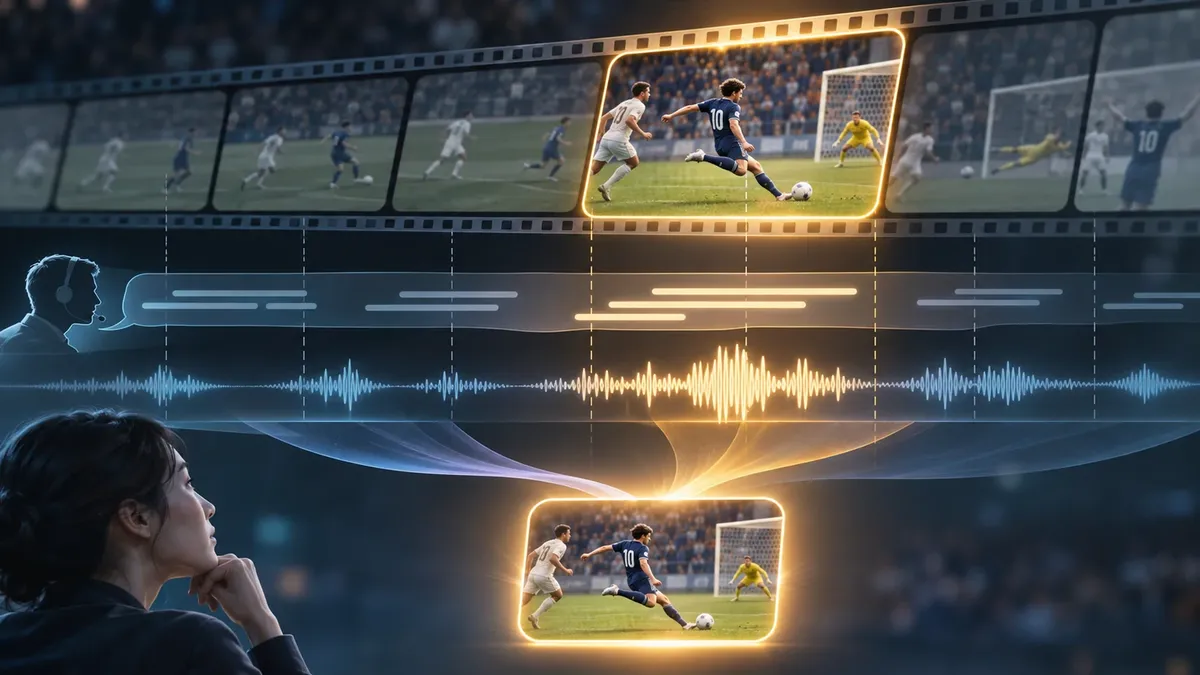
A goal is an obvious highlight. A corner kick might be decisive—or routine. Researchers tested whether AI models can tell the difference, using professional football highlight reels as a guide to what counts as important. Their results suggest that simply giving a model more kinds of information does not guarantee better judgment.
A video summary is only as good as the moments it selects. Before an AI can narrate a football match or produce a useful recap, it needs to distinguish a pivotal event from an ordinary passage of play. But importance is not always visible in a single frame: the same type of action can matter in one game situation and not another.
In this study, Aditya K. Surikuchi, Raquel Fernández and Sandro Pezzelle ask whether current foundation models can recognize those differences. They focus on football and treat moments included in expert-produced broadcast highlight reels as “important.” The central test is whether models can classify short sections of a match as important or non-important—and whether video, audio commentary and commentary transcripts work better together than separately.
Building a dataset from matches and highlight reels
The researchers created MOMENTS by matching broadcast highlight videos to corresponding full-match footage. They used visual similarity comparisons to locate sections of the full games that appeared in the highlights. The matching was hierarchical: rather than comparing every frame with every other frame, the method narrowed the search using frames sampled at one-second intervals, then refined the matches.
From the matches, the team extracted 1,977 important moments. They sampled an equal number of non-important moments from other parts of the games, producing 3,954 examples in total. Audio commentary accompanied the video, and the researchers used an automatic speech-recognition system to create transcripts. They extended the audio and transcript segments beyond the end of each video moment to account for the delay between an event and a commentator describing it.
The team evaluated a range of off-the-shelf language, vision-language, audio-language and omni-modal models. Each was tested with different combinations of video, audio and text. They also trained simple logistic-regression baselines using features from individual modalities. Performance was measured as a classification task, with metrics including accuracy and Matthews correlation coefficient (MCC), which summarizes correct and incorrect predictions across both classes. The researchers additionally examined models’ confidence scores to estimate how different inputs contributed to their predictions.
More input did not reliably mean better judgment
The task remained difficult across the models tested. The strongest reported result came from the proprietary Gemini-2.5-Flash model using audio and video together: its accuracy was 0.795, with an MCC of 0.598. The paper reports that other leading settings included an open model using language and video, and a vision-language model using video alone. The authors found no clear, statistically significant advantage for multimodal input across the open-source models and settings they compared.
The confidence analyses point to a difference between the two classes. For video-capable models, visual information tended to contribute most to correct identification of important moments. Commentary—especially its textual content—played a stronger role in confidence when models correctly identified non-important moments. That distinction makes sense in context: a visual scene may show an action, while commentary can help explain whether it matters in that particular situation.
The researchers also examined goals alongside more context-dependent events, such as corners, throw-ins and shots on target. Open-source models tended to be more confident about goals than about these contextual moments. For the open models examined, combining modalities often did not raise confidence above the best single-modality result; in some cases, multimodal inputs appeared to interfere. The proprietary model showed a different pattern in this analysis, but the authors cannot inspect its internal architecture, and that result should not be treated as proof that all closed models combine information more effectively.
What the findings can—and cannot—show
The study suggests that a model’s ability to process video, sound and language is not the same as reliably combining them. For highlight recognition, the useful signal may depend on the moment: visuals can indicate what happened, while commentary can provide context. The authors argue that future systems may need to adjust how they combine information from different sources rather than rely on fixed fusion strategies.
There are important limits. The dataset covers football, where expert-produced highlight reels provide a practical proxy for importance; those editorial choices are not a universal definition of what matters. The authors note that their findings may not extend beyond sports to other multimodal events that lack a comparable editorial process. The study also treats moments largely as separate examples, rather than testing how a moment’s significance depends on the rest of a match. Models were evaluated off the shelf, without fine-tuning or example demonstrations, so other setups could perform differently.
Finally, the authors’ analysis of model confidence is observational. It can reveal patterns in which inputs are associated with predictions, but it does not prove that a model has a specific internal failure mechanism or that combining modalities caused an error. The results are evidence about this task, dataset and set of models—not a verdict on every multimodal AI system. The work is available as an arXiv preprint; the supplied source does not establish whether this version has undergone peer review.
- multimodal AI
- video understanding
- football highlights
- AI evaluation
- event recognition
- video summarization
Related reading
Automatically matched by shared topic keywords. These links do not imply that the sources agree or establish a consensus.
V-STORM tests whether video AI can connect the evidence it finds
Source published
Shared keywords: ai evaluation, multimodal ai, video understanding
Why physical-event alignment may need trajectories
Source published
Shared keywords: event recognition, multimodal ai
When Video AI Sees the Impossible
Source published
Shared keywords: multimodal ai, video understanding
How MVAgent coordinates AI to understand multiple videos
Source published
Shared keywords: multimodal ai
LoopSeek separates video search from answering
Source published
Shared keywords: multimodal ai