TRANSMISSION // 2601.09532v2
How fast can a strange quark star spin?
Source published
A numerical study estimates how rotation sets lower and upper mass limits for hypothetical strange quark stars, using a density-dependent quark-matter model.
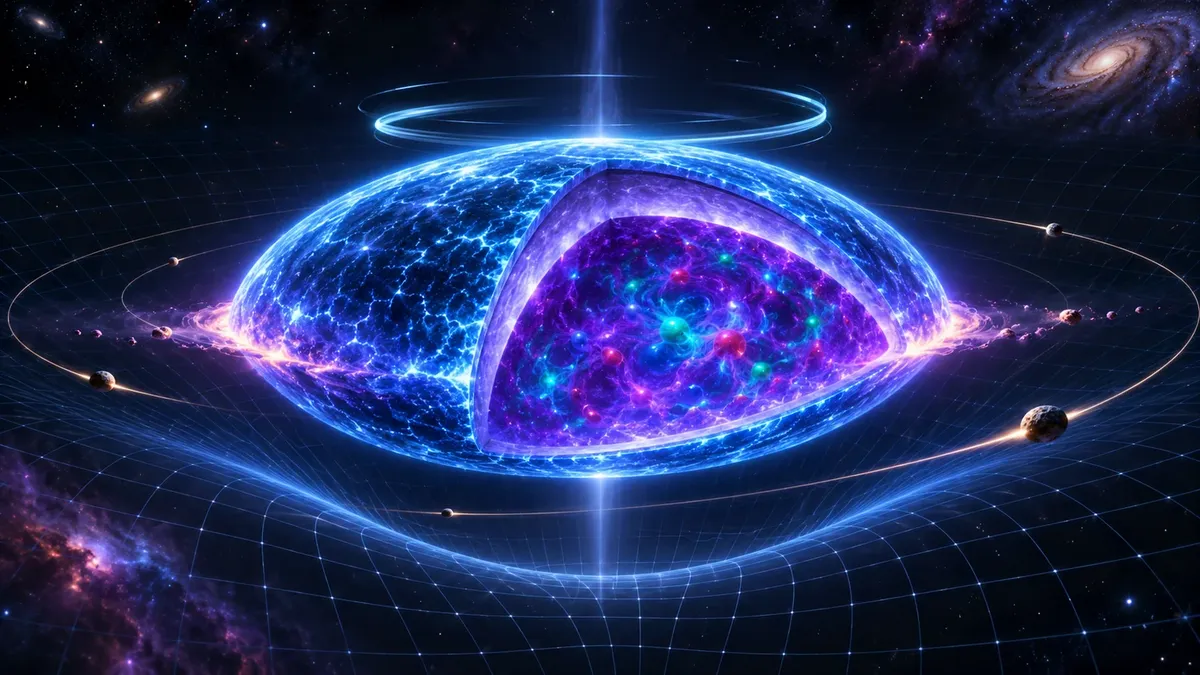
Strange quark stars are hypothetical compact objects made of matter containing up, down and strange quarks. A new calculation asks how rapidly such stars can rotate before material at their equators begins to fly off—and what that limit means for the lightest and heaviest stars the model permits.
A rapidly spinning star faces a balancing act. Gravity pulls matter inward, while rotation pushes it outward; at the equator, a sufficiently fast spin can make surface material orbit rather than remain attached. This threshold is called the mass-shedding limit, or Keplerian limit. For hypothetical strange quark stars, reaching high rotation rates may also require a minimum mass: a star that is too light cannot hold itself together at the required spin.
That is the central question of a study by Fatemeh Kayanikhoo and colleagues: how do the minimum and maximum gravitational masses of rapidly rotating strange quark stars depend on spin, and what frequencies mark the mass-shedding boundary?
Modeling a star under extreme conditions
The researchers assume that strange quark matter can exist as a self-bound form of matter, held together by the strong interaction rather than by gravity alone. They describe it with a version of the MIT bag model, a framework for representing quark matter. Unlike the simplest version, their model lets the “bag constant”—a parameter in the model’s energy and pressure—change with density.
They then use the LORENE computational library to solve equations describing stars in general relativity. The calculations model stars rotating uniformly and without magnetic fields, examining rotation frequencies from 1,100 to 1,300 hertz. For each sequence of models, the researchers vary the star’s central enthalpy, a quantity related to its internal pressure and density, and calculate properties such as gravitational mass and radius. The mass-shedding boundary is identified by comparing the star’s spin with the orbital frequency at its equator.
The key distinction is between a star’s maximum mass and the mass-shedding limit. A maximum in mass along a fixed-frequency sequence does not, by itself, identify the last configuration before matter is shed. The authors calculate the equatorial orbital frequency to locate the Keplerian configuration. Their numerical method also has limits: the paper reports that some high-frequency configurations required estimates from extrapolation.
Rotation changes both ends of the mass range
In the model, the maximum gravitational mass rises as rotation increases. The paper’s results section reports values from about 2.55 to 2.87 times the Sun’s mass across the 1,100–1,300-hertz range, while its conclusions give a range of 2.55 to 2.78 solar masses. This is an internal discrepancy between sections of the paper; the supplied abstract does not give a numerical maximum-mass range. The authors also calculate a maximum mass of 2.35 solar masses for a nonrotating star in this equation-of-state model.
At the other end, the calculations find a minimum mass for rapidly rotating configurations. For the frequencies where the relevant configurations could be determined—1,175 to 1,300 hertz—the paper reports minimum masses spanning 0.54 to 2.13 solar masses. The abstract emphasizes the physical point: although slowly rotating self-bound stars do not have a minimum mass in this model, sustaining rapid rotation imposes one. The outer edge of a low-mass star is especially vulnerable to centrifugal effects, so higher spin requires a denser, more massive configuration.
The authors find an approximately linear relationship between rotation frequency and the masses associated with both the minimum-mass and mass-shedding configurations. They report a slope near 0.08 kilohertz per solar mass. They also compare their numerical Keplerian frequencies with an established approximate formula: the formula is slightly high for configurations at or below 1.4 solar masses, while the two approaches converge closely above 1.5 solar masses, according to the paper.
What the results do—and do not—show
The modeled mass range is broadly consistent with the paper’s cited pulsar mass measurements and with the reported mass estimate for the unusually light compact object in HESS J1731−347. That is a compatibility claim, not evidence that these objects are strange quark stars. The paper notes that direct observational signatures establishing quark stars have not been found.
These conclusions depend on the assumed equation of state and on idealizations such as a non-magnetized star. The authors also describe numerical limitations: they could not determine minimum-mass and mass-shedding configurations below 1,175 hertz, and some calculations at the upper end of the frequency range failed or required extrapolation. They plan further work on magnetized configurations and alternative equations of state.
The supplied source is an arXiv version of an article listed in Acta Astronomica. Its calculations are theoretical model results, not direct measurements of strange quark stars. Even when a model’s mass limits resemble observed compact-object masses, other explanations remain possible. The work therefore maps what one set of assumptions permits, rather than confirming that these exotic stars exist.
- strange quark stars
- quark matter
- rapid rotation
- mass-shedding limit
- Keplerian frequency
- compact stars
Related reading
Automatically matched by shared topic keywords. These links do not imply that the sources agree or establish a consensus.
How Magnetism and Spin Shape Strange Quark Stars
Source published
Shared keywords: quark matter, rapid rotation, strange quark stars
Dark Matter and the Evolution of Strange Stars
Source published
Shared keywords: compact stars, strange quark stars
How Quark Matter Could Affect Neutron-Star Rotation
Source published
Shared keywords: quark matter
How Quark Matter Could Change a Young Neutron Star’s Future
Source published
Shared keywords: quark matter
When photons return, compact stars cool more slowly
Source published
Shared keywords: compact stars