TRANSMISSION // 2601.08509v3
How should forecasts respond to scenarios?
Source published
What If TSF proposes a benchmark for assessing how time-series forecasts respond to future scenarios, beyond predictive accuracy alone.
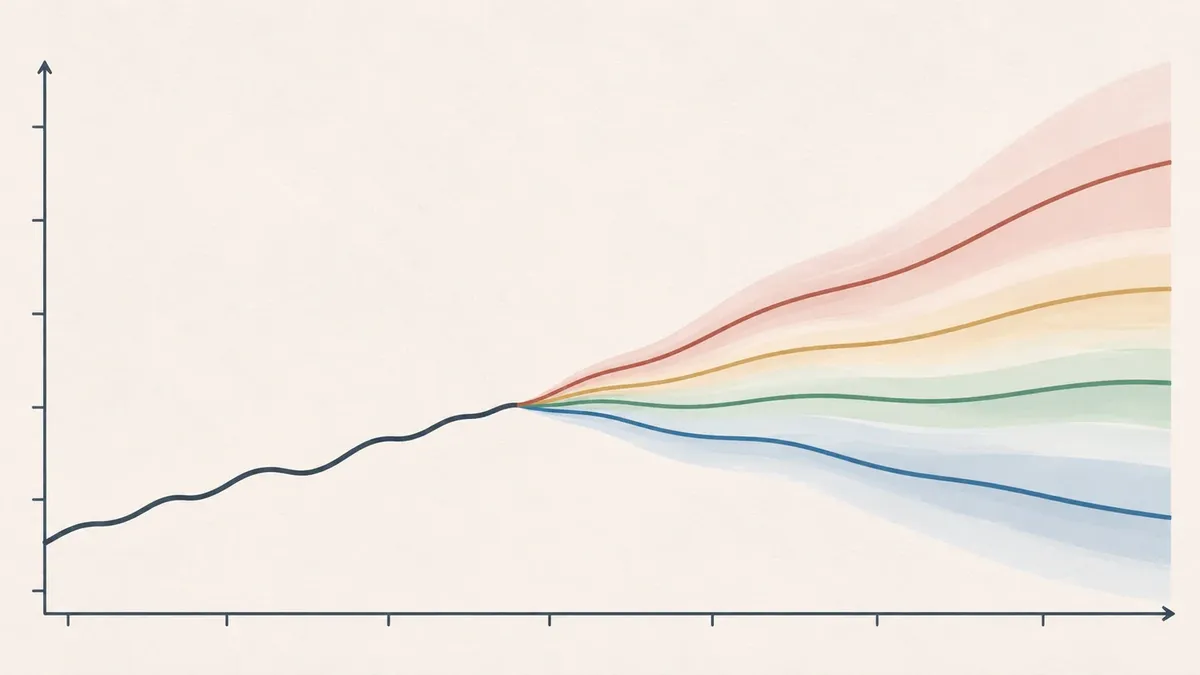
A forecast can be accurate without revealing whether a model uses scenario information appropriately. What If TSF proposes ways to evaluate how predictions relate when future scenarios differ.
Forecasting models are often assessed by comparing their predictions with what actually happens. But when a model also receives information about future scenarios, accuracy alone may not show whether its forecasts respond appropriately. A model might ignore relevant information, fail to distinguish scenarios with different implications, or overreact to irrelevant or weak signals.
In What If TSF: Evaluating Scenario-Guided Multimodal Time Series Forecasting, Jinkwan Jang and colleagues introduce What If TSF (WIT), a benchmark for evaluating how models respond to future scenarios. The benchmark fixes the forecasting state while systematically varying future scenarios, so forecasts can be compared across scenario conditions.
Three kinds of comparison
The benchmark describes three complementary evaluations. Factual Comparison measures the predictive utility of factual scenario information: whether that information helps prediction.
Relational Comparison evaluates whether forecasts across scenarios satisfy expected relations involving direction, contrast, intensity, and restraint. The abstract names these relation types but does not give examples or define the precise tests, so their operational details cannot be inferred from the supplied information.
Grounded Comparison offers a complementary empirical assessment of scenario-induced forecast revision trajectories where comparable real cases are available. The abstract does not explain how those cases are selected or how the trajectories are measured.
Accuracy is not the whole evaluation
The authors report that gains in factual accuracy do not consistently translate into appropriate responses to alternative scenarios. This supports their argument that multimodal forecasting should be evaluated beyond predictive accuracy. It does not mean scenario information is never useful or that every model responds poorly.
The abstract does not provide numerical results, name the evaluated models or datasets, or describe the detailed experimental protocol. Those details may be in the full paper, but they cannot be assessed from the supplied abstract alone. The size and scope of the reported findings therefore remain unclear here.
As described in the abstract, WIT provides a framework for asking not only whether a forecast is accurate, but also how predictions relate across different scenarios. A benchmark evaluation does not by itself establish that a model understands a scenario or that using its forecasts improves real-world decisions.
This article is based on the paper’s abstract rather than a full-text review. The source is an arXiv preprint, and the supplied information does not establish whether it has undergone peer review. Assessing the benchmark’s implementation and the strength and generality of its evidence requires details beyond those available in the abstract.
- time-series forecasting
- multimodal forecasting
- scenario evaluation
- forecast benchmarks
Related reading
Automatically matched by shared topic keywords. These links do not imply that the sources agree or establish a consensus.
Turning news into numerical clues for forecasting
Source published
Shared keywords: multimodal forecasting, time series forecasting
Could More Computing Time Improve Time-Series Forecasts?
Source published
Shared keywords: time series forecasting
How Small Can a Forecasting Model Be?
Source published
Shared keywords: time series forecasting
A spiking network learns to forecast connected signals
Source published
Shared keywords: time series forecasting
What online LSTMs remember—and where their forecasts can break down
Source published
Shared keywords: time series forecasting