TRANSMISSION // 2601.06035v2
When a Plausible 3D Body Misses the Shape That Matters
Source published
A preprint argues that SAM 3D Body can produce convincing human meshes while smoothing away distinctive anatomy. Its examples raise questions about medical use, but its ambiguously described evaluation and lack of numerical results limit the strength of the evidence.
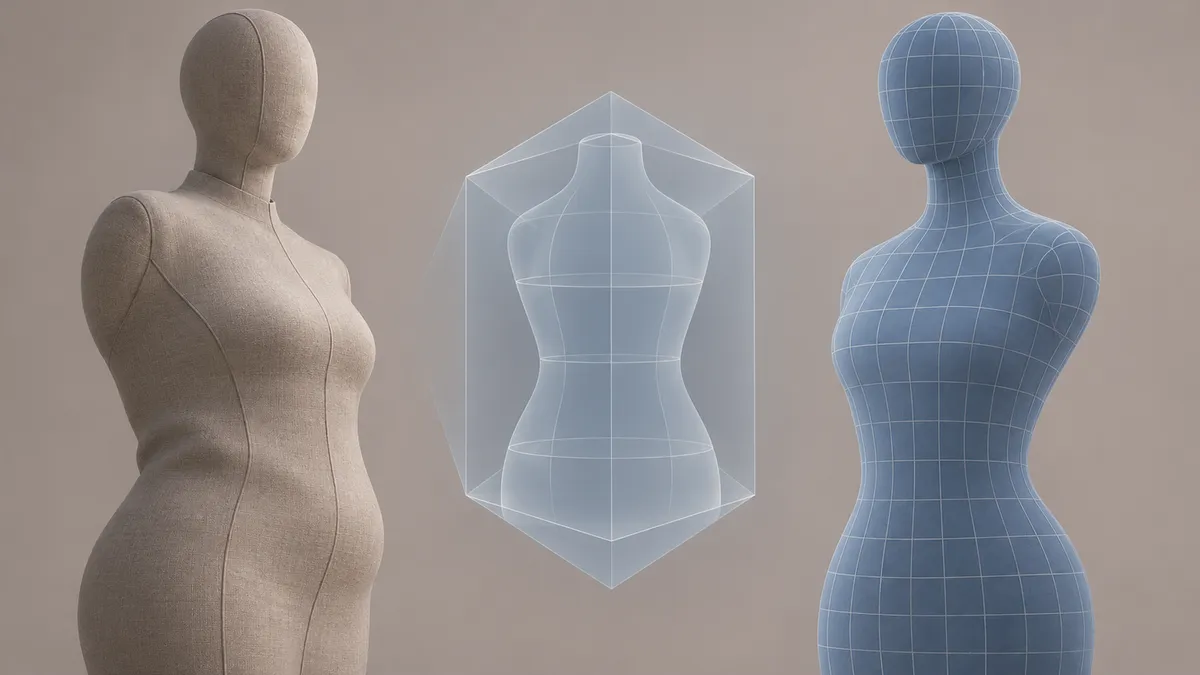
A reconstructed body can look convincingly human without faithfully representing the person in the photograph. Aizierjiang Aiersilan, Ruting Cheng and James Hahn examine that distinction in a preprint about SAM 3D Body, focusing on anatomical differences that could matter for medical applications.
Looking human is not the same as matching a person
SAM 3D Body reconstructs a three-dimensional human mesh from a single image. In Investigating Anthropometric Fidelity in SAM 3D Body, researchers at the George Washington University argue that its ability to produce clean, articulated bodies should not be mistaken for precise anatomical reconstruction.
The preprint, revised in May 2026, describes outputs that smooth away distinctive features associated with pregnancy, scoliosis, unilateral limb loss and severe obesity. Its central concern is not simply missing wrinkles. The authors report that substantial differences in body geometry can also disappear, leaving a more standardized approximation of the photographed person.
That distinction matters for the medical applications discussed in the paper: a plausible pose and an orderly surface do not establish that a reconstruction preserves the anatomy being assessed.
What the evidence establishes—and leaves unclear
The paper illustrates its argument with image-to-mesh examples and a figure comparing commercial-scanner body shapes with SAM 3D Body outputs for a pregnant and a non-pregnant woman. The authors interpret these comparisons as evidence of a tendency toward an average body shape.
The quantitative account requires more caution. The methods section describes an internal protocol involving 500 image-to-mesh pairs derived from clinical surface scans, but calls that evaluation set “hypothetical yet clinically grounded.” This wording leaves unclear whether the stated collection and evaluation were actually completed as described. The figure comparisons should therefore not be presented as validation from an established 500-pair clinical benchmark.
The authors discuss two reconstruction measures. Chamfer Distance compares nearest-point distances between surfaces; Earth Mover’s Distance compares point clouds through an optimal matching. They report low Chamfer Distance for normative healthy adults and increased Earth Mover’s Distance for unusual morphologies. However, the paper supplies no numerical scores for these claims. Readers cannot determine the size or consistency of the reported differences from the account provided.
Three proposed explanations
The first explanation concerns the Momentum Human Rig, or MHR, which supplies the model’s body representation. According to the paper, its shape vector contains 45 components: 20 for the body, 20 for the head and five for the hands. The authors argue that the body’s compressed, linear shape space cannot adequately express some localized anatomical variations.
Their argument is that an image cannot make a parametric model produce a shape outside its available representation. They also report inspecting the open-source release and conclude that manual two-dimensional keypoint prompts can clarify pose without overcoming that representational boundary. This does not establish that every medical variation lies outside the model’s shape space.
The second proposed mechanism involves DINOv3, the visual encoder used to condition reconstruction. The authors suggest that features designed to remain stable across visual changes may underrepresent anatomical differences that matter clinically. Their comparison between pregnant and non-pregnant body embeddings is a theoretical argument, not a reported measurement of those embeddings.
Third, they propose that training data and annotation practices favor conventional body shapes. They argue that fitting and refinement procedures could treat genuine irregularities as errors and replace them with smoother geometry. These explanations are presented through mathematical models and architectural reasoning; the paper does not experimentally isolate their individual contributions.
Together, the authors frame these mechanisms as a “perception-distortion” trade-off: producing a believable human can conflict with preserving the particular subject’s geometry.
Proposed adaptations, not demonstrated fixes
The paper outlines several research directions. Hybrid representations would retain an articulated base mesh while adding a more flexible refinement layer, such as neural signed-distance functions or three-dimensional Gaussian representations. Expanded shape parameters would explicitly represent localized differences rather than relying only on global body shape.
A proposed “Medical-in-the-Loop” process would use qualified domain experts and objectives based on geometric agreement and clinically relevant landmarks. These approaches would require suitable clinical capture and annotation data. They remain proposals, not validated improvements demonstrated in this work.
The authors also suggest simulation uses, including avatar generation and deformable base meshes. The practical message is narrower than a rejection of human mesh recovery: visual plausibility does not establish anatomical fidelity. This preprint raises a concern about diagnostic use, but does not provide a quantified clinical validation or a proven remedy.
- SAM 3D Body
- human mesh recovery
- anthropometric fidelity
- Momentum Human Rig
- medical reconstruction
- parametric body models
- preprint