TRANSMISSION // 2601.05048v3
How charged particles move near black holes
Source published
An analytical model examines particle motion in an idealized magnetic environment around a spinning black hole, including conditions for acceleration near its poles.
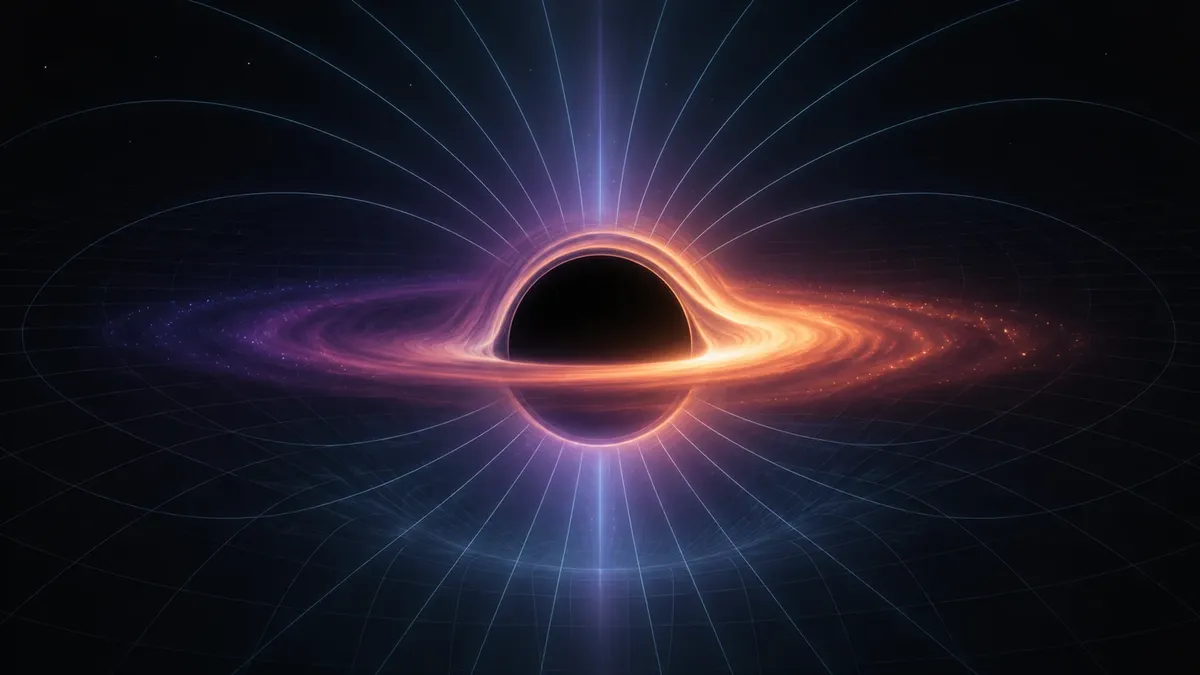
How might individual charged particles contribute to a relativistic jet? A theoretical study uses an idealized model of a spinning black hole’s magnetosphere to derive conditions for polar motion, particle acceleration and blueshift.
Relativistic jets—flows of plasma—are observed in systems including active galactic nuclei and X-ray binaries. Simulations can reproduce jets in the changing magnetospheres around spinning black holes, but analytically describing the paths of the individual charged particles that make up a jet remains difficult.
In an arXiv preprint, Jibril Ben Achour, Ileyk El Mellah and Eric Gourgoulhon approach that question with a mathematical model. They study charged particles near the poles of a rotating black hole and ask what their motion can reveal about possible jet launching.
An idealized magnetosphere
The authors use a Kerr black hole, the rotating-black-hole solution of general relativity, surrounded by a magnetic configuration called a monopole magnetosphere. They focus on electrogeodesic motion: the motion of charged particles under gravitational and electromagnetic influences. According to the abstract, this setup makes the motion integrable, allowing the authors to analyze particle trajectories mathematically.
This is a model of particle motion in a specified magnetic environment, not a simulation of a complete, evolving jet. The authors also report that their results extend to a split-monopole Kerr solution, with a redefinition of the charged particles’ angular momentum. The abstract does not provide further detail about that configuration or the redefinition.
Conditions for motion and acceleration
One result is a criterion for when the black hole’s rotation axis can be a stable position in latitude for a particle. The authors describe this as representing an idealized jet. This is a theoretical condition within their model, not evidence that particles in observed jets follow that path.
The analysis also gives an expression for magnetic frame-dragging, a term the authors use for an effect associated with particle motion in the magnetosphere around a rotating black hole. And it derives a condition under which an observer far away would measure particles from the black hole’s surroundings as blueshifted: their measured energy would be shifted upward relative to the relevant comparison.
For acceleration, the abstract reports a restricted region where particles can be accelerated. The maximum radius of this region depends on the black hole’s spin and magnetization. The abstract does not give a numerical boundary or define magnetization in detail, so the result cannot be translated here into a specific distance for an astronomical object.
What the result does not establish
The study provides an analytical framework for examining how charged-particle motion relates to a rotating black hole’s magnetosphere. It does not, on the evidence available here, show that these trajectories are the mechanism responsible for launching observed jets. Nor does the abstract report a direct comparison with astronomical observations.
The source available for this article is the paper’s abstract, rather than its full text. That limits what can be assessed about the derivations, assumptions, parameter ranges and checks on the model. The work is an arXiv preprint, and the supplied information does not establish whether it has undergone peer review. Its findings should therefore be understood as results within an idealized theoretical setup, not as a complete or confirmed account of jet launching.
- black holes
- relativistic jets
- Kerr magnetosphere
- charged particles
- electrogeodesic motion
- astrophysics
Reviewed cross-references
These connections were reviewed by a model, not independently fact-checked by a human. Similarity does not imply agreement; consult the original papers and the evidence below.
Two gamma-ray-producing regions emerge in black hole simulations
Supporting evidence: Both studies find particle acceleration in a black-hole magnetosphere: Ben Achour et al. derive acceleration for charged test particles in a Kerr monopole field, while Kin et al. simulate acceleration in a polar spark gap. This is qualitative support for acceleration as a possible magnetospheric process, not evidence that the mechanisms or conditions match; the analytic model uses a vacuum test field, whereas the simulations include plasma, radiation, and pair production.
Model review: · openai-codex/gpt-6-luna
Evidence and provenance
Selected excerpts, not complete papers. PDF extraction can omit figures or damage equations, tables and reading order; sources may be preprints.
2601.05048v3 — Original paper
Excerpt reference:
static/papers/2601.05048v3.md:13-103
Basis: Paper text
Source SHA-256:62533f5fba53e5f8c85fd4001cc9fcca4aa4db9edf5a172f99750efd00727b7e2611.10428v1 — Original paper
Excerpt reference:
static/papers/2611.10428v1.md:12-61
Basis: Paper text
Source SHA-256:86dee3a43bb6b6d376d8972be538bd2efe29c73033c9a3acea33c7becc4746db
Related reading
Automatically matched by shared topic keywords. These links do not imply that the sources agree or establish a consensus.
A narrow black-hole jet could explain a seven-hour gamma-ray burst
Source published
Shared keywords: relativistic jets
Radio and optical rhythms hint at changes in a blazar’s jet
Source published
Shared keywords: relativistic jets
Falling merger debris could fuel—and frustrate—a second cosmic jet
Source published
Shared keywords: black holes, relativistic jets
Blazar polarization hints at magnetic changes that build on one another
Source published
Shared keywords: relativistic jets
Webb maps gas and stars moving differently around faint active black holes
Source published
Shared keywords: black holes