TRANSMISSION // 2601.03286v2
A Korean-first vision-language model puts reasoning and tool use to the test
Source published
NAVER’s HyperCLOVA X 32B Think combines Korean-focused reasoning, image understanding and agent training. Its report finds strengths on Korean and tool-use tests, alongside weaker results on some English benchmarks.
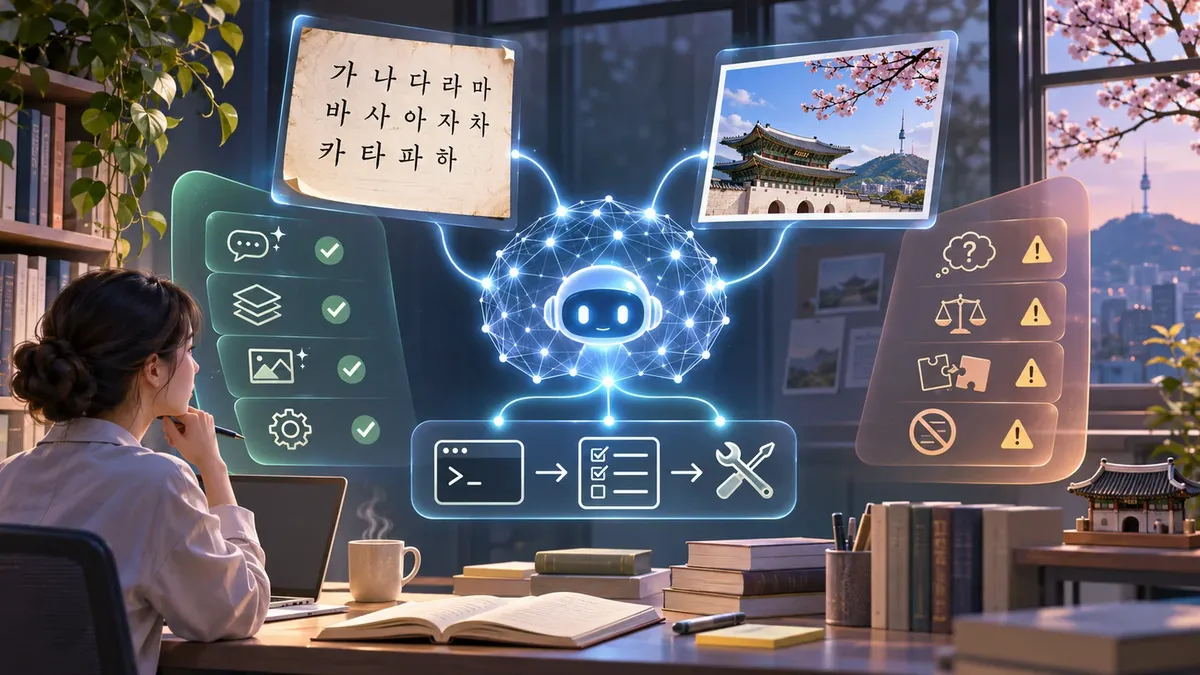
Can a model built to reason in Korean also interpret images and carry out multi-step tasks with tools? NAVER Cloud’s HyperCLOVA X 32B Think is designed to do all three. The team reports competitive results on several Korean-language and agent benchmarks, but its own evaluations also show weaker performance on some English tests.
A model that can answer questions in Korean, interpret an image and use tools to complete a task needs more than a larger store of facts. It must connect language with visual information, sustain multi-step reasoning and respond coherently as an environment changes. HyperCLOVA X 32B Think, a model from NAVER Cloud, is designed around that combination, with particular emphasis on Korean language and cultural context.
The team’s technical report asks a practical question: can a model trained with a Korean-centered approach also perform well at multimodal understanding and tool-using tasks? The researchers describe the model’s construction and compare its performance with other systems on text, image-question-answering and agent benchmarks. The report is available as an arXiv preprint, and its authors are part of the organization that developed the model.
One model for text, images and tools
HyperCLOVA X 32B Think is a decoder-only Transformer: a language-model architecture that processes text and visual representations together. An image encoder converts pictures into representations that are projected into the language model’s shared processing space. The report also describes video input, handled by sampling frames rather than processing every moment continuously.
Training took place in stages. The team first emphasized broad language knowledge, then increased attention to longer contexts and reasoning, including Korean-focused data. Later supervised fine-tuning added instruction-following and image-related capabilities. Reinforcement learning was used for several goals, among them reasoning, tool use and alignment with human preferences. For agent training, the model interacted with environments; in software-engineering tasks, for example, it could generate code, run it, observe feedback and try again.
The evaluation covered three broad areas: text-to-text tasks, where the model answers written questions; vision-to-text tasks, where it answers questions about images; and agent tasks, where it acts through tools or multi-turn environments. The authors compared it with open models of roughly comparable scale, including Qwen3-VL 32B and InternVL 38B, and included a text-only model in some comparisons. For agent tests, they also included larger commercial systems. Benchmarks included Korean language and knowledge tests, image-based assessments, Tau interactive tasks and TerminalBench command-line tasks. The report says the evaluations used a shared framework and specified configurations, though benchmark results still depend on the prompts, scoring rules and systems used to run them.
Strengths are clearest in Korean
The authors report that HyperCLOVA X 32B Think performs strongly across many Korean text benchmarks, including tests of cultural knowledge, language and professional subjects. On Korean image-understanding evaluations, it was competitive across most tasks and ranked particularly highly on KoNET, an education-focused benchmark. The team also reports strong results on some tool-use evaluations, where the model must complete tasks over multiple interactions or work in a terminal.
The picture is not uniformly positive. The report says the model performed below some comparison systems on English text benchmarks such as HellaSwag and PIQA, and on several English image benchmarks. It reports a stronger result on TextVQA, which tests reading text in images. In other words, success on one English visual task does not establish a general advantage across English-language image understanding.
A further caveat comes from the team’s own discussion of training. The model began as a text-focused system and was later extended to handle images. The authors say text benchmark performance gradually declined as multimodal training progressed, a pattern they associate with catastrophic forgetting: gains in new capabilities can come with losses in earlier ones. That observation is a reported training trend, not proof that multimodal training always causes such losses.
What the results do—and don’t—show
Benchmark comparisons provide useful evidence about performance on selected tasks, not a complete measure of real-world ability. Results can shift with evaluation design, and success in a simulated agent environment does not guarantee reliable behavior in every workplace or service. The report’s claims about Korean cultural understanding, practical usefulness and efficiency should therefore be read as interpretations of the tests presented, rather than as settled conclusions about all users or settings.
The source is a technical report posted on arXiv, not evidence here of independent peer review. It is also written by the model’s developers, so external replication and evaluation would help establish how well the results generalize. The report says the model’s weights are released under a custom license that permits commercial use subject to conditions; “open-weight” does not mean unrestricted use. Taken together, the work presents a Korean-centered multimodal model with reported strengths in Korean tests and agent benchmarks, while making clear that performance varies by language and task.
- HyperCLOVA X 32B Think
- vision-language models
- Korean AI
- AI reasoning
- AI agents
- multimodal models
Reviewed cross-references
These connections were reviewed by a model, not independently fact-checked by a human. Similarity does not imply agreement; consult the original papers and the evidence below.
How HyperCLOVA X 8B Omni Brings Text, Audio and Vision Together
Shared method: Both reports describe Korean-oriented text tokenization that combines morphology-aware pre-tokenization with low-probability StoChasTok and adapts an English-centric subword vocabulary. The Omni report says it follows THINK’s pipeline; this establishes a shared tokenizer method, not equivalent model performance or training outcomes.
Model review: · openai-codex/gpt-6-luna
Evidence and provenance
Selected excerpts, not complete papers. PDF extraction can omit figures or damage equations, tables and reading order; sources may be preprints.
2601.03286v2 — Original paper
Excerpt reference:
static/papers/2601.03286v2.md:133-166
Basis: Paper text
Source SHA-256:2f3159ed3a5bb0ed82347a8ff4223badd58103f09626aa8a64eca49e106827922601.01792v2 — Original paper
Excerpt reference:
static/papers/2601.01792v2.md:88-146
Basis: Paper text
Source SHA-256:d31abaeaa6b4fc2189912cadd54192eea9e1bbf47872ac45a223f831d585c918
Related reading
Automatically matched by shared topic keywords. These links do not imply that the sources agree or establish a consensus.
Can an image generator learn from its own critiques?
Source published
Shared keywords: vision language models
When a Picture Hints at a Harmful Task, AI May Help
Source published
Shared keywords: multimodal models, vision language models
When visual AI learns the answer but loses the thread
Source published
Shared keywords: vision language models
Teaching vision-language AI when a short answer is enough
Source published
Shared keywords: vision language models
When turning text into images makes AI think longer
Source published
Shared keywords: ai reasoning, vision language models