TRANSMISSION // 2601.01792v2
How HyperCLOVA X 8B Omni Brings Text, Audio and Vision Together
Source published
NAVER’s HyperCLOVA X 8B Omni uses a shared Transformer backbone with specialized components for text, audio and vision. Its developer reports mixed results across selected benchmarks.
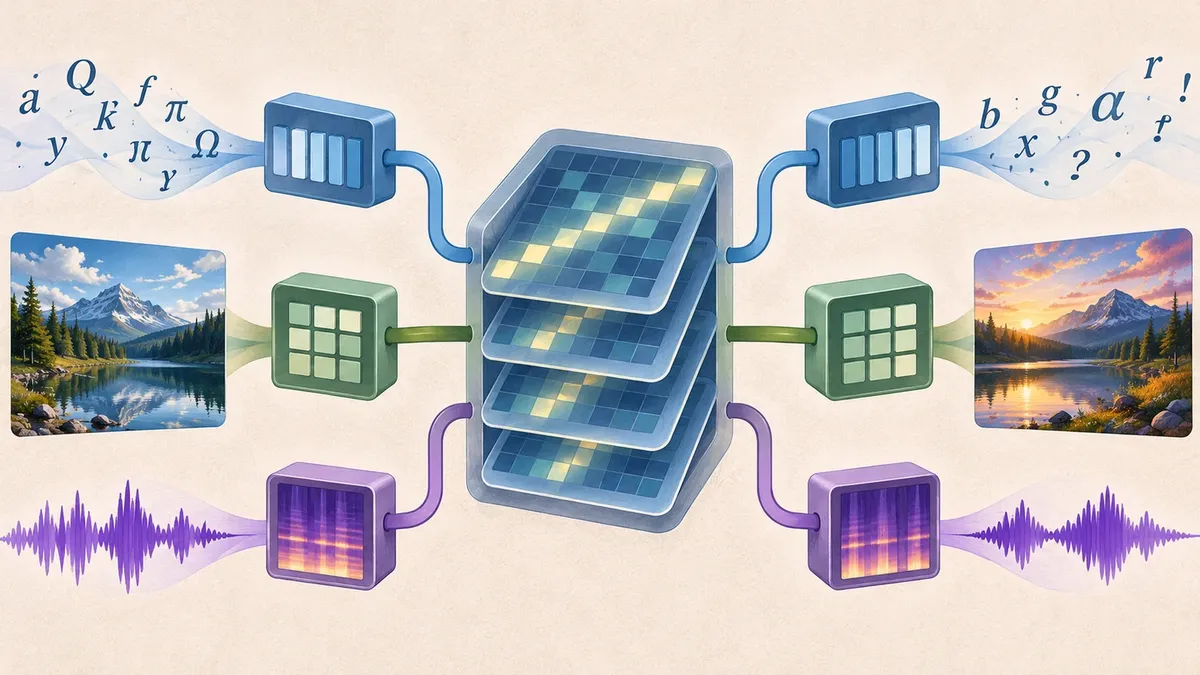
Can one AI model work with text, audio and images as both inputs and outputs? NAVER Cloud’s HyperCLOVA X 8B Omni is designed to do that, using a shared Transformer backbone alongside components specialized for different media. Its developers report competitive results on selected tasks, while describing the model as an early step toward broader multimodal assistants.
One backbone, distinct modality components
HyperCLOVA X 8B Omni addresses a broad design question: can a single model framework understand and generate text, audio and visual content? For example, the system’s supported modalities make a spoken question about an image followed by a spoken answer a plausible interaction. That example describes a possible use, not a result reported in the evaluations.
In a technical report, NAVER Cloud’s HyperCLOVA X Team describes the model as the first in the HyperCLOVA X family to support text, audio and vision as both inputs and outputs. The “8B” name identifies its scale; the report does not explicitly state a parameter count. Nor does “single model” mean that every kind of media is handled by identical components: the design combines a shared Transformer backbone with modality-specific tokenizers, encoders and decoders.
How the system works
The backbone is a decoder-only Transformer trained to predict the next item in a sequence. That sequence can interleave text tokens with representations of image and audio content. Discrete tokens give the model units it can predict; continuous embeddings from vision and audio encoders are also supplied for fine-grained understanding and grounding. When it generates visual or audio content, specialized decoders convert representations into pixels or waveforms.
Training was staged. The report describes text pretraining, followed by multimodal training with discrete modality tokens, then later integration of continuous encoders. The vision encoder was actively optimized during a vision-focused phase; the audio encoder was subsequently aligned using a lightweight adapter while the main backbone remained frozen. The system was then instruction-tuned in stages for conversational and multimodal tasks.
This architecture provides one framework for multiple input-output combinations, but the report does not isolate whether sharing components, rather than other aspects of the design and training, accounts for particular benchmark results.
What the report says the evaluations found
The team says it evaluated tasks spanning text, vision and audio, including text-to-text, image understanding and generation, speech recognition, audio captioning, speech translation and text-to-speech. These are the report’s stated task categories, not a claim that every category has a fully documented or independently verified result here. Evaluations were conducted on selected Korean and English tasks; the report does not establish that every task category was tested in both languages. Baselines also varied according to which tasks they support.
Results are task-specific. On Video-MME, evaluated without subtitles, the report gives HyperCLOVA X 8B Omni a score of 58.2, below the 64.3 reported for Qwen2.5 Omni 7B. The authors describe the result as competitive for the model’s scale. They report state-of-the-art word error rates on the Korean speech-recognition benchmarks KsponSpeech and Fleurs-ko. For speech translation, they report the highest scores among the evaluated systems in both English-to-Korean and Korean-to-English directions. Those rankings apply to the benchmarks and comparison systems described, not to all models or real-world situations.
For text-to-speech, 30 listeners evaluated 20 utterances per model across five systems, with 100 evaluations per listener. The report describes the results as competitive for naturalness and pronunciation clarity in English and Korean, and says the model received higher scores than comparison systems for Korean speech. This was an internal test set: it provides evidence about those samples and listeners, not a general assessment of speech quality across voices and settings.
What remains uncertain
The report describes the 8B-scale model as a pathfinding point and proposes scaling up as future work. Its evaluations cover selected benchmarks; they cannot establish performance across every language, task or deployment. The report also notes a design trade-off in vision generation: semantic tokenization can lose fine visual detail, and non-square images are resized during tokenization, potentially distorting geometry. The authors say their tests did not show severe degradation, but that does not settle performance where precise shapes matter.
The weights are released under a custom license, with commercial use permitted subject to conditions. This is a technical report from the model’s developer and an arXiv preprint, not independent confirmation of its claims. Broad modality support, by itself, does not demonstrate reliability, safety or cost-effectiveness in a particular application. The results are best read as an initial, benchmark-based account of a shared-backbone design with distinct components for different media.
- HyperCLOVA X
- multimodal AI
- audio models
- vision-language models
- AI evaluation
- NAVER Cloud
Reviewed cross-references
These connections were reviewed by a model, not independently fact-checked by a human. Similarity does not imply agreement; consult the original papers and the evidence below.
Can one AI encoder handle pictures, video and sound?
Shared method: Both papers describe jointly training one shared Transformer backbone across modalities rather than using wholly separate modality-specific models. The designs differ: HyperCLOVA X 8B Omni is an autoregressive text-audio-vision model with interleaved tokens and embeddings, while Omni-Encoder is a contrastive encoder for image, video, audio, and audiovisual inputs; this connection is limited to shared-backbone joint training, not equivalent objectives or capabilities.
Model review: · openai-codex/gpt-6-luna
Evidence and provenance
Selected excerpts, not complete papers. PDF extraction can omit figures or damage equations, tables and reading order; sources may be preprints.
2601.01792v2 — Original paper
Excerpt reference:
static/papers/2601.01792v2.md:88-146
Basis: Paper text
Source SHA-256:d31abaeaa6b4fc2189912cadd54192eea9e1bbf47872ac45a223f831d585c9182611.05406v1 — Original paper
Excerpt reference:
static/papers/2611.05406v1.md:147-198
Basis: Paper text
Source SHA-256:7e2d9c854ed2bf093fd47a501d09082699bec8a18b758480be3b333add87b17a
Related reading
Automatically matched by shared topic keywords. These links do not imply that the sources agree or establish a consensus.
A Korean-first vision-language model puts reasoning and tool use to the test
Source published
Shared keywords: vision language models
Teaching a Vision-Language Model When to Abstain—While Preserving Its Answers
Source published
Shared keywords: ai evaluation, multimodal ai, vision language models
Can AI read artistic intent in audiovisual art?
Source published
Shared keywords: multimodal ai
AVIS Lets Vision-Language Models Spend Effort Where It May Help
Source published
Shared keywords: multimodal ai, vision language models
Why a personal AI assistant needs to find the right person first
Source published
Shared keywords: multimodal ai, vision language models