TRANSMISSION // 2512.24304v3
A quantum bound-breaking claim hinges on time evolution
Source published
A theoretical reanalysis argues that a reported temporal quantum-bound violation arises from inconsistent definitions of evolution across time intervals.
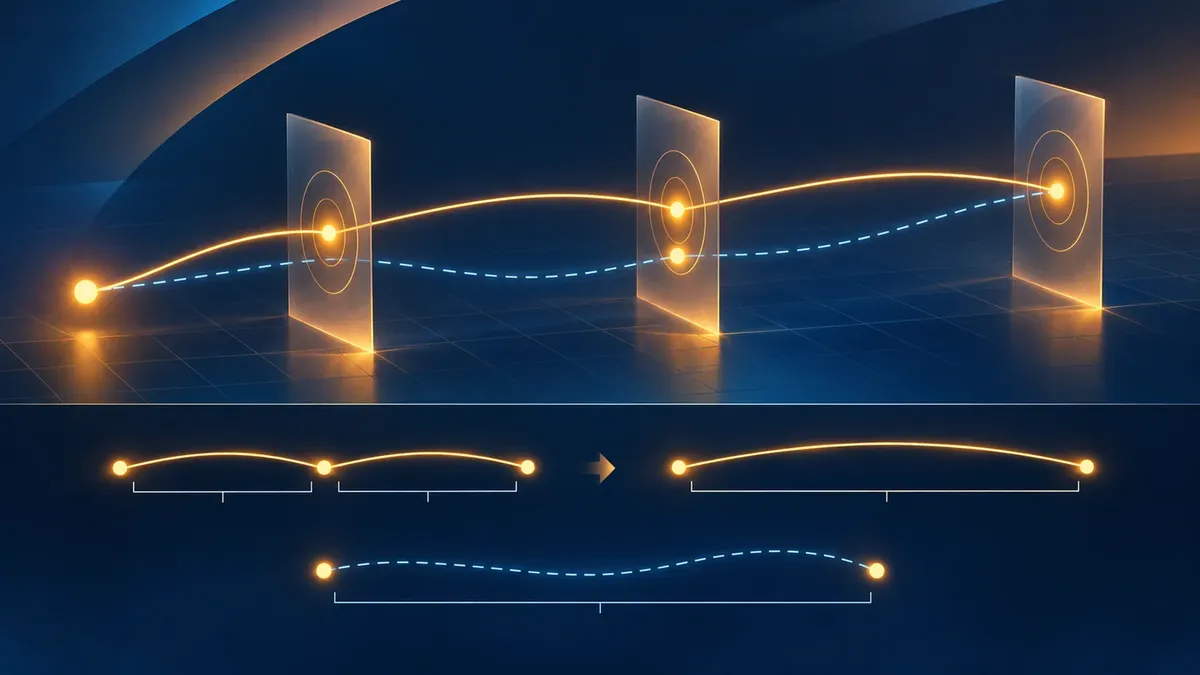
A 2025 experiment reported correlations beyond a quantum limit for measurements made at different times. Antoni Wójcik and Jan Wójcik argue that the apparent excess comes from combining interval-evolution operators that do not satisfy a consistency condition required for testing that limit.
What is the temporal Tsirelson bound?
Quantum mechanics allows correlations that classical physics cannot explain, but quantum correlations also have limits. In the Leggett–Garg framework, researchers examine correlations between measurements made on the same system at different times. The temporal Tsirelson bound limits a particular combination of those correlations.
In In defense of temporal Tsirelson bound, Antoni Wójcik and Jan Wójcik revisit a 2025 experiment by Chatterjee and colleagues. That experiment reported exceeding the bound using a qubit—a two-state quantum system—and described its dynamics as a “superposition of unitary time evolutions.” The new paper challenges both that description and the claim that the bound was violated.
A conventional description of the dynamics
The authors analyze the mathematical operation used in the earlier work and show how to describe it as ordinary unitary evolution generated by a time-dependent Hamiltonian. A Hamiltonian specifies how a quantum system changes over time. In the authors’ formulation, its magnitude varies while its direction stays fixed.
That reinterpretation does not mean the system is not evolving or that the operation cannot be implemented. Rather, the authors argue that this particular dynamics does not require a new concept in which a system follows multiple distinct evolutions at once; it can be expressed within conventional quantum mechanics.
Their main criticism concerns how the experiment’s measurements were combined. A three-time Leggett–Garg test uses correlations from three pairs of times. For those correlations to form a consistent test, the evolution from the first time to the third must agree with evolving from the first to the second and then from the second to the third. In operator language, the interval evolutions must obey a composition condition.
The authors say the earlier analysis used one operator for each short interval but a separately defined operator for the full, longer interval. For the dynamics in question, the full-interval operator is not generally equal to applying the short-interval operator twice. They therefore argue that the reported correlation combination did not meet a necessary condition for applying the temporal Tsirelson bound.
What changes when intervals are defined consistently?
The paper examines two alternative ways to define the interval operators so they satisfy the composition condition. In one, the same short-step evolution is applied twice. In the other, the second step uses the appropriate propagator for a time-dependent Hamiltonian. The authors report that neither version exceeds the temporal Tsirelson bound.
They also examine the bound-related quantity across time intervals and maximize it over a specified interval range for fixed model parameters. In the consistent scenarios, they report that the maximum stays within the bound. The apparent excess occurs only in the calculation they identify as using inconsistent interval definitions.
The conclusion is specific: the authors dispute whether this result is a valid violation of the quantum bound, not whether quantum systems can show unusual temporal correlations or violate classical Leggett–Garg limits. They say the protocol could be modified using NMR techniques developed by the earlier team, but this paper does not report a new experiment implementing those changes.
What remains uncertain
This is a theoretical reanalysis of a reported experiment, not an independent replication. Its conclusion depends on the authors’ account of the consistency condition and how it applies to the earlier protocol. The supplied material does not include a response from the original authors, and incomplete search results cannot establish scientific consensus or rule out counterarguments. The critique should therefore be read as an argument about this specific test, not as a settled resolution of the dispute.
There is a source-version caveat: the supplied arXiv record identifies version 3 as posted on December 30, 2025, while the extracted paper text gives a date of November 23, 2026. The available material does not explain the discrepancy. The work is an arXiv preprint, and the source information here does not establish whether this version has undergone peer review. The paper’s central methodological point is that a claimed bound violation should be assessed only after checking that the interval evolutions satisfy the assumptions behind the bound.
- quantum physics
- Leggett–Garg inequality
- temporal Tsirelson bound
- quantum measurement
- unitary evolution
- preprint
Related reading
Automatically matched by shared topic keywords. These links do not imply that the sources agree or establish a consensus.
The control cost of resetting a qubit without revealing its past
Source published
Shared keywords: quantum physics
One Quantum Measurement Sends Out Many Different Fronts
Source published
Shared keywords: quantum measurement
A probability table may reveal what a quantum channel does—and what the lab is doing
Source published
Shared keywords: quantum measurement
How extra copies change the way we read three-qubit entanglement
Source published
Shared keywords: quantum measurement
A statistical correction helps VQE escape measurement plateaus
Source published
Shared keywords: quantum measurement