TRANSMISSION // 2512.21234v2
Inflation with friction: why gravity demands a careful theory
Source published
A proposed framework shows how to describe dissipation and noise during inflation without making gravity’s equations internally inconsistent. Its key result is a minimal allowed modification—not evidence that this specific form of dissipation occurs in the early universe.
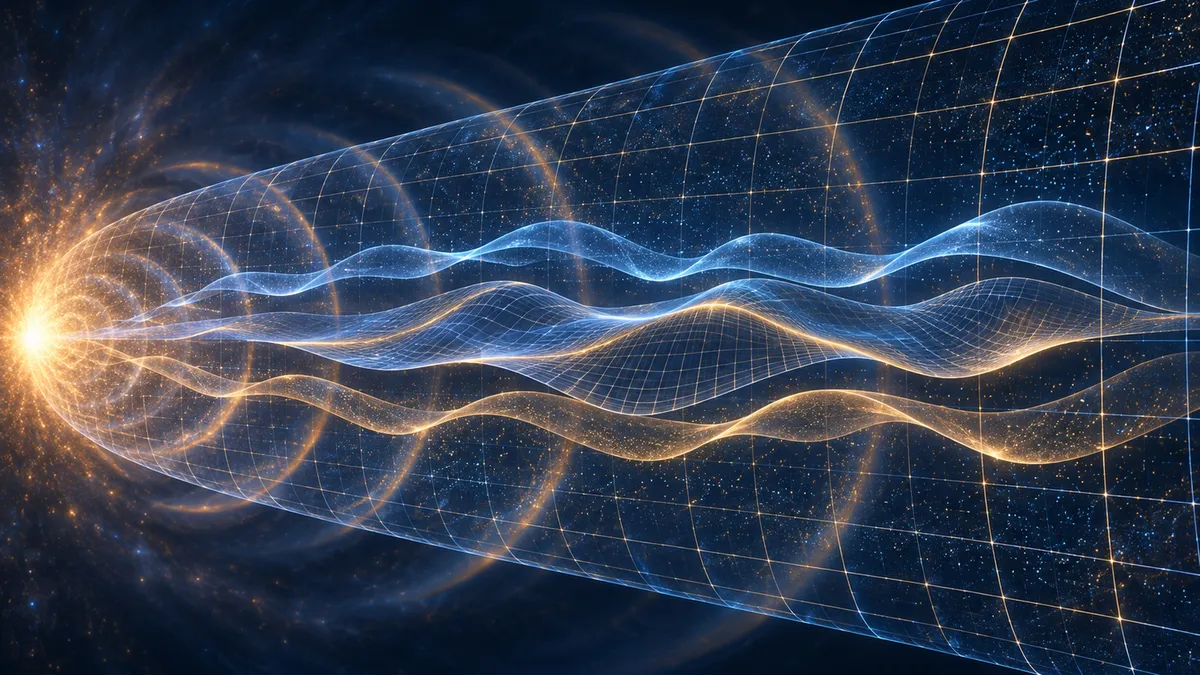
Inflation is often modeled as a self-contained system. But if the field driving it interacts with other, unobserved fields, those interactions can act like friction and add random noise. How can physicists include such effects while keeping gravity’s equations consistent? Perseas Christodoulidis and Jinn-Ouk Gong construct a framework for doing so, and show why many seemingly allowable additions do not work.
During cosmic inflation, the early universe expanded at an accelerating rate. The process is usually described with equations for the inflating field and gravity. But if the inflating field exchanges energy with other fields—perhaps fields too heavy or complicated to track directly—the remaining system is effectively “open.” Like a moving object in a fluid, it may experience dissipation, and its motion may be affected by fluctuations in its environment.
The challenge is not simply to add a friction term. Gravity’s equations are linked by constraints and identities that reflect the theory’s coordinate freedom. If new terms break those relationships in the wrong way, the equations can demand more independent conditions than the system can satisfy. The result is not a consistent description of a propagating fluctuation.
In this preprint, Christodoulidis and Gong ask how to build an open effective field theory (EFT) of inflation that keeps gravity in the picture. An EFT is a way of organizing a theory around the ingredients and scales relevant to a problem, without specifying every microscopic detail. The authors use the Schwinger–Keldysh framework, a method for describing systems that interact with unobserved degrees of freedom. In this approach, the fields are doubled into two copies, which allows the equations to encode both dissipative effects and noise.
The authors focus on a local, or Markovian, approximation: the environment is assumed to relax much faster than the inflationary dynamics of interest. Under that assumption, its influence can be represented with local terms rather than a detailed history-dependent response. They examine which such terms can be added while preserving a workable gravitational constraint structure.
Their central finding is restrictive: symmetry alone permits many candidate open terms, but most of those the authors investigate overconstrain the scalar equations. In their examples, the equations fail to retain the expected propagating scalar mode once the full gravitational constraints are included. They also show why checking a simplified “decoupling” limit—where metric fluctuations are neglected—can miss this problem. A term that appears acceptable in that limit may fail when gravity is restored.
The authors identify a minimal candidate that does work: a particular trace-adjusted combination of the extrinsic curvature, a quantity describing how spatial slices change through time. This term gives the equations a modified, or “deformed,” identity that links them together. In the framework they construct, the resulting theory has one propagating scalar mode and two tensor modes, as in the standard inflationary setup. The scalar’s equation takes a Langevin-like form, meaning it includes both a dissipative contribution and a noise source.
The paper also discusses the scalar power spectrum—the distribution of sizes of curvature fluctuations across different scales. It separates contributions associated with the initial quantum state and with noise. The authors say the noise contribution depends on the chosen noise kernel, so the prediction is model-dependent. Their construction therefore supplies a consistent framework for exploring such effects; it does not establish a single universal power spectrum or a measured signal.
There are important limits to what this result shows. The work is theoretical: it constructs and analyzes equations rather than testing an inflationary model against new observations. Its local description assumes rapidly relaxing environmental degrees of freedom, and the authors identify a broader classification of consistent operators and nonlinear predictions as work for the future. They specifically point to questions about higher-order correlations, including the bispectrum. The paper is an arXiv preprint, and the evidence provided here does not establish peer-review status or independent confirmation. Its conclusions should be read as a proposed consistency framework, not as evidence that dissipation of this form occurred in the universe.
- cosmic inflation
- gravity
- effective field theory
- open quantum systems
- dissipation
- Schwinger–Keldysh
Related reading
Automatically matched by shared topic keywords. These links do not imply that the sources agree or establish a consensus.
How neutron-star tides could reveal the stars’ hidden vibrations
Source published
Shared keywords: effective field theory
What a system’s relaxation modes can—and cannot—reveal about equilibrium
Source published
Shared keywords: open quantum systems
Counting the cost of simulating light and matter on a quantum computer
Source published
Shared keywords: open quantum systems
Stability Limits a Class of Interacting Dark-Sector Models
Source published
Shared keywords: effective field theory
Planck reanalysis finds a modest hint of inflation-era particle signatures
Source published
Shared keywords: cosmic inflation