TRANSMISSION // 2512.19888v3
Early dark energy faces a tight cosmic ceiling
Source published
A comparison of dark-energy models finds little room for an early scaling phase to change the expansion history or ease the Hubble tension.
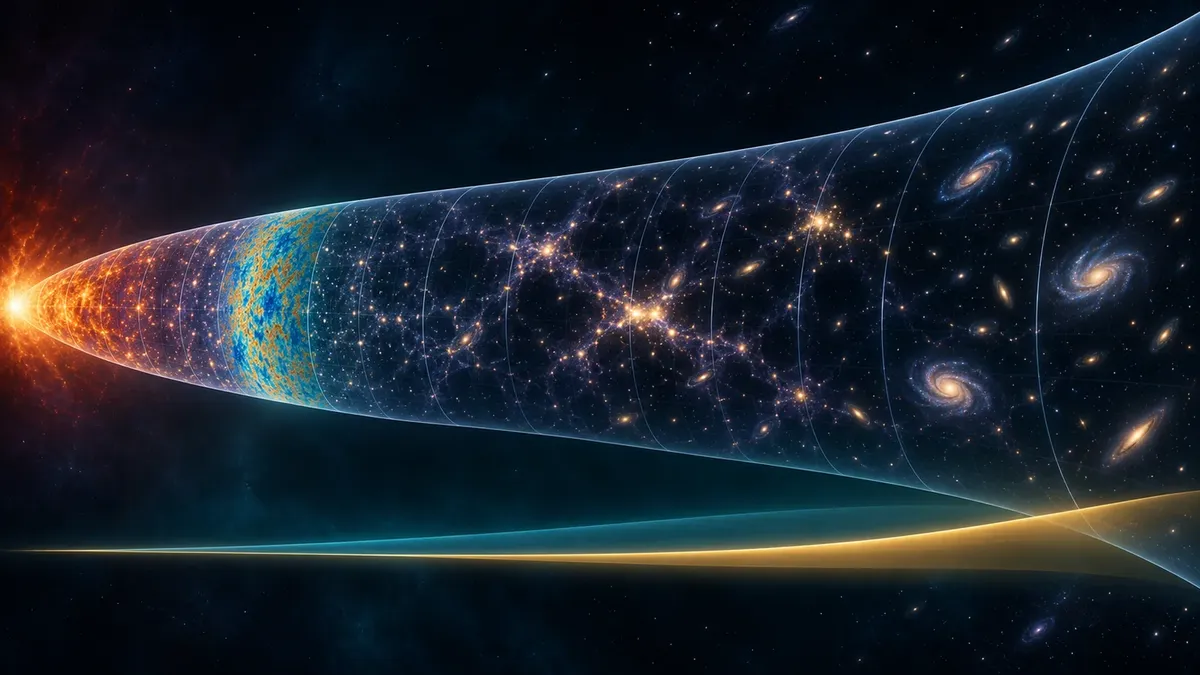
Could dark energy have mattered more in the young Universe and still explain today’s accelerated expansion? A study testing several scalar-field models against cosmic microwave background, galaxy-survey and supernova data finds that any early scaling contribution must be small. The models do not shift the inferred expansion rate enough to ease the Hubble tension.
Dark energy is the name given to whatever is driving the Universe’s expansion to speed up. In the standard cosmological model, ΛCDM, that role belongs to a cosmological constant. But some combinations of recent measurements have motivated tests of alternatives in which dark energy changes over time. One question is whether a field could have contributed a little in the early Universe, then evolved into a form that drives acceleration today.
A new preprint by Sk. Sohail, Sonej Alam and Md. Wali Hossain tests several such possibilities. The models include “thawing” scalar fields, which are initially held nearly still by the expansion before beginning to roll, and “scaling” fields, whose energy density tracks that of the dominant cosmic ingredient—radiation or matter—while remaining a minority. The authors also test scaling fields combined with a cosmological constant or with simple descriptions of evolving dark energy.
Putting models against several kinds of evidence
The team compared predictions with measurements of the cosmic microwave background (CMB), baryon acoustic oscillations (BAO) and Type Ia supernovae. The CMB records conditions in the early Universe; BAO measurements trace a characteristic distance scale in the distribution of galaxies; and supernovae help map how cosmic expansion changed over time.
For each model, the researchers used the Cobaya statistical framework to sample possible parameter values and a modified version of the CLASS cosmology code to calculate predictions. They then assessed how well the models fit the data, including with criteria that penalise extra adjustable parameters. This matters because a more flexible model can often improve a fit simply by having more ways to adapt.
A small allowance for early scaling
Across the tested models, the main background estimates—including the present expansion rate—were broadly consistent. The inferred Hubble constant, H₀, stayed around 67.7–68.3 kilometres per second per megaparsec. In this analysis, none of the models moved H₀ enough to relieve the Hubble tension: the disagreement between some local measurements and values inferred from the early Universe under ΛCDM.
When a scaling phase was included, the allowed peak fraction of early dark energy was below 0.75% for several versions, and below 1.5% for the version paired with a time-varying CPL description. The field’s steep early-time potential also had to be very steep in the models that permit scaling. The authors infer that the field’s contribution around the transition from radiation to matter domination remains below about half a percent. In their analysis, that leaves too little early energy to change the sound horizon—the distance travelled by sound waves in the early plasma—in a way that would address the Hubble tension.
The results distinguish early-time additions from late-time flexibility. A CPL model, a commonly used formula for an evolving dark-energy equation of state, showed a roughly 2.7-sigma preference over ΛCDM in the authors’ likelihood-ratio comparison. Its preferred parameters correspond to phantom-like behaviour at low redshift: in this terminology, an equation of state below −1. This is a preference within a particular model and dataset, not a direct observation of dark energy or proof that it behaves this way. Constant-equation-of-state and thawing models remained consistent with a cosmological constant.
Adding an early scaling field to the CPL model did not improve the fit relative to CPL alone. Other scaling models could fit about as well as ΛCDM, but their additional, weakly constrained parameters led to worse scores under the Akaike and Bayesian information criteria. These comparisons do not establish that the models are impossible; they indicate that, given these data and criteria, extra complexity did not earn a clear advantage.
What the result does—and does not—settle
The analysis tests specific choices of scalar-field potential and late-time behaviour, not every possible theory of dark energy. Its conclusions also depend on the chosen data combination, modelling assumptions, parameter ranges and statistical criteria. The reported preference for evolving dark energy is mild and parametrization-dependent; the authors’ results do not show that a physical scalar field has been detected.
The source is an arXiv preprint, so its claims should be treated as research findings awaiting the usual scrutiny of peer review and independent checks. The paper’s overall message is narrower than a verdict on dark energy: in the models examined, a simple early scaling phase is tightly limited and brings no improvement to the fit, while some late-time descriptions allow a modest preference for evolution.
- dark energy
- cosmology
- Hubble tension
- early dark energy
- DESI DR2
- cosmic microwave background
- scalar fields
Reviewed cross-references
These connections were reviewed by a model, not independently fact-checked by a human. Similarity does not imply agreement; consult the original papers and the evidence below.
The ‘tail’ of early dark energy may matter for the Hubble tension
Shared method: Both studies use cosmological parameter estimation with CMB, BAO and supernova data to test scalar-field dark-energy models. The datasets and model constructions differ: the origin examines early scaling and thawing models with Planck PR4, DESI DR2 and Pantheon+, while the target studies EDE-tail shapes with its specified Planck likelihoods, DESI DR2 and a Cepheid-calibrated supernova sample; this is a methodological connection, not evidence that their findings agree.
Model review: · openai-codex/gpt-6-luna
Evidence and provenance
Selected excerpts, not complete papers. PDF extraction can omit figures or damage equations, tables and reading order; sources may be preprints.
2512.19888v3 — Original paper
Excerpt reference:
static/papers/2512.19888v3.md:56-107
Basis: Paper text
Source SHA-256:23af9e004807c2685c4ebc3e790d3fa618ae43126752392f5ed2c858618d1b5c2611.27069v1 — Original paper
Excerpt reference:
static/papers/2611.27069v1.md:231-287
Basis: Paper text
Source SHA-256:e67c5b67a38200a6d1f90d82999e2a3fb318e1919aead0e42140b632c621d620
Related reading
Automatically matched by shared topic keywords. These links do not imply that the sources agree or establish a consensus.
The ‘tail’ of early dark energy may matter for the Hubble tension
Source published
Shared keywords: cosmic microwave background, early dark energy, hubble tension, scalar fields
A late-time dark-matter supply could soften a cosmological trade-off
Source published
Shared keywords: early dark energy, hubble tension
Two early-universe changes improve a fit to cosmic expansion data—but not across every test
Source published
Shared keywords: cosmic microwave background, early dark energy, hubble tension
Can Ripples in the Universe’s Oldest Light Reveal When New Physics Acted?
Source published
Shared keywords: cosmic microwave background, early dark energy
Can dark matter and dark energy share an origin? A new cosmology test keeps the idea in contention
Source published
Shared keywords: cosmic microwave background, dark energy