TRANSMISSION // 2512.19695v2
Webb probes the chemistry of a galaxy near cosmic dawn
Source published
A 51-hour JWST spectrum detects oxygen and hydrogen emission from JADES-GS-z14-0, but two methods give different estimates of its oxygen abundance.
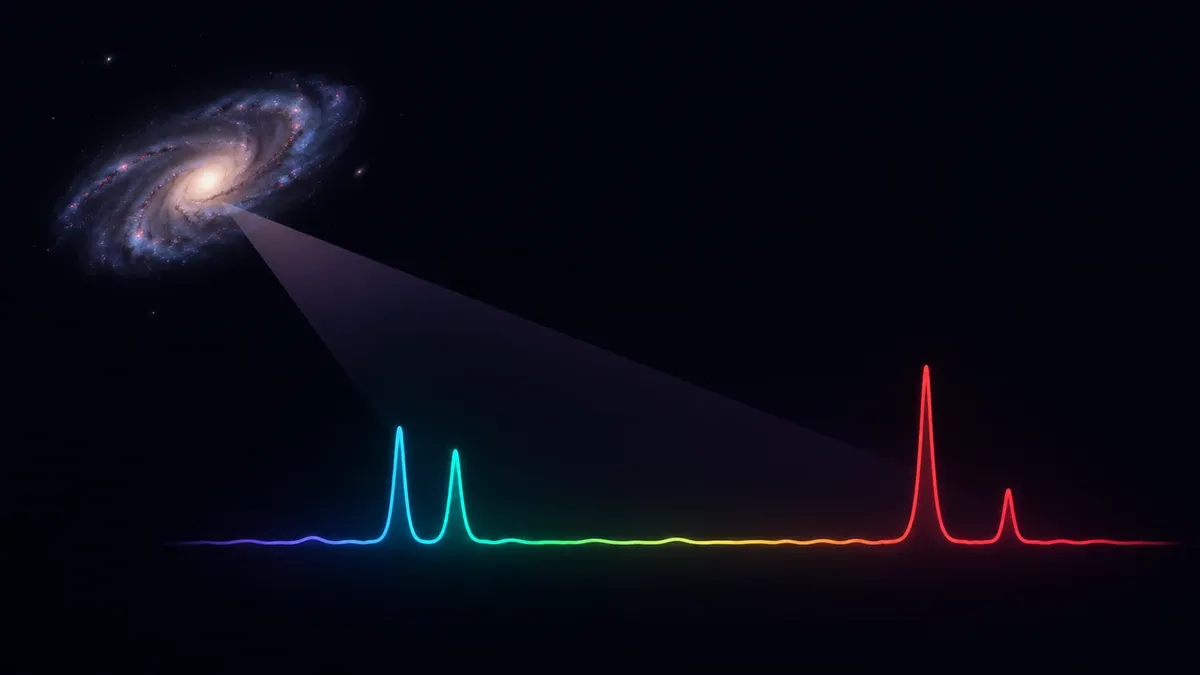
How much had galaxies near cosmic dawn already changed the chemistry of their surroundings? A roughly 51-hour observation with JWST’s MIRI instrument captured emission lines from JADES-GS-z14-0, at redshift 14.18. The lines offer clues about its gas and recent star formation, but estimates of its oxygen abundance differ substantially depending on the method used.
Astronomers use light from distant galaxies to investigate how stars form and how heavier elements accumulate over cosmic time. In an abstract-only report of a new study, Jakob M. Helton and colleagues describe a JWST/MIRI spectrum of JADES-GS-z14-0, at redshift 14.18. The observation lasted about 51 hours, which the authors describe as the longest spectroscopic integration yet acquired with MIRI.
Cosmic expansion shifts light from this distant galaxy to longer wavelengths. In the spectrum, the researchers report detecting a pair of oxygen emission lines, [O III], at about 14 times the measurement uncertainty, and hydrogen-alpha (Hα) at about four times the uncertainty. These nebular lines come from energized gas. Their strengths can help researchers estimate the gas’s physical and chemical properties, though such estimates rely on diagnostic methods and models.
The authors infer that dust dims the galaxy’s light only modestly. They estimate a recent star-formation rate of about eight solar masses per year, with an uncertainty of two, and a rate per unit area of about 20 solar masses per year per square kiloparsec, with an uncertainty of five. They also estimate an ionizing-photon production efficiency of about 10^25.3 in the paper’s units, with an uncertainty of 0.1 in the logarithm. This describes the production of energetic photons; the abstract does not state how many escape the galaxy.
Two routes to oxygen abundance
The chemical estimate depends strongly on the analysis. Using standard strong-line diagnostics—methods that infer gas properties from emission-line strengths—the team estimates an oxygen abundance of [O/H] ≈ −1.2, or about 6% of the Sun’s. The same approach gives a carbon-to-oxygen ratio below the solar ratio, a high ionization parameter, and a hydrogen-particle density of about 690 per cubic centimeter, with an uncertainty of about 200.
Detailed photoionization modeling produces a different oxygen estimate: [O/H] ≈ −0.2, with an uncertainty of −0.4 to +0.4 in the reported logarithmic value, corresponding to about 60% of the Sun’s abundance. These results come from different methods and assumptions, so they should not be treated as matching measurements. The difference underscores that detecting emission lines does not, by itself, settle the galaxy’s chemical abundance.
The authors say the inferred properties resemble those reported for several other luminous galaxies beyond redshift 10 studied with MIRI spectroscopy. They also report that existing simulations do not reproduce this galaxy’s empirical and inferred properties. That points to a challenge for models, but does not identify a particular explanation.
This is one galaxy, observed at one moment in its history; its measurements cannot establish how representative it is. Because the available source is the paper’s abstract, it does not provide enough detail to evaluate the full analysis, diagnostic assumptions, or simulation comparisons independently. The work is identified as an arXiv preprint, and the supplied information does not establish whether it has been peer reviewed. Further observations and analysis will be needed to clarify why the abundance estimates differ and how this galaxy fits into the broader population.
For this observation, the long integration yielded reported detections of emission lines that allow researchers to estimate properties of gas in a very distant galaxy. The contrasting abundance estimates also show why those inferred properties need to be interpreted in light of the methods used.
- JWST
- cosmic dawn
- early galaxies
- JADES-GS-z14-0
- MIRI spectroscopy
- oxygen abundance
- star formation
Reviewed cross-references
These connections were reviewed by a model, not independently fact-checked by a human. Similarity does not imply agreement; consult the original papers and the evidence below.
Why Astronomers Want a Bigger JWST Survey of the First Galaxies
Supporting evidence: Both papers identify limits of drawing population-level conclusions from sparse observations: Helton et al. note that their study concerns one galaxy and that its representativeness is unclear, while the Genesis Initiative white paper argues that current samples are insufficient to distinguish explanations for early-galaxy population trends. The comparison supports the bounded point that broader samples are needed; the white paper is an advocacy document, not an independent observational test.
Model review: · openai-codex/gpt-6-luna
Evidence and provenance
Selected excerpts, not complete papers. PDF extraction can omit figures or damage equations, tables and reading order; sources may be preprints.
2512.19695v2 — Original paper
Excerpt reference:
static/papers/2512.19695v2.md:2497-2564
Basis: Paper text
Source SHA-256:636cb626d27eec842fc0d410d1dc1245efdcfd4ce7fc049fbb4442a5d49264032611.07027v1 — Original paper
Excerpt reference:
static/papers/2611.07027v1.md:199-250
Basis: Paper text
Source SHA-256:21bbc9fbadcac3bc09631fe2f879fad5883582c72c274e01f5330140295453b0
Related reading
Automatically matched by shared topic keywords. These links do not imply that the sources agree or establish a consensus.
AMORE6 offers clues to possible primordial stars
Source published
Shared keywords: early galaxies, oxygen abundance
Five observations that could sharpen our picture of early galaxies
Source published
Shared keywords: cosmic dawn
What powers the Little Red Dots? A model finds smaller black holes in faint galaxies
Source published
Shared keywords: early galaxies
Webb finds a nearly pristine pocket in an early galaxy
Source published
Shared keywords: early galaxies, oxygen abundance
Why Astronomers Want a Bigger JWST Survey of the First Galaxies
Source published
Shared keywords: cosmic dawn