TRANSMISSION // 2512.05659v2
AI may reshape public-service work task by task
Source published
An analysis of UK Civil Service vacancies finds that task-level differences account for more estimated AI-exposure variation than profession and grade. Simulations explore possible redesigns, not actual job losses.
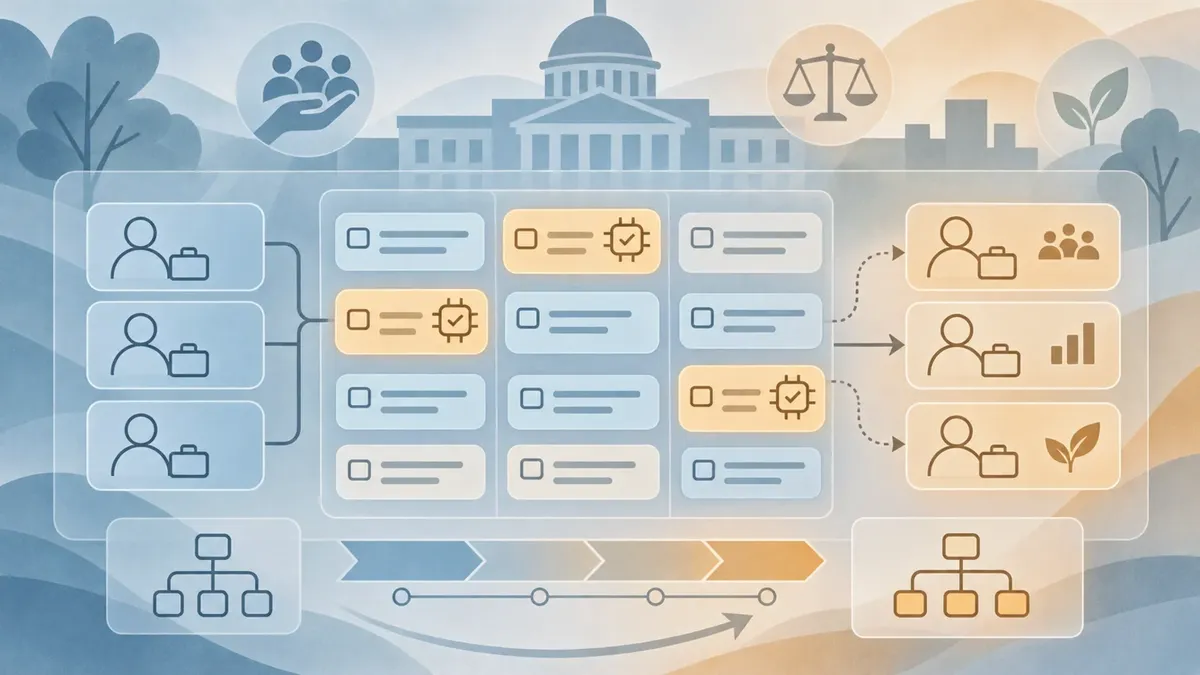
A job title alone may not show how different tasks within a role are estimated to be exposed to AI. Researchers analyzed UK Civil Service vacancy data and simulated ways roles and teams might be redesigned. The simulations are not evidence that staffing has already changed.
Why look at tasks within roles?
A role can be thought of as a bundle of tasks. If those tasks differ in their estimated potential for automation, a job title or grade may not tell the whole story about how AI could affect the work. The paper AI and the Division of Labor in Public Sector Jobs and Teams asks how much estimated exposure varies among tasks within roles, and what that might mean for redesigning public-sector work.
The study focuses on UK Civil Service vacancies. It compares variation in estimated exposure within roles with variation associated with professions and grades, then uses simulations to examine possible changes to roles and teams.
How the study was done
The authors analyzed 283,484 UK Civil Service vacancies and extracted 2.7 million tasks from them. They estimated the automation potential of those tasks using an ensemble of eight foundation models.
These estimates are based on vacancy descriptions and model assessments. They are not records of which tasks have actually been automated. The authors also simulated redesign at the role and team levels. Those exercises describe possible outcomes under the study’s assumptions; they do not show that the changes have happened or will happen.
What the abstract reports
Differences among tasks within roles account for 65.3% of total estimated exposure variance in the analysis. Profession and grade together account for 4.0%. The results point to task-level variation as an important part of the exposure patterns the authors measured, rather than relying only on broad categories such as profession and grade.
The authors propose considering a role’s average exposure alongside how much its tasks differ from one another. They suggest that these measures could help distinguish situations where workforce adjustment, job redesign, targeted task automation, or limited intervention may be relevant. The abstract describes this as a way to think about possible responses; it does not report a test of these choices in public bodies.
In the role-redesign simulation, administration’s share of working time falls from 30.0% to 24.6%, while assurance tasks rise from 8.7% to 14.5%. These figures describe the simulated task mix. They do not establish that AI performs all the work involved or that the changes would improve services.
In the team-level simulation, overlapping roles are merged. The number of distinct roles falls by 17.7%, while headcount falls by 6.4%. The simulated posts removed are from junior and middle grades, leaving the restructured teams weighted toward senior staff. This is a modeled outcome, not a measured change in Civil Service staffing.
What the evidence cannot tell us here
The available source for this account is the paper’s abstract, rather than its full methods, tables, or discussion. It does not provide enough information to assess how the task estimates were validated, how the eight models’ results were combined, or how the simulations respond to different assumptions. These are details unavailable in the supplied source, not established flaws in the study.
The reported exposure estimates and redesign scenarios should not be read as evidence that AI has caused job changes. Nor do the simulations establish that the projected changes will take place. The findings concern UK Civil Service vacancies; the abstract does not establish how well they apply elsewhere.
This paper is a preprint listed on arXiv, and the supplied information does not establish whether it has undergone peer review. For now, its results are best understood as model-based estimates and hypothetical redesign scenarios—not a forecast of actual workforce changes.
- artificial intelligence
- public sector
- UK Civil Service
- task automation
- job redesign
- labor economics
Related reading
Automatically matched by shared topic keywords. These links do not imply that the sources agree or establish a consensus.
What workers value beyond their paychecks
Source published
Shared keywords: artificial intelligence, labor economics
AI Job Ads Promise More Than Higher Pay—but the Benefits Vary
Source published
Shared keywords: labor economics
How robust are wage effects across the income ladder?
Source published
Shared keywords: labor economics
Why competing firms may automate too much
Source published
Shared keywords: labor economics
When Stable Job Matches Lose Their Lattice
Source published
Shared keywords: labor economics