TRANSMISSION // 2512.00672v3
How ML Agents Plan With Specialized Tools
Source published
ML-Tool-Bench evaluates tool-using AI agents on tabular machine-learning challenges. Its abstract reports improved results with deterministic rewards and feedback, and with task decomposition.
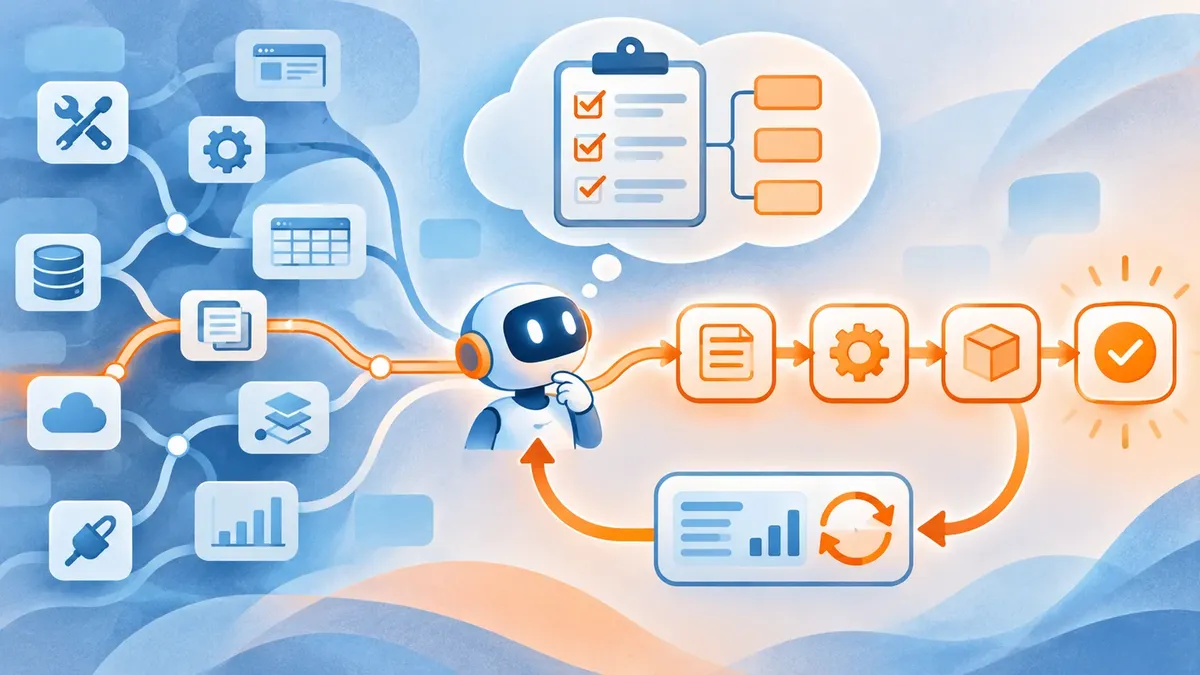
Machine-learning work can involve linked decisions, from data analysis to model selection and tuning. ML-Tool-Bench asks whether AI agents can plan such work using specialized tools—and reports that two planning approaches improved performance on its Kaggle challenges.
An AI agent working on a machine-learning task must coordinate actions, not just call a tool once. ML-Tool-Bench: Tool-Augmented Planning for ML Tasks introduces a benchmark to evaluate that planning ability in workflows involving machine-learning tools.
The authors say that existing tool-use benchmarks tend to focus on narrower skills, such as choosing a tool or supplying arguments for a tool call. Their benchmark is designed to examine planning across more complex workflows. It includes 61 specialized tools and 15 tabular machine-learning challenges from Kaggle. It also supports in-memory named objects, so agents can name, save and retrieve intermediate results as they work.
The abstract reports that standard ReAct-style approaches struggled to produce valid sequences of tool calls for complex machine-learning pipelines. Tree-search methods using language-model-based evaluation also underperformed, which the authors attribute to inconsistent scoring of states.
The paper proposes two approaches to address these difficulties: shaped deterministic rewards paired with structured textual feedback, and decomposing the original problem into a sequence of subtasks. The abstract reports that these approaches significantly improved trajectory validity and task performance. It does not specify how the two approaches interact, so their results should not be treated as evidence that they work only—or best—when combined.
In experiments using GPT-4o, the authors report an improvement over ReAct of 16.52 percentile positions, taking the median across the Kaggle challenges. That is the abstract’s wording; it does not define the measure further. The figure should therefore be read as a reported comparison, not converted into an accuracy gain or taken to mean that every challenge improved equally.
The findings suggest that planning structure and feedback are useful avenues to test when building tool-using agents for machine-learning work. But the reported result concerns a particular benchmark: 15 Kaggle challenges, the tools included in the benchmark, and the stated GPT-4o comparison. It does not by itself establish how the approaches perform on other models or on data-science work beyond this setting.
This account is based on the paper’s abstract, rather than a review of its full text, so details beyond that summary cannot be assessed here. The source is an arXiv preprint; its metadata does not establish peer-review status. The abstract presents ML-Tool-Bench as a foundation for further work. Its reported gains are promising within the benchmark, while broader conclusions require evidence beyond the abstract and tested challenges.
- AI agents
- machine learning
- tool use
- planning
- Kaggle
- benchmark
Reviewed cross-references
These connections were reviewed by a model, not independently fact-checked by a human. Similarity does not imply agreement; consult the original papers and the evidence below.
ArchPilot Uses Proxy Tests to Search ML Designs More Efficiently
Shared method: Both papers use tree search in ML-agent workflows: ML-Tool-Bench evaluates MCTS variants for long-horizon tool planning, while ArchPilot uses a restart-enabled, MCTS-inspired controller to search candidate architectures using proxy scores. This is a shared search approach, not evidence that their distinct reward, state, or evaluation designs are equivalent.
Model review: · openai-codex/gpt-6-luna
Evidence and provenance
Selected excerpts, not complete papers. PDF extraction can omit figures or damage equations, tables and reading order; sources may be preprints.
2512.00672v3 — Original paper
Excerpt reference:
static/papers/2512.00672v3.md:154-227
Basis: Paper text
Source SHA-256:59ee8032c14fd98e23a99d09a6670fc9bde00b12e87ed0ae79ef95d6040c8e082511.03985v2 — Original paper
Excerpt reference:
static/papers/2511.03985v2.md:205-284
Basis: Paper text
Source SHA-256:1733b56b10e5833e196d488aa50695d324de6bf49c94a58d313dc1674f54f8dd
Related reading
Automatically matched by shared topic keywords. These links do not imply that the sources agree or establish a consensus.
Why AI Agents Still Stumble on Complex Tasks
Source published
Shared keywords: ai agents, tool use
DrugCoding tests whether AI can keep complex drug-discovery workflows on track
Source published
Shared keywords: ai agents, tool use
Giving AI agents a shared budget for risky actions
Source published
Shared keywords: ai agents, tool use
ArchPilot Uses Proxy Tests to Search ML Designs More Efficiently
Source published
Shared keywords: ai agents
Chemistry AI can run tools—and still get the science wrong
Source published
Shared keywords: ai agents