TRANSMISSION // 2511.14262v4
An RL agent that learns to focus on objects and interactions
Source published
STICA builds a predictive world model from object-like visual tokens and uses learned token dependencies to guide decisions. In simulated benchmarks, it often learned faster and performed better than the tested alternatives, though the experiments do not establish broad real-world benefits.
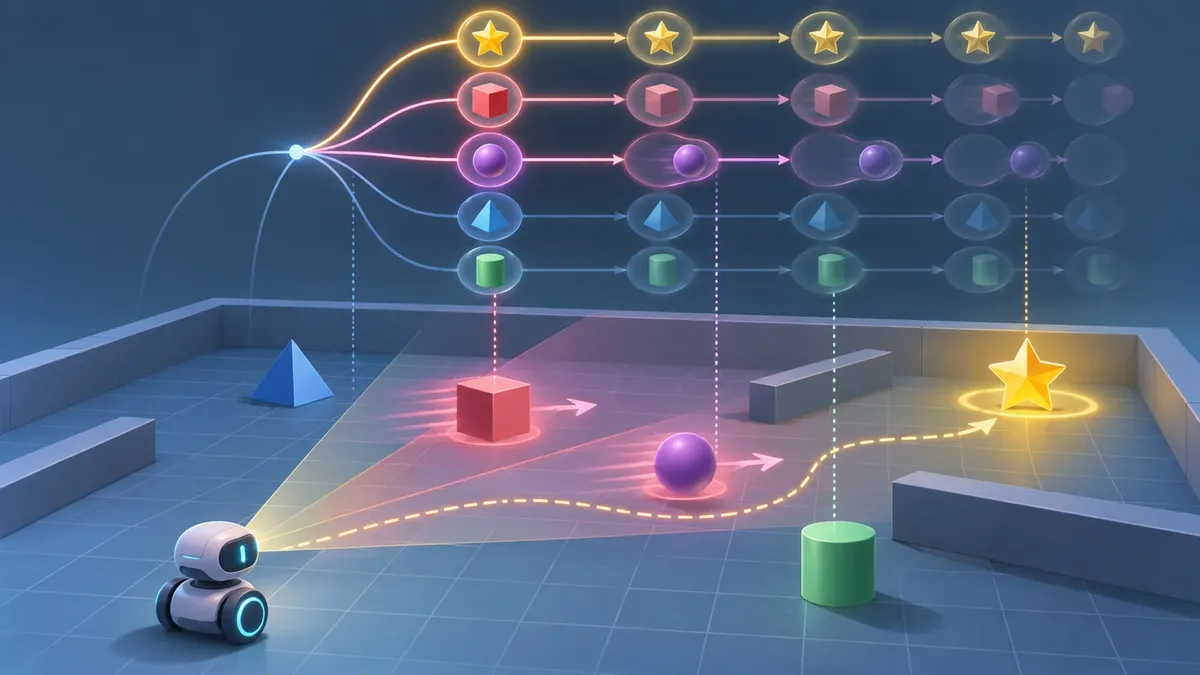
A robot navigating a cluttered scene must distinguish what matters—a target, an obstacle, a moving object—from the background. This paper introduces STICA, a reinforcement-learning system designed to represent scenes as separate objects and use their relationships when choosing actions. Its reported gains are promising, but come from a limited set of simulated tasks.
Why represent a scene as objects?
Reinforcement-learning agents can learn by trying actions and observing what happens, but gathering experience can be costly, especially for physical machines. A world model aims to help: it predicts what may happen next, allowing an agent to practise in imagined versions of its environment.
Many world models compress an entire scene into a single representation. The authors argue that this can make it harder to capture how individual objects move and interact, particularly when the scene changes. Their proposed alternative, called STICA—Slot Transformer Imagination with Causality-aware reinforcement learning—breaks visual observations into object-like components and predicts their dynamics separately.
The paper asks whether combining this object-centered representation with a way of prioritizing task-relevant interactions can improve learning and performance on object-rich reinforcement-learning tasks.
How STICA works
STICA has three main parts: a visual encoder, a predictive world model, and networks that select actions and estimate their value. The encoder uses a slot-based method to turn an image into several latent tokens, intended to represent individual objects, plus a separate token for static background information. These are learned from visual observations rather than supplied as hand-labeled object identities. The system also represents the agent’s actions and rewards as inputs to its predictive model.
A Transformer-based model then predicts how object tokens, rewards, and other elements change over time. The agent can use these predictions to explore imagined trajectories, rather than relying only on new interactions with the environment.
The policy and value networks also use attention adjusted by estimated token dependencies. In plain terms, the system tries to give more influence to objects that appear relevant to choosing an action or predicting its payoff. The authors call this “causality-aware,” but clarify that their use of causality means token-level dependency—not causal inference in the stronger scientific sense of establishing what would happen under an intervention.
What the experiments found
The researchers evaluated STICA in two simulated benchmark settings. In Safety Gym, they used eight tasks involving first-person views, goals or buttons, and obstacles; some targets change during an episode. They compared STICA with three model-based reinforcement-learning agents: TWM, DreamerV3, and TD-MPC2. They also tested three tasks from the Object-Centric Visual RL benchmark, which includes tasks such as moving to a target, pushing an object to a goal, and reaching an object with a simulated arm.
On Safety Gym, the authors report that STICA had the best final performance and learning speed on all tested tasks except PointGoal1. That exception was a simpler task, where the paper says a holistic representation may be sufficient. On the three Object-Centric Visual RL tasks, STICA had the highest final success rate among the evaluated methods. These results suggest that the approach can be useful in the tested environments; they do not show that it will outperform other agents in every setting.
Ablation experiments—tests that remove parts of a system—helped examine which components mattered. The authors report that causal attention produced a substantial performance gain in their comparisons, while separating background information had a more modest benefit. They also found that object-centric representations alone yielded only a marginal improvement in one comparison. Visualizations showed that STICA’s networks often attended to targets, while versions without causal attention or background removal spread attention more broadly. Attention maps are evidence about what the model weights, however, not proof that it has learned human-like causal reasoning.
What remains uncertain
The findings come from benchmark simulations, not experiments with physical robots or real-world environments. The Safety Gym evaluation also measured average reward return, not the benchmark’s safety costs, so it does not establish that STICA is safer. The authors excluded more difficult Push tasks and did not evaluate Doggo agents; they also tested only selected tasks from the other benchmark. Performance could differ on environments beyond those choices.
The comparisons are also specific to the reported experimental setup. The paper states that STICA has about 35 million parameters and was trained with one A100 GPU; results may depend on implementation and training conditions. The available source is a preprint on arXiv, and the supplied paper extraction may have lost table formatting. Although the paper reports publication-related copyright information, this source alone does not establish independent replication or peer-review status. Further testing would be needed to assess how robustly the method transfers to new tasks and physical settings.
STICA’s contribution is a practical design idea: predict scenes in object-like pieces, then use estimated dependencies to focus an agent’s decisions. The benchmark results support that idea in the tested simulations, while leaving open how broadly it will work.
- reinforcement learning
- world models
- object-centric AI
- causal attention
- STICA
- robotics simulation
Related reading
Automatically matched by shared topic keywords. These links do not imply that the sources agree or establish a consensus.
OmniPiano tests AI control with up to five virtual piano-playing hands
Source published
Shared keywords: reinforcement learning, robotics simulation
An AI maze navigator remembers by updating its world model
Source published
Shared keywords: world models
What should an AI explore before it has a task?
Source published
Shared keywords: reinforcement learning, world models
WorldMind tests spatial reasoning without turning every imagined view into an image
Source published
Shared keywords: reinforcement learning, world models
What would make an AI agent genuinely curious?
Source published
Shared keywords: reinforcement learning, world models