TRANSMISSION // 2511.08448v3
Could satellites help test hidden forces behind dark energy?
Source published
A theoretical study compares Gravity Probe B, LAGEOS-2 and a proposed orbital Sagnac measurement as probes of three screened dark-energy models.
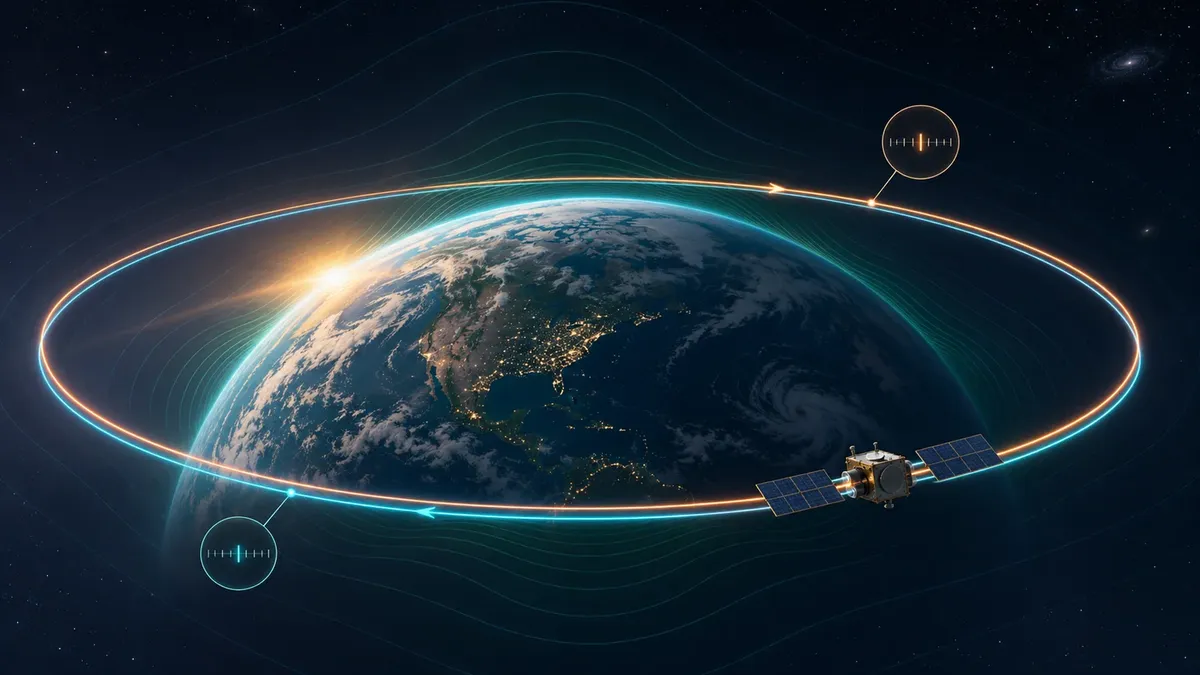
Some theories propose a new force linked to cosmic acceleration, while suggesting it is hidden near dense objects. Researchers calculate how measurements around Earth could constrain that idea—and why one especially sensitive proposal remains hypothetical.
Dark energy is the name given to whatever drives the Universe’s accelerated expansion. One possibility is that it involves a new field that also produces an extra force. That force would normally be hard to reconcile with precise tests of gravity, so some theories propose “screening”: the force is suppressed in dense surroundings but can remain relevant on cosmic scales.
Fabiano Feleppa and colleagues ask whether measurements near Earth could help constrain three screened models: chameleon, symmetron and dilaton. Their analysis considers how the models might affect gravitational measurements in Earth’s comparatively low-density surroundings, where screening may be less effective than around more compact bodies.
Three ways to look for a small deviation
The authors calculate how each model could alter three measurements. The first is geodetic precession, measured by Gravity Probe B: the gradual change in the direction of orbiting gyroscopes’ spin axes as they move through curved spacetime. The second is the advance of the orbital pericenter—the point at which a satellite comes closest to Earth—measured using LAGEOS-2. The third is a proposed orbital Sagnac test. In that arrangement, light travels around a closed orbital path in opposite directions, and the experiment compares the beams’ arrival times.
The calculations use a first post-Newtonian approximation, a method for estimating small corrections to Newtonian gravity in a relatively weak gravitational field. The researchers express predicted effects through parameters describing departures from general relativity, then compare them with measurement uncertainties to identify which portions of each model’s parameter space would be excluded.
This is a theoretical comparison, not a report of a new detection. Gravity Probe B and LAGEOS-2 provide existing measurements for the analysis. The Sagnac arrangement, by contrast, has not been performed as described. The authors estimate its potential reach using clock performance as a guide and make assumptions about controlling other sources of error.
Different models favor different measurements
The study’s main result is that no single measurement provides the strongest constraint for all three models. In the parameter ranges examined, LAGEOS-2 gives the strongest Earth-orbit constraints for symmetron and dilaton models. The authors attribute this to how pericenter advance responds to a combination of gravity parameters that is especially informative for those models.
For the chameleon model, the prospective Sagnac measurement gives the tightest constraint among the tests considered. The paper further calculates that, at an assumed delay precision of order 10⁻¹⁹, the proposed test would exclude the entire chameleon parameter space examined. That conclusion is conditional: it is a projection within the paper’s model and assumptions, not an observed exclusion or a statement about every possible chameleon theory.
The Sagnac estimate needs particular care. In its main comparison, the paper adopts a relative uncertainty of 10⁻¹⁵, using current space-qualified atomic-clock performance as a benchmark. The authors also discuss a much more ambitious 10⁻¹⁹ delay-precision scenario associated with nuclear clocks. They describe the setup as idealized and note that achieving the assumed precision would require exceptionally tight control of the light paths. The experiment’s performance has not been demonstrated.
What the bounds do—and do not—mean
The limits depend on choices about model parameters, Earth’s local environment and the experimental error budget. The analysis treats Earth as a spherically symmetric source in its main calculations, then checks a correction associated with Earth’s oblateness. For the Sagnac case, the authors estimate that uncertainty in this correction is below the adopted clock-related tolerance. Larger or unmodeled experimental errors could weaken projected bounds.
The results do not show that screened dark energy exists, or establish that dark energy is caused by a new field. They describe how selected measurements could constrain specific versions of these models if the calculations and assumptions apply. The source is an arXiv preprint; the supplied record does not establish its peer-review status. Its bounds are model-dependent theoretical estimates, not direct experimental results or a consensus assessment.
Source: Feleppa et al., arXiv:2511.08448v3.
- screened dark energy
- modified gravity
- Gravity Probe B
- LAGEOS-2
- Sagnac effect
- atomic clocks
Reviewed cross-references
These connections were reviewed by a model, not independently fact-checked by a human. Similarity does not imply agreement; consult the original papers and the evidence below.
Could Entangled Spins Reveal Screened Dark Energy?
Shared method: Both studies use a post-Newtonian scalar-tensor framework to calculate effects of screened gravity, but apply it to different observables: satellite precession and Sagnac delay in the origin paper, and entangled-spin CHSH correlations in Feleppa, Lambiase and Vagnozzi’s pilot study. This is a shared theoretical approach, not a shared measurement or result; the latter study says detection would be extremely challenging.
Model review: · openai-codex/gpt-6-luna
Evidence and provenance
Selected excerpts, not complete papers. PDF extraction can omit figures or damage equations, tables and reading order; sources may be preprints.
2511.08448v3 — Original paper
Excerpt reference:
static/papers/2511.08448v3.md:61-109
Basis: Paper text
Source SHA-256:5aa94471989bccdbe4850691f2ccf175a38fab6a2118791a9a386298c9ef39ab2511.08448v3 — Original paper
Excerpt reference:
static/papers/2511.08448v3.md:303-428
Basis: Paper text
Source SHA-256:5aa94471989bccdbe4850691f2ccf175a38fab6a2118791a9a386298c9ef39ab2508.18448v5 — Original paper
Excerpt reference:
static/papers/2508.18448v5.md:111-165
Basis: Paper text
Source SHA-256:8fe987946db44dd27fc8686917580524fb64d60c803e80757fc92d14b26519e02508.18448v5 — Original paper
Excerpt reference:
static/papers/2508.18448v5.md:3930-3980
Basis: Paper text
Source SHA-256:8fe987946db44dd27fc8686917580524fb64d60c803e80757fc92d14b26519e0
Related reading
Automatically matched by shared topic keywords. These links do not imply that the sources agree or establish a consensus.
How Galileo’s clocks could search for hypothetical cosmic walls
Source published
Shared keywords: atomic clocks
Can One Modified Gravity Rule Work Across a Star’s Different Matter Phases?
Source published
Shared keywords: modified gravity
A softly broken symmetry offers a route across the phantom divide
Source published
Shared keywords: modified gravity
A spinning white dwarf’s tidal response depends on how the star changes shape
Source published
Shared keywords: modified gravity