TRANSMISSION // 2511.06124v2
A proposed shortcut to addressable quantum gates
Source published
A theoretical protocol uses auxiliary error-correcting codes and gate teleportation to target logical qubits in quantum LDPC codes, trading extra qubits for constant-time gates.
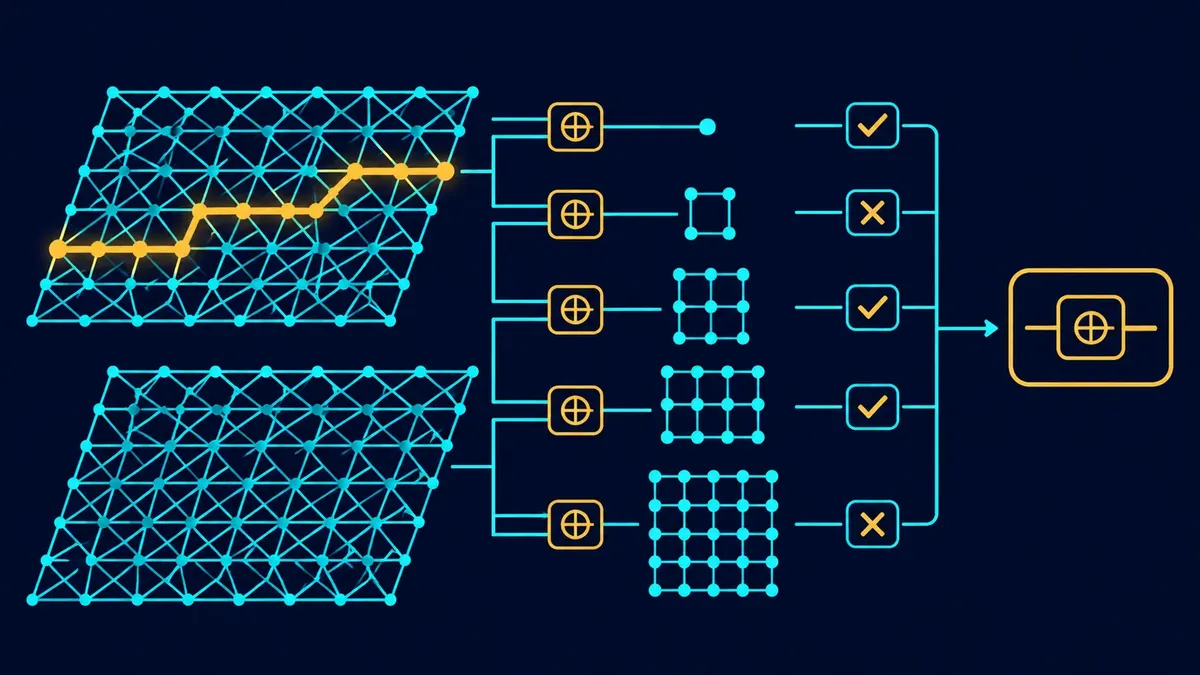
High-rate quantum error-correcting codes can encode many logical qubits in a physical register, but performing a gate on just one chosen logical qubit is a challenge. A proposed protocol uses an auxiliary code and measurement-based gate teleportation to make such operations take constant time with respect to code distance. Simulations test the idea on selected La-cross codes and expose trade-offs in error protection, qubit overhead and decoding.
Quantum error correction protects information by encoding logical qubits across many physical qubits. High-rate quantum low-density parity-check (LDPC) codes are promising because they can encode many logical qubits in one register. But their compact encoding poses a practical question: how can a computer operate on one selected logical qubit without affecting others?
Lattice surgery—a common framework for logical operations—uses measurements to connect code regions. The authors describe its time overhead as growing with code distance, a measure of a code’s error-protection ability. Their proposal instead uses an auxiliary error-correcting code to carry out logical gates through gate teleportation. Here, teleportation means preparing and coupling encoded resources, measuring the codes, and using the outcomes to determine corrections. It is a circuit method for applying logical operations, not a claim of physically moving a qubit or sending information through space.
An auxiliary code as a gate resource
The protocol couples selected physical qubits in the target LDPC code to an auxiliary Bacon–Shor code or unrotated surface code using transversal operations: structured gates pairing qubits across the two codes. Measurements of the auxiliary code complete the logical operation. The auxiliary code is arranged as a distance-by-distance block; it is not necessarily smaller than the target code.
The authors develop the scheme mainly for La-cross LDPC codes. For the construction to work fault-tolerantly, the target code must provide enough equivalent, non-overlapping representations of the relevant logical operators—specifically, as many as the code distance. Non-overlap matters because shared qubits could allow faults to propagate into harmful correlated errors. The construction also relies on further code-structure conditions; the surface-code version requires additional coupling on a secondary lattice to preserve the stabilizers. Whether other high-rate or constant-rate code families satisfy the needed conditions remains an open question.
The protocol provides an overcomplete set of logical Clifford gates, including single- and multi-qubit operations, and can natively measure joint products of logical Pauli operators. The authors also describe how non-Clifford resources, such as cultivated magic states, could be combined with the scheme for universal computation. These are proposed capabilities, not demonstrations on a quantum processor.
The stated resource trade-off is constant time overhead with respect to code distance and O(d²) qubit overhead, giving O(d²) spacetime overhead overall, where d is the code distance. The approach exchanges time spent on surgery for spatial resources and requires suitable connectivity between the codes.
What the simulations test
The researchers use the Stim circuit simulator and Monte Carlo sampling to estimate logical error probabilities. They simulate selected La-cross code instances with distances 4, 5 and 7, comparing logical-gate circuits with memory circuits. Their noise model includes errors after two-qubit gates, measurements and resets, while treating single-qubit gates and idle operations as perfect. They decode using belief propagation with ordered-statistics decoding (BP+OSD), which infers likely errors from measurement outcomes.
For the surface-code auxiliary, simulations of Hadamard, S and two-qubit XY gate circuits show higher logical error probabilities and lower physical-error thresholds than the memory benchmarks under the studied conditions. In the specific Hadamard comparison, the Bacon–Shor gadget has a lower pseudo-threshold than the surface-code gadget. The paper explains that Bacon–Shor’s construction has only a finite-size pseudo-threshold: its error rate is not guaranteed to keep improving as distance grows. The authors’ surface-code extension is designed to recover a genuine asymptotic threshold, at the cost of extra coupling and gate operations. That is a theoretical property of the construction, not evidence of performance in hardware.
The findings have important limits. The simulations cover selected, relatively small code instances and an assumed noise model that omits single-qubit and idle errors. The authors also note that BP+OSD can be computationally expensive, particularly for deep circuits, and that practical decoding speed remains a challenge. The paper’s code structure and connectivity requirements may not transfer directly to other LDPC families or devices.
The work therefore presents a design proposal, supported by circuit simulations: auxiliary codes and gate teleportation could enable addressable logical operations with time overhead independent of distance, in exchange for added qubits and demanding connectivity and decoding. Whether that balance is useful in practice will depend on hardware, code choice and decoder performance. The evidence here is a preprint and should be read as a research proposal with simulation results, not an experimental demonstration.
- quantum computing
- quantum error correction
- quantum LDPC codes
- logical gates
- gate teleportation
- fault-tolerant computing
Reviewed cross-references
These connections were reviewed by a model, not independently fact-checked by a human. Similarity does not imply agreement; consult the original papers and the evidence below.
For silicon quantum memory, the route can matter as much as the circuit
Shared method: Both proposals use teleportation: Pecorari et al. teleport logical resources to implement addressable Clifford operations, while Chow and Baugh teleport a syndrome ancilla through a distributed singlet to measure non-local checks. The roles and hardware settings differ, so this is a shared technique, not evidence of comparable performance.
Model review: · openai-codex/gpt-6-luna
Evidence and provenance
Selected excerpts, not complete papers. PDF extraction can omit figures or damage equations, tables and reading order; sources may be preprints.
2511.06124v2 — Original paper
Excerpt reference:
static/papers/2511.06124v2.md:65-137
Basis: Paper text
Source SHA-256:4ce5e80365ee5a034433100f59f31c002cfc0843b23d73827ad0bad021d71d782611.13371v1 — Original paper
Excerpt reference:
static/papers/2611.13371v1.md:351-411
Basis: Paper text
Source SHA-256:ba12666871c5c83bc582d6cfe8966911a966c0ca2ac3773bd04b32dc0c120a99
Related reading
Automatically matched by shared topic keywords. These links do not imply that the sources agree or establish a consensus.
Magic-state factories tailored to quantum algorithms
Source published
Shared keywords: fault tolerant computing, quantum computing, quantum error correction
GeneCS Targets Leaner Quantum Code Surgery
Source published
Shared keywords: quantum error correction, quantum ldpc codes
A fixed recipe extends quantum error-correcting codes
Source published
Shared keywords: quantum computing, quantum error correction, quantum ldpc codes
A smarter search for leaner quantum graph states
Source published
Shared keywords: quantum computing, quantum error correction
A changing grid could offer a new way to protect quantum information
Source published
Shared keywords: quantum error correction