TRANSMISSION // 2511.04222v2
A predicted 133 K superconductor comes with a stability problem
Source published
Calculations predict high-temperature superconductivity in three hydrogen-rich compounds at ambient pressure, but none has yet been made or tested.
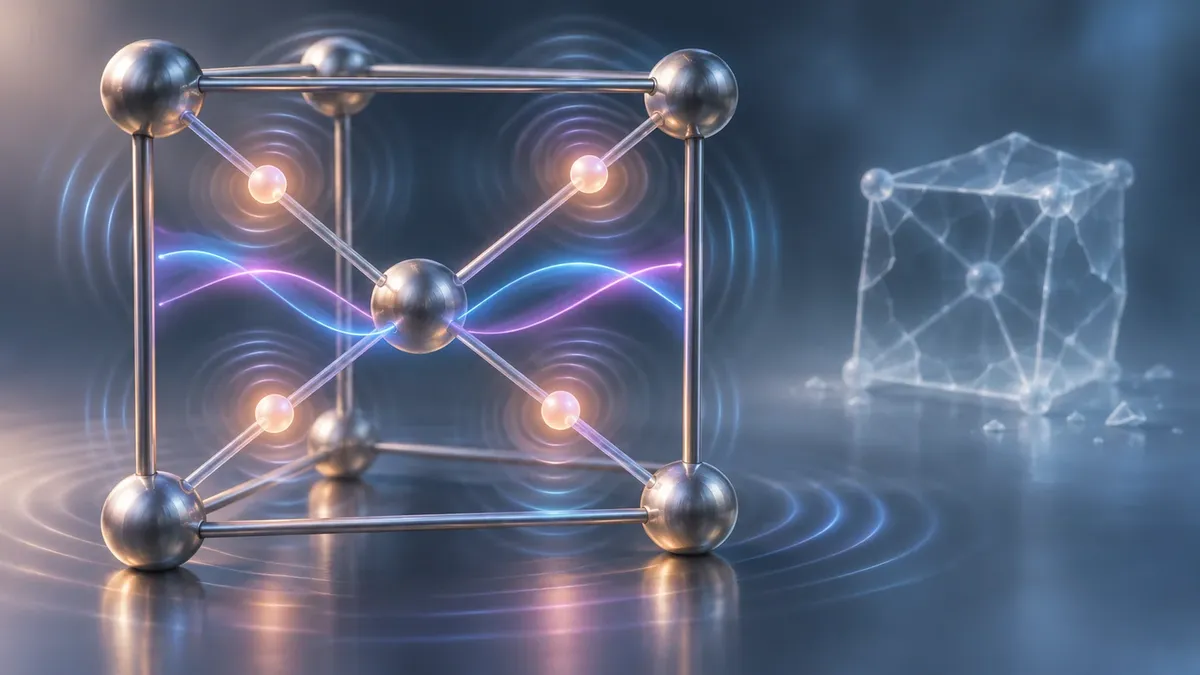
Could a hydrogen-rich material superconduct without being squeezed to extreme pressures? A computational study proposes three candidates—and finds that the most promising predicted transition temperature belongs to a compound that may be difficult to keep intact.
Hydrogen-rich compounds have produced some of the highest known superconducting transition temperatures, but often only under enormous pressure. A new computational study asks whether a different arrangement of hydrogen and metal atoms could support high-temperature superconductivity at ambient pressure. Its answer is a qualified prediction: three candidate compounds, including one with an estimated transition temperature of 133 kelvin, but significant obstacles to making them in the laboratory.
The materials are platinum hydride (PtH₄), palladium hydride (PdH₄) and gold hydride (AuH₄). The researchers propose that these compounds could form a cubic structure related to the crystal structure of PtHg₄. In the proposed arrangement, hydrogen atoms sit at particular positions along the body diagonals of a lattice formed by metal atoms. The team’s design idea is that the metal lattice acts as a chemical template, helping to organize the hydrogen atoms.
How the predictions were made
The researchers used high-throughput first-principles calculations to screen MH₄ compounds across the metals, then examined promising structures in greater detail. In broad terms, these calculations use quantum mechanics to estimate a material’s structure and properties from its atoms, rather than measuring a sample in the lab.
The team calculated how the proposed structures vibrate and how those vibrations interact with electrons. That interaction—called electron–phonon coupling—can help electrons pair up, allowing superconductivity. They estimated transition temperatures using two theoretical approaches: the Allen–Dynes equation and the isotropic Migdal–Eliashberg equations. The headline estimates come from the latter, using a standard assumed value for a parameter describing the repulsion between electrons.
Those estimates are 84 K for PtH₄, 133 K for PdH₄ and 89 K for AuH₄. All are above 77 K, the boiling point of liquid nitrogen at atmospheric pressure. These are calculated transition temperatures, not measurements: the paper does not report a laboratory-made sample or an experimental demonstration of superconductivity.
The calculations attribute the predicted behavior mainly to hydrogen vibrations and strong electron–phonon coupling. In PdH₄, the researchers identify softened vibrations in an intermediate-frequency range as a substantial contributor to the coupling. In simpler terms, some hydrogen-related motions are comparatively easy to excite, and the calculations suggest they help electrons interact in a way that favors superconductivity.
A high predicted temperature is not the whole story
The main caveat is stability. The calculations place all three compounds above the thermodynamic stability threshold at ambient pressure: they are reported as 191 millielectronvolts per atom above the convex hull for PtH₄, 308 for PdH₄ and 432 for AuH₄. This indicates that, under the study’s calculations, other arrangements of the same ingredients are energetically favored. It could make synthesis difficult, though it does not prove the compounds cannot be made or preserved under unusual, nonequilibrium conditions.
The researchers also ran simulations of atomic motion at 300 K. PtH₄ retained its structure during a 20-picosecond simulation, but PdH₄ and AuH₄ showed hydrogen diffusion and/or structural decomposition over short simulation times. A short simulation cannot establish long-term stability. The authors explicitly caution that it cannot rule out slower diffusion, decomposition or structural change. The study’s additional finite-temperature phonon calculation supports short-term stability for PtH₄, not experimental durability.
The predicted temperatures also depend on theoretical assumptions. In the authors’ calculations, changing the electron-repulsion parameter changes the estimates; for example, the Migdal–Eliashberg estimate for PdH₄ falls from 133 K at the assumed value of 0.10 to 83 K at 0.15. The calculations use a harmonic treatment of lattice vibrations, while the authors note that anharmonic effects—departures from that simplified treatment—could alter both vibrations and transition temperatures. They say a full assessment of those effects is beyond this study.
The work therefore offers a proposed design route, not evidence that an ambient-pressure superconductor with these properties is ready for use. The central challenge is experimental: finding a way to create the predicted structures and determine whether they survive long enough to test. This account is based on the supplied arXiv preprint; a preprint is not, by itself, evidence of peer review or experimental confirmation.
- superconductivity
- hydrides
- materials science
- first-principles calculations
- electron-phonon coupling
- metastable materials
Reviewed cross-references
These connections were reviewed by a model, not independently fact-checked by a human. Similarity does not imply agreement; consult the original papers and the evidence below.
AutoDFT lets calculations change course as they run
Shared method: Both works use first-principles electronic-structure calculations: the hydride study applies them to predict structures and electron-phonon superconductivity, while AutoDFT automates DFT workflows and evaluates property calculations. This is a shared computational method, not evidence that AutoDFT analyzed these hydrides or reproduced their predictions; the hydride excerpt does not identify its software.
Model review: · openai-codex/gpt-6-luna
Evidence and provenance
Selected excerpts, not complete papers. PDF extraction can omit figures or damage equations, tables and reading order; sources may be preprints.
2511.04222v2 — Original paper
Excerpt reference:
static/papers/2511.04222v2.md:106-159
Basis: Paper text
Source SHA-256:b1af5998647fdf578bc1b8f79de360490e04ade0ccc199e64b291da08e4d2a9f2511.04222v2 — Original paper
Excerpt reference:
static/papers/2511.04222v2.md:443-556
Basis: Paper text
Source SHA-256:b1af5998647fdf578bc1b8f79de360490e04ade0ccc199e64b291da08e4d2a9f2605.26179v3 — Original paper
Excerpt reference:
static/papers/2605.26179v3.md:462-516
Basis: Paper text
Source SHA-256:a12bbe9df50dfcee11296d7f9869c4fa52b6bd0c28b9af0d202cd159fd500ce8
Related reading
Automatically matched by shared topic keywords. These links do not imply that the sources agree or establish a consensus.
An atomistic AI model built for supercomputers
Source published
Shared keywords: materials science
Why rare training facts may help AI make discoveries
Source published
Shared keywords: materials science
SkillBuffBench: A proposed test of AI-agent skills
Source published
Shared keywords: materials science
AutoDFT lets calculations change course as they run
Source published
Shared keywords: materials science
One model, two tasks in catalyst design
Source published
Shared keywords: materials science