TRANSMISSION // 2511.03212v1
MvBody pilot combines 3D body scans and medical history to predict cesarean delivery
Source published
A preprint reports that MvBody, an AI model combining late-pregnancy body scans with self-reported medical information, achieved 84.62% accuracy in a held-out test group. The study involved 101 participants, and its 60% sensitivity, small dataset and commercial-scanner dependence leave broader clinical usefulness unresolved.
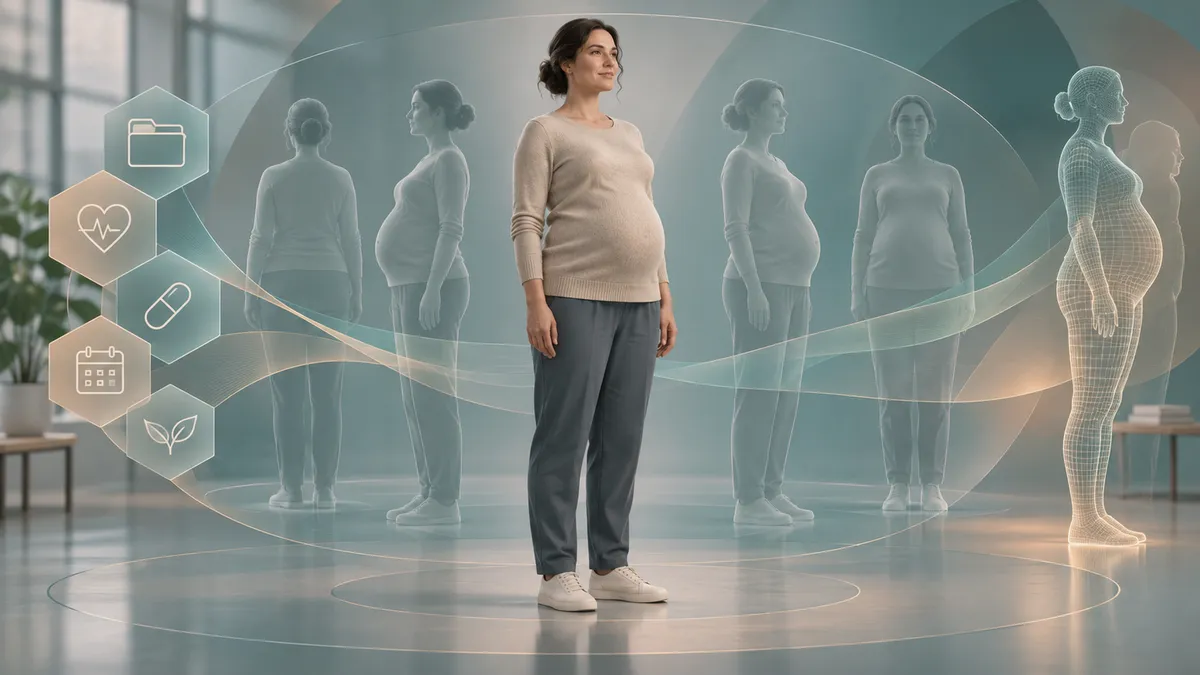
Could external body shape help anticipate cesarean delivery before labor? A pilot study explores that possibility with a model that analyzes multiple views of optical 3D scans alongside maternal medical history. Its results suggest a research direction, not an established tool for deciding how someone should give birth.
A pilot aimed at accessible prenatal assessment
In a preprint submitted to arXiv on November 5, 2025, Ruting Cheng and colleagues introduce MvBody, a neural network designed to predict cesarean delivery from late-pregnancy body scans and self-reported medical information. The researchers frame it as a potential complement to clinical risk assessment, particularly for settings where detailed hospital-based measurements are difficult to obtain. The supplied source is a preprint, not evidence of peer-reviewed validation.
The intended application is prenatal planning rather than decision-making during labor. However, the present study tests prediction in a small participant group; it does not establish that using the model improves maternal or neonatal outcomes.
What the researchers collected
The study enrolled 101 participants, of whom 25 delivered by cesarean section and 76 delivered vaginally. According to the paper, all cesarean deliveries were medically indicated. Participants underwent optical body scanning between 31 and 38 weeks of pregnancy using a commercial Fit3D scanner. Two or three scans per person produced 236 scans altogether.
The accompanying information included age, height, pre-pregnancy weight, current weight, gestational age, pregnancy and delivery history, previous cesarean delivery, and several medical conditions. Eligibility restrictions included excluding multiple gestations, participants younger than 18 and those with a BMI above 60, among other criteria.
The distinction between participants and scans matters: repeated scans increased the number of inputs, not the number of people studied. For evaluation, the researchers used each participant’s highest prediction score across their scans as that person’s final risk score.
Turning body shape into a prediction
MvBody converts each 3D scan into 12 two-dimensional views taken around the body. A convolutional neural network extracts visual features, and Transformer components combine information across views. A separate branch processes the medical information, with the two streams exchanging information at two stages.
The image-processing component uses VGG11 pretrained on ImageNet. The authors also combine standard classification training with a metric-learning objective that encourages representations from the same delivery category to cluster together and those from different categories to separate. These choices were intended to help the network learn from a small dataset.
Comparisons included logistic regression, random forests, support vector classification, a backpropagation neural network and other 3D-analysis approaches. Several conventional models received scanner-derived body measurements summarized through principal component analysis, alongside medical information, rather than the full multi-view images.
Promising results, with important qualifications
The researchers randomly allocated about three-quarters of participants to five-fold cross-validation and reserved the remainder for a held-out test set. This was a split within the study cohort, not validation in a separately recruited population.
During cross-validation, MvBody achieved 82.67% accuracy and an area under the receiver operating characteristic curve, or AUC, of 0.746. Its sensitivity was 55%, while two comparison methods reached 70%. It therefore did not lead on every measure.
On the held-out test set, MvBody achieved 84.62% accuracy, 60% sensitivity, 90.48% specificity and an AUC of 0.724. In practical terms, it identified 60% of the cesarean deliveries while correctly classifying about 90% of vaginal deliveries. Its accuracy tied that of the tested backpropagation neural network, although MvBody had higher sensitivity and AUC.
The reported test-set AUC p-value was 0.126, above the conventional 0.05 threshold. That result does not establish statistically significant discrimination above chance under the reported test, nor does it demonstrate significant superiority over competing models. The authors also report difficulty identifying cesareans associated with fetal malpresentation.
What the explanations reveal
Using Integrated Gradients, the team examined which inputs contributed to the network’s predictions. Prominent medical features included pre-pregnancy weight, age, number of pregnancies, number of previous deliveries and prior cesarean history.
Image attributions emphasized body boundaries and, unexpectedly, the head and shoulders more strongly than the abdomen. Removing the head and shoulders reduced cross-validation AUC from 0.746 to 0.594. This supports their usefulness to this model on these data; it does not establish a biological mechanism or show that those body regions cause cesarean delivery.
The authors identify the small dataset as a limitation and call for larger datasets to strengthen robustness across diverse populations. Smartphone scanning remains future work: the reported results relied on a commercial scanner, not a demonstrated home-based phone system.
- cesarean delivery
- MvBody
- 3D optical body scanning
- prenatal risk prediction
- multi-view Transformer
- Integrated Gradients
- medical AI
- preprint