TRANSMISSION // 2511.02363v3
Could gravity leave a lasting quantum phase?
Source published
A theoretical proposal uses acceleration-induced electric fields in a conductor to imprint a phase on superconductors, then reads it as magnetic flux. The predicted signal is not yet an experimental result.
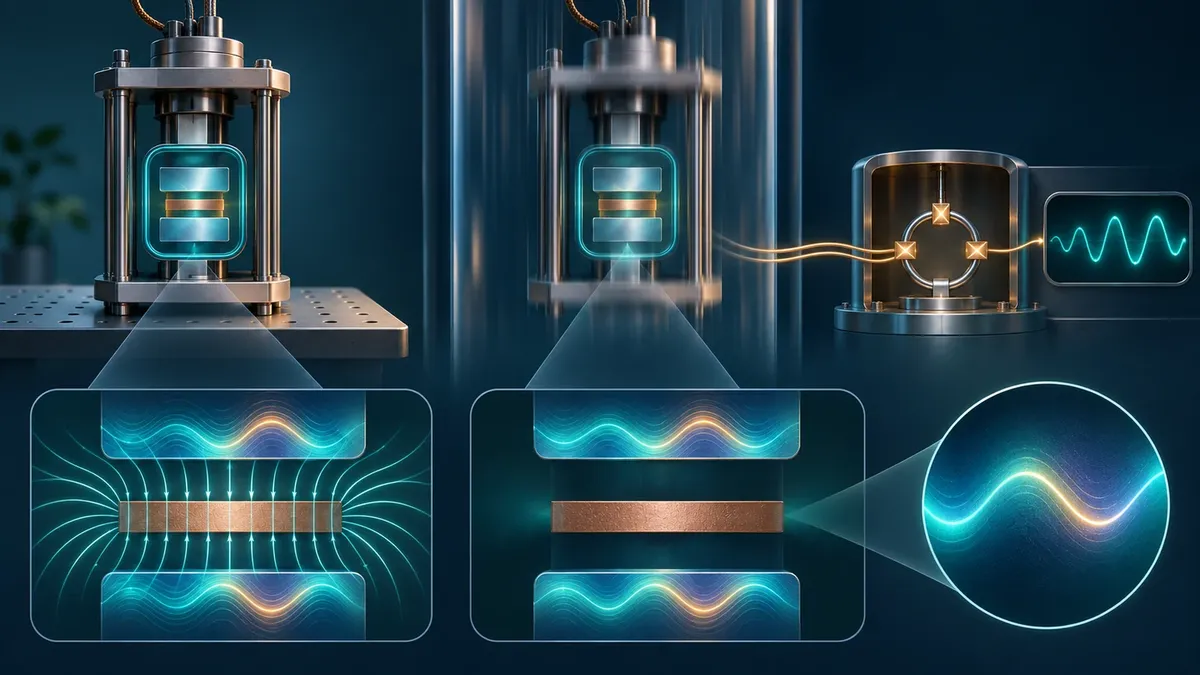
A brief electric field can, in principle, leave a phase difference behind after the field disappears. This preprint proposes generating that field inside a normal conductor by changing the apparatus’s acceleration, then detecting the stored phase with a superconducting circuit.
A field can vanish while its effects remain. In electromagnetic memory, a passing electromagnetic process is predicted to leave a lasting record—for example, a change in charged particles’ motion. The authors of a new theoretical proposal ask whether a related record could be stored not in a particle’s trajectory, but in the quantum phase of a superconducting system.
Their proposed setup links two superconducting regions through a short normal-metal conductor, with insulating layers to limit unwanted current between them. The superconductors are first connected so their quantum phases line up, then isolated. While the apparatus is supported, gravity-related acceleration is predicted to create a small electric field inside the normal conductor. The authors argue that this field can imprint a relative phase on the superconductors. Switching the apparatus into free fall should greatly reduce the effective acceleration and remove the field. Reconnecting the superconductors would then convert the remaining phase difference into a current or magnetic flux, measurable with a SQUID—a sensitive device for detecting tiny magnetic signals.
The physical idea draws on the electric Aharonov–Bohm effect. In quantum mechanics, electromagnetic potentials can affect a particle’s phase even when the particle does not pass through a region with an electric or magnetic field. Here, the proposed field exists temporarily in the conductor, and the authors calculate a phase related to the field’s time integral. The “memory” is the predicted persistence of the phase after the field has gone, provided the superconducting system retains coherence.
A proposed test, not an observation
The paper is a theoretical design and estimate, not a report of an experiment. For one representative set of parameters—a conductor about 100 nanometres long and a holding time around one millisecond—the authors estimate a phase of roughly 0.03 radians. They argue that this could be detectable with present-day SQUID sensitivity. That estimate depends on the proposed device and assumptions; it does not establish that a working apparatus will produce or preserve the signal.
The authors outline controls intended to distinguish the effect from other phase shifts. The signal should vary with the time spent in the supported stage and with the conductor’s length. Reversing the apparatus’s orientation should reverse the predicted gravity-related contribution, while a holding-time scan in free fall offers a null test. Comparing measurements at different holding times can help cancel repeatable offsets from switching and readout.
Those controls matter because the main challenge may not be the nominal sensor sensitivity. Mechanical changes between supported and free-fall stages can create stress, acoustic disturbances, and other electrical or phase shifts. The paper identifies acceleration-related stress as a major potential background and acknowledges that its coupling to a specific device needs further calculation and experimental calibration. A phase that grows with holding time is not, by itself, proof of a gravitational origin: a residual voltage can also create a time-dependent phase. Orientation reversal and other checks would therefore be essential.
The proposal also depends on preserving phase coherence while the superconducting regions are isolated. Charging effects can spread the phase, and quasiparticle events or environmental disturbances can degrade coherence. The authors discuss ways to reduce some of these effects, but whether coherence lasts long enough in the complete proposed arrangement remains an experimental question.
There is a further interpretive distinction. The paper presents acceleration as a way to generate a transient electric field without an externally applied voltage pulse, and the resulting phase as a possible test of electromagnetic memory and the electric Aharonov–Bohm effect. It does not claim that an experiment has verified either phenomenon. The authors also suggest a simpler version aimed at the Aharonov–Bohm phase alone, without the final transition into free fall.
The result is best read as a testable proposal: a route from a very small internal electric field to a potentially measurable superconducting phase. Its promise rests on calculations and estimated sensitivities; demonstrating the effect would require building the device, controlling mechanical and electrical backgrounds, and showing that the phase behaves as predicted. The source is an arXiv preprint, so its claims should be treated as provisional rather than as an established experimental finding.
- electromagnetic memory
- Aharonov–Bohm effect
- superconductivity
- quantum phase
- SQUID
- theoretical proposal