TRANSMISSION // 2510.15265v1
Can causal time-series models travel across Greenland?
Source published
A study tests whether identifying lagged relationships in satellite and weather records can help classify how Greenland’s surface lakes evolve. Its causal-feature model performs better than a correlation-based baseline in the reported region-held-out tests, though the exact evaluation setup is ambiguous and the results cover only two melt seasons.
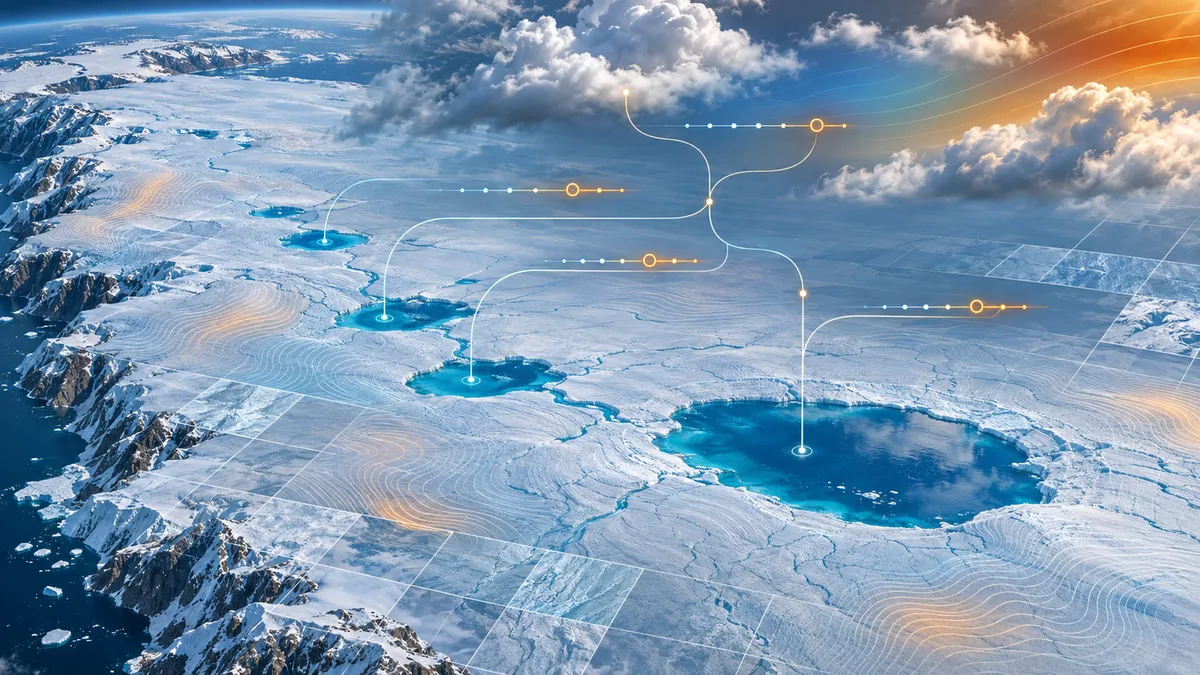
Greenland’s summer lakes can refreeze, become buried, or drain gradually or rapidly. Their changing signals are visible to satellites, but patterns observed in one part of the ice sheet may not hold elsewhere. A new preprint asks whether selecting time-lagged predictors through causal discovery can make lake classifications more reliable across regions.
A lake on Greenland’s ice sheet may refreeze, become covered by snow and firn, or drain slowly or suddenly. These different fates matter for how meltwater is stored or routed. Yet a model trained in one region may not work as well in another, where climate and ice conditions differ. The study behind a new preprint asks whether causal time-series methods can help models transfer across those differences.
The researchers developed RIC-TSC, a pipeline that looks for time-lagged relationships among lake observations and environmental variables, then uses selected signals to classify each lake’s evolution. “Causal” needs care here: the method searches observational time series for statistically supported directed relationships. Those relationships are not, on their own, proof that one variable physically causes another.
The data combine Sentinel-1 radar, Sentinel-2 and Landsat-8 optical imagery, and CARRA weather reanalysis. The team assembled daily records for 1,000 manually labeled lakes from the 2018 and 2019 melt seasons, spanning Greenland’s six drainage basins. The labels were balanced across four outcomes: refreeze, burial, slow drainage, and rapid drainage.
To identify candidate predictors, the researchers used Joint PCMCI+ (J-PCMCI+), a method for finding possible lagged links in time-series data through conditional-independence tests. Its conditioning procedure can help distinguish candidate links from some other measured influences, but the source does not establish that every relevant variable or unmeasured influence was accounted for. The team estimated a Greenland-wide graph using 60 lakes and separate basin-level graphs using 20 lakes per basin. The analysis considered lags of up to seven days. It identified, among other patterns, links between radar backscatter and its recent values, and optical water fraction as a same-time predictor. Some regional graphs also identified variables such as relative humidity or sea-surface temperature.
The selected predictors and their lags then went into MiniROCKET, a time-series feature-extraction method, followed by a regularized classifier. The comparison model used all nine observed variables without causal filtering. In a pooled evaluation, the causal pipeline’s accuracy gain was reported as “+1.06%”; the paper does not clarify whether this is a relative percentage gain or a percentage-point difference. Within individual basins, the causal model improved on or matched the baseline in four of six regions, but performed worse in the Northeast.
The clearest reported advantage came in tests intended to measure transfer across regions: the causal model’s accuracy was higher than the baseline’s in all six reported comparisons, with reported gains from 1.99% to 12.59%. The largest was for the North. These results suggest that, in this benchmark, restricting inputs to selected lagged predictors helped the classifier handle spatial differences. They do not establish that the same advantage will hold for other years, data sources, or ice-sheet tasks.
The exact setup of those transfer tests is unclear in the paper. The evaluation text describes training on one basin and testing on the other five, while calling the procedure leave-one-region-out, which usually means holding one region out for testing and training on the others. The table’s “Train Region” heading fits the one-basin-training description, but does not resolve the conflict. Clarification is needed to interpret the reported comparisons precisely.
Other limitations matter too. The labeled sample covers two melt seasons, and the causal graphs were estimated from relatively small subsets of lakes compared with the full labeled dataset. The authors note that causal discovery can be sensitive to sample size and autocorrelation, and that expert labels may not capture every hydrological nuance. Because the analysis is observational, the identified links depend on statistical assumptions and may be affected by unmeasured factors. The accuracy results concern classification, not proof of physical mechanisms or demonstrated forecasts of future lake behavior.
This work is an arXiv preprint, so its findings should be treated as provisional rather than as a peer-reviewed conclusion. The reported results offer an initial test of combining causal discovery with sequence classification; further evaluation, including clarification of the transfer-test design, would help establish how broadly the approach works.
- Greenland
- supraglacial lakes
- causal discovery
- time series
- satellite imagery
- distribution shift
- Earth observation
Related reading
Automatically matched by shared topic keywords. These links do not imply that the sources agree or establish a consensus.
A two-stage reasoning system helps AI choose Earth-observation evidence
Source published
Shared keywords: earth observation, satellite imagery
AI satellite analysts struggle to separate land change from sensor change
Source published
Shared keywords: earth observation, satellite imagery
CARM adapts trust masks as scientific super-resolution data change
Source published
Shared keywords: earth observation
Untangling the changing light signals of NGC 5548
Source published
Shared keywords: causal discovery
Language-model gains may come from diversity, not hidden experts
Source published
Shared keywords: distribution shift